What is Karungali Mala? Origin, Meaning, Significance in South Indian Tradition
Complete guide to Karungali Mala (ebony wood prayer beads). Origin story, botanical details, why sacred to Ayyappa/Shiva/Murugan, significance explained.
What is Karungali Mala? Origin, Meaning & Sacred Significance
Ebony wood prayer beads · Tamil/Telugu/Kannada tradition · Sacred to Ayyappa, Shiva, Murugan · Why unpolished matters
Quick Answer: What is Karungali Mala?
Karungali Mala is a prayer bead necklace made from genuine ebony wood (Diospyros ebenum), traditionally used in South Indian spiritual practices.
The word "Karungali":
- Tamil: கருங்காலி (Karungali)
- Telugu: కరుంగాలి (Karungali)
- Kannada: ಕರುಂಗಾಲಿ (Karungali)
- Malayalam: കരുങ്കാലി (Karunkaali)
Meaning: "Karun" (கருண்) = Black/Dark + "Kali/Gaali" (காலி) = Wood
Full meaning: "Black Wood" or "Dark Wood" — referring to ebony's naturally dark color.
Configuration: Typically 108 beads + 1 Guru bead strung on thread, worn around the neck or wrist.
Primary uses:
- Ayyappa vratham (41-day Sabarimala pilgrimage discipline)
- Daily japa (mantra chanting meditation)
- Shiva and Murugan devotion
- Spiritual protection and grounding
Botanical Understanding: What is Karungali Wood?
Scientific Name: Diospyros ebenum
Karungali is the Tamil/Telugu name for ebony wood, scientifically known as Diospyros ebenum.
Tree Characteristics:
- Family: Ebenaceae (ebony family)
- Common names:
- English: Ceylon Ebony, Indian Ebony
- Sanskrit: Krishna Kaala (कृष्ण काल — "Black Time/Wood")
- Tamil: Karungali (கருங்காலி)
- Height: Can grow up to 20-25 meters tall
- Wood properties: Extremely dense, heavy, naturally dark brown to black
- Durability: One of the hardest and most durable woods
- Growth: Slow-growing tree (takes decades to mature)
Where Ebony Trees Grow
Primary regions:
- Sri Lanka (Ceylon ebony — considered finest quality)
- South India — Tamil Nadu, Kerala, Karnataka
- Indonesia
- Parts of Africa (different ebony species)
Climate: Tropical and subtropical regions
Why South Indian ebony is prized:
- Grows in sacred regions (Western Ghats)
- Used traditionally in temples for centuries
- Connected to regional spiritual practices
Etymology: Breaking Down "Karungali"
Tamil/Telugu Root Words
கருங்காலி (Karungali) comes from two components:
1. Karun (கருண்) / Karu (கரு)
- Primary meaning: "Black" or "Dark"
- Also carries connotations of "ancient" or "deep"
- Used in Tamil to denote dark-colored objects
2. Kali/Gaali (காலி/காலி)
- Meaning: "Wood" or "Timber"
- General term for wood material
Alternative interpretation: Some scholars connect "Kali" to Goddess Kali (the fierce form of Shakti), suggesting the wood carries protective, powerful energy. However, the primary meaning remains "black wood."
Sanskrit Connection: Krishna Kaala
In Sanskrit texts, ebony is called Krishna Kaala (कृष्ण काल):
- Krishna (कृष्ण) = Black, dark (also Lord Krishna's name)
- Kaala (काल) = Time, or wood/timber
This connects ebony to timeless, ancient, powerful energy.
The Sacred Origin Story: Why Karungali is Holy
Connection to Lord Shiva
Traditional belief: Karungali wood is sacred to Lord Shiva.
The story (from regional oral tradition):
After Lord Shiva performed the Tandava (cosmic dance of destruction and creation), his divine energy infused certain sacred trees. Ebony trees absorbed Shiva's transformative power, becoming naturally dark from the intensity of that energy.
Symbolism:
- Dark color = Shiva's ash-covered body (Vibhuti)
- Density = Shiva's indestructible nature
- Grounding quality = Shiva as the ultimate stabilizer (Mahadeva)
Because of this, wearing ebony wood connects you to Shiva's transformative and protective energy.
Connection to Lord Ayyappa
Lord Ayyappa (also called Dharma Sastha, Hariharaputra) is the son of Shiva and Mohini (Vishnu's female form).
Why Ayyappa devotees wear Karungali:
During the 41-day Ayyappa vratham, devotees undertake:
- Celibacy (brahmacharya)
- Sattvic vegetarian diet
- Discipline and austerity
- Daily prayer and meditation
Karungali Mala serves as:
- Physical symbol of the vow
- Grounding tool during the intense discipline
- Protection against negative influences during vulnerable spiritual state
- Connection to Shiva (Ayyappa's father) and Lord Ayyappa himself
Wearing Karungali during vratham is non-negotiable in traditional practice — it's as essential as the black clothes (kaali/irumudi).
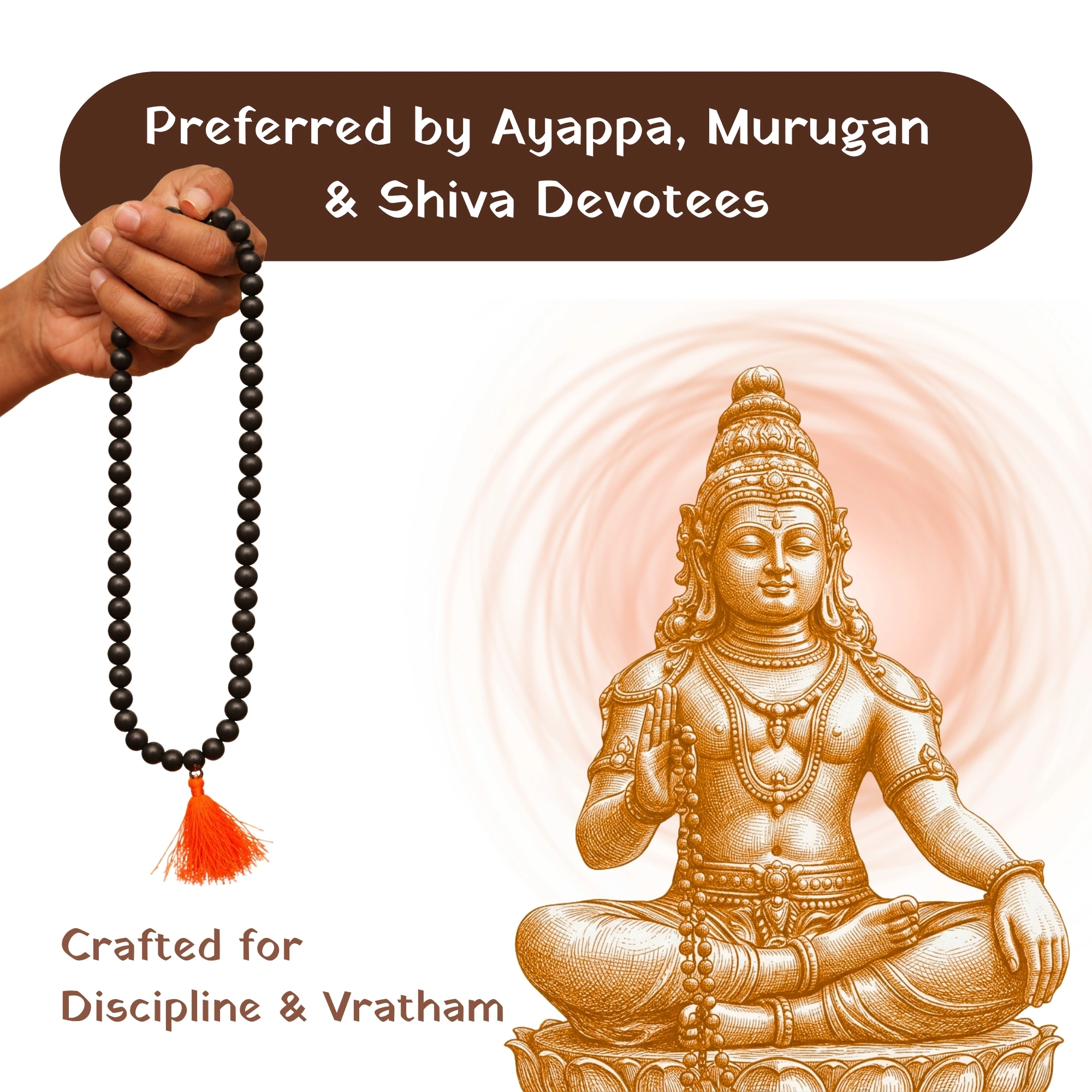
🛒 Order Authentic Karungali for Vratham →
Connection to Lord Murugan (Kartikeya)
Lord Murugan (கார்த்திகேய in Tamil, also called Skanda, Subramanya) is the son of Shiva and Parvati, widely worshiped in South India.
Why Murugan devotees use Karungali:
1. Shiva's Son
- Murugan is Shiva's son, so anything sacred to Shiva is used in Murugan worship
- Karungali connects to the Shaivite tradition
2. Grounding for Vel Energy
- Murugan's weapon is the Vel (spear) — represents piercing clarity and focused power
- Karungali's grounding nature balances the intense Vel energy
- Prevents spiritual practices from becoming ungrounded or scattered
3. Tamil Devotional Tradition
- In Tamil Nadu, Murugan worship is deeply connected to discipline (வ்ரதம்)
- Karungali supports this disciplined devotional path
Mantra for Murugan with Karungali: "Om Saravana Bhava" (ஓம் சரவண பவ)
Murugan & Shiva-specific practices with Karungali →
Why Karungali is Used as Prayer Beads
1. Natural Grounding Energy
Ebony wood is one of the densest woods — it literally grounds you.
Benefits of this physical property:
- Energetic grounding — prevents spiritual practice from becoming "too airy" or ungrounded
- Stability — supports discipline and consistency
- Absorbs negative energy — like a sponge for psychic debris
Think of it as: Wearing a spiritual anchor. During intense practices (like 41-day vratham), this grounding prevents you from being overwhelmed or scattered.
2. Absorbs and Neutralizes Negativity
Traditional belief: Ebony wood absorbs negative energies from the environment and wearer.
How this works (energetically):
- As you move through daily life, you encounter various energies (anger, jealousy, fear from others)
- Karungali acts as a buffer — absorbs these rather than letting them affect you
- Over time, the beads may darken or feel "heavier" (a sign they've absorbed negativity)
- Re-energization clears this accumulated energy
Why this matters during vratham: You're in a vulnerable spiritual state — cleansing, opening, purifying. Karungali protects your energy field during this process.
3. Supports Focus During Japa
Japa = Repetitive mantra chanting
Karungali's role in japa:
- Tactile sensation of moving beads keeps you present
- Weight of ebony provides physical feedback (you feel the practice)
- 108 beads create a complete meditation cycle
- Natural texture (unpolished) keeps hands engaged without being distracting
Unlike lighter woods or plastic beads, Karungali's weight and texture create embodied mindfulness.
4. Traditional Requirement for Vratham
Ayyappa vratham has specific requirements:
- Black clothes (representing renunciation)
- Rudraksha or Karungali mala (spiritual protection)
- Tulsi mala (sometimes, for Vishnu connection through Mohini)
Karungali is preferred over Rudraksha for vratham because:
- More grounding (vratham requires heavy discipline)
- Tamil/Kerala tradition specifically uses Karungali
- Black color matches the black clothes (energetic coherence)
🛒 Start Your Vratham with Authentic Mala →
Unpolished vs Polished: Why Traditional is Unpolished
The Polishing Debate
Modern market: Most sellers polish Karungali to make it shiny and attractive.
Traditional method: Karungali should be completely unpolished.
Why Unpolished is Superior (Spiritually)
1. Preserves Natural Vibration
- Polishing removes the outer layer of wood
- This outer layer carries the energetic signature of the tree
- Unpolished wood maintains direct connection to the tree's spirit
2. Retains Texture for Japa
- Slight roughness provides tactile feedback during bead counting
- Helps maintain mindful awareness during chanting
- Polished beads are too smooth — easy to "zone out" mechanically
3. Absorbs Sweat and Body Contact
- Unpolished wood absorbs your sweat during practice
- This creates personalized energetic bond between you and the mala
- Over time, the beads darken and smooth naturally from your touch (this is desirable)
- Polished wood creates a barrier — prevents this natural bonding
4. Traditional Authenticity
- Ancient yogis and rishis used unpolished beads
- Polishing is a modern commercial addition to make products look fancy
- Spiritual practice ≠ fashion accessory
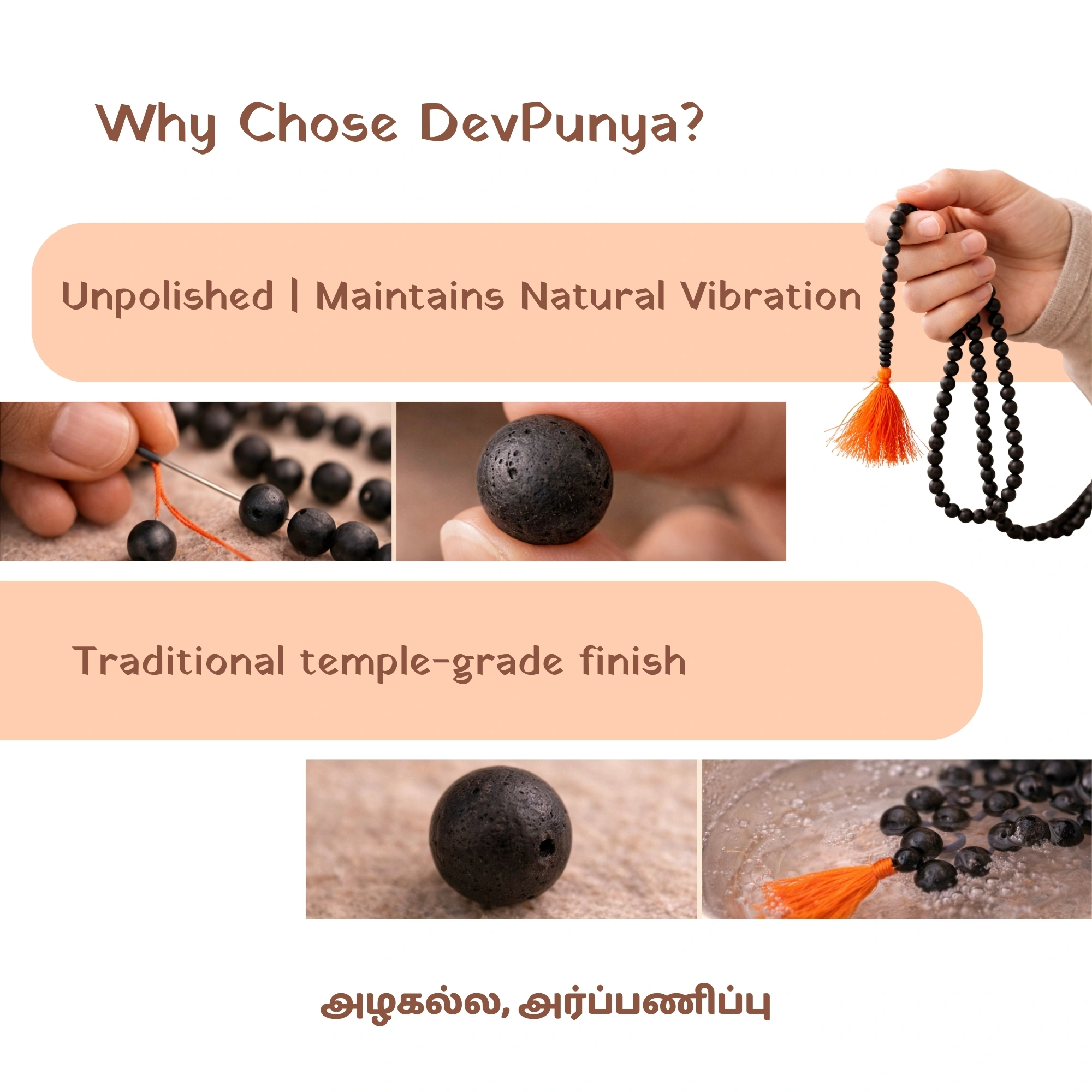
Analogy: Polishing Karungali is like wrapping a crystal in plastic. It looks nice, but you've blocked the energy transmission.
🛒 Order 100% Unpolished Karungali →
The 108+1 Bead Configuration
Why 108 Beads?
108 is a sacred number across Hindu, Buddhist, and Jain traditions.
Significance of 108:
1. Cosmic Mathematics
- 108 = Distance from Earth to Sun ÷ Sun's diameter (approximately)
- 108 = Distance from Earth to Moon ÷ Moon's diameter (approximately)
- Ancient astronomers recognized this cosmic proportion
2. Scriptural Importance
- 108 Upanishads in Vedic texts
- 108 names of major deities (Ashtottara Shatanamavali)
- 108 sacred sites (Divya Desams in Vaishnavism)
3. Chakra System
- 108 energy lines (nadis) converge at the heart chakra
- Chanting 108 times activates all these energy pathways
4. Mantra Completion
- One full meditation cycle = 108 repetitions
- Creates energetic completion and closure
The Guru Bead (+1)
The 109th bead (larger than others) is the Guru bead or Meru bead.
Purpose:
- Marks start/end of the mala
- Never cross the Guru bead during japa — when you reach it, reverse direction
- Represents the guru (teacher) or deity — honoring them
Why not cross it? Crossing the Guru bead is considered disrespectful — like stepping over your teacher. Instead, you reverse and continue in the opposite direction.
Karungali in Buddhist Tradition
Not Just Hindu — Buddhist Connection
Karungali (ebony) is also used in Buddhism, especially:
- Theravada Buddhism (Sri Lanka, Southeast Asia)
- Tibetan Buddhism (alongside bodhi seed malas)
Why Buddhists use ebony:
- Grounding — supports Vipassana (insight meditation)
- Durability — ebony lasts for generations (symbol of dharma's permanence)
- Natural black color — represents emptiness (shunyata) and the void
Buddhist mantra with Karungali: "Om Mani Padme Hum"
This demonstrates Karungali's universal spiritual utility — transcends specific traditions while remaining deeply rooted in South Indian Shaivite/Ayyappa devotion.
Modern Scientific Perspective on Ebony Wood
Physical Properties
Why ebony is unique:
1. Extreme Density
- One of the densest woods on Earth
- Specific gravity: 1.0-1.2 (heavier than water — sinks)
- This density creates strong electromagnetic properties
2. Natural Oils
- Ebony contains natural resins and oils
- These oils have mild antibacterial properties
- Prevents decay (why ebony artifacts last centuries)
3. Fine Grain Structure
- Extremely tight grain (almost no visible pores)
- Creates smooth surface even when unpolished
- Ideal for tactile use (won't splinter)
Energetic Properties (Traditional + Modern Understanding)
Traditional view: Ebony grounds energy and absorbs negativity.
Modern interpretation:
- Dense wood = strong magnetic field
- May interact with body's bioelectrical field
- Provides electromagnetic stability
Note: Scientific research on wood energy properties is limited. Traditional benefits are based on centuries of experiential wisdom, not just modern studies.
Who Should Wear Karungali Mala?
Universal Accessibility
Unlike some spiritual items with restrictions, Karungali is for everyone:
✅ All genders — Men, women (Note: Ayyappa vratham itself is traditionally male-only, but Karungali mala has no gender restriction outside vratham)
✅ All ages — Children to elderly
✅ All spiritual paths — Shaivites, Vaishnavites, Shaktas, Buddhists
✅ All occupations — Students, professionals, homemakers, retirees
Especially Beneficial For:
1. Ayyappa Devotees
- Essential for 41-day vratham
- Maintains vow energy
- Traditional requirement
2. Shiva Devotees
- Karungali is sacred to Shiva
- Supports Shiva meditation and sadhana
- Grounding for intense Shaivite practices
3. Murugan Devotees
- Balances Vel energy
- Traditional in Tamil devotional practice
- Supports disciplined worship
4. People Seeking Discipline
- Students needing focus
- Professionals building consistency
- Anyone working on self-control
5. Spiritual Practitioners
- Daily japa/meditation practitioners
- Those in intense sadhana periods
- People needing energetic protection
6. People Feeling Ungrounded
- Anxious, scattered individuals
- Those overwhelmed by life
- Anyone needing stability
Karungali Mala vs Other Prayer Beads
Karungali vs Rudraksha
When to choose Karungali:
- Vratham/discipline periods (Ayyappa, intense sadhana)
- Need strong grounding
- South Indian tradition preference
- Black color resonates with you
When to choose Rudraksha:
- General spiritual wellness
- Shiva devotion (traditional Rudraksha connection)
- Stress relief and meditation
- Year-round daily wear
Karungali vs Tulsi
Tulsi (Holy Basil) Mala:
- Sacred to Lord Vishnu
- Lighter, more delicate
- Sattvic (pure) energy
Karungali:
- Sacred to Lord Shiva/Ayyappa
- Heavy, grounding
- Tamasic-to-Sattvic transformation energy (destroys negativity to create purity)
Can you wear both? Yes, but traditionally one at a time during specific practices.
Karungali + Rudraksha Hybrid
Best of both worlds:
- Combines Karungali's grounding + Rudraksha's spiritual protection
- Comprehensive energetic support
- Suitable for year-round practice
🛒 Hybrid Mala (Karungali + Rudraksha) →
How Karungali Mala is Made (Traditional Process)
From Tree to Mala
Step 1: Wood Selection
- Mature ebony trees (minimum 15-20 years old)
- Wood from heartwood (darkest, densest part)
- Sustainably sourced (not from endangered forests)
Step 2: Cutting and Shaping
- Wood cut into small cylinders
- Each bead shaped by hand or machine
- Size: Typically 8-10mm diameter
Step 3: Hole Drilling
- Center hole drilled through each bead
- Must be precise for thread alignment
Step 4: NO POLISHING
- Traditional method: Beads left completely unpolished
- Natural matte finish preserved
- Slight irregularities remain (this is authentic)
Step 5: Stringing
- 108 beads + 1 Guru bead strung on durable thread
- Traditionally black or red thread
- Knots between beads (prevents all beads falling if thread breaks)
Step 6: Energization (for Abhimantrit Mala)
- Taken to sacred temple (in DevPunya's case: Pashupatinath Temple, Haridwar)
- Vedic ritual performed by qualified Pandit Ji
- Mantras chanted to activate the mala
Buying Authentic Karungali: What to Look For
Green Flags (Genuine Seller)
✅ Lab certificate — Wood species verified (Diospyros ebenum)
✅ Unpolished finish — Natural texture visible
✅ Heavy weight — Should feel substantial
✅ Video proof of energization (if claimed as Abhimantrit)
✅ Transparent seller — Clear contact info, return policy
✅ Customer reviews — Verified purchases
Red Flags (Possible Fake)
❌ Too cheap — Genuine ebony has a price floor
❌ Polished/shiny — Likely not traditional quality
❌ Too light weight — Probably fake wood
❌ No certificate — No way to verify authenticity
❌ "Energized" claim with no proof — 99% are lying
DevPunya provides:
- ✅ Lab certificate
- ✅ 100% unpolished
- ✅ Video proof of energization
- ✅ Amazon verified with reviews
Complete guide to spot fake Karungali →
🛒 Order Certified Authentic Mala →
Frequently Asked Questions
Q: Is Karungali the same as Krishna Kaala?
A: Yes. Karungali (Tamil/Telugu) and Krishna Kaala (Sanskrit) both refer to ebony wood (Diospyros ebenum).
Q: Can women wear Karungali Mala?
A: Yes. While Ayyappa vratham is traditionally male-only, the Karungali mala itself has no gender restriction. Women wear it for Shiva/Murugan devotion and general spiritual practice.
Q: क्या Karungali और Rudraksha एक साथ पहन सकते हैं?
A: हाँ, कुछ लोग दोनों पहनते हैं। लेकिन traditionally, एक specific practice के लिए एक mala पहनी जाती है। 🛒 Hybrid mala दोनों के beads combine करता है।
Q: How do I know if my Karungali is genuine ebony?
A: Water test — genuine ebony sinks (very dense wood). Also check for lab certificate and weight (should be heavy).
Q: Should I oil Karungali like Rudraksha?
A: NO. Karungali does NOT need oiling. Just wipe with damp cloth occasionally. Oiling is for Rudraksha, not ebony.
Q: Can I wear Karungali if I'm not doing Ayyappa vratham?
A: Absolutely. Karungali is excellent for daily Shiva/Murugan devotion, general spiritual practice, and anyone seeking grounding and protection.
Summary: What is Karungali Mala?
Karungali Mala is:
- Prayer bead necklace made from genuine ebony wood (Diospyros ebenum)
- 108+1 beads strung on thread
- Sacred to Ayyappa, Shiva, and Murugan
- Essential for Ayyappa vratham (41-day discipline)
- Traditionally unpolished to preserve natural energy
- Used for japa (mantra chanting) and spiritual protection
- Provides grounding and discipline support
- Absorbs negative energy from environment
🛒 Start Your Practice with Authentic Karungali →
Related: Karungali Benefits | How to Use | Ayyappa Vratham Guide | Genuine vs Fake