How to Use Karungali Mala — First-Time Ritual, Daily Wearing, Japa Technique
Complete guide on using Karungali Mala correctly. First-time wearing ritual, daily practices, mantras, do's and don'ts, japa technique for 108 beads.
How to Use Karungali Mala — Complete Practical Guide
First-time ritual · Daily wearing · Japa technique · Mantras · Do's and don'ts · Vratham usage
Quick Start Guide (If You're in a Hurry)
Simplest method to start wearing Karungali Mala:
- Monday morning (or day before vratham begins)
- Morning bath taken
- Wash mala gently with clean water
- Chant mantra:
- Ayyappa: "Swami Sharanam Ayyappa" (18 times)
- Shiva: "Om Namah Shivaya" (11 times)
- Wear around neck or wrist
- Remove before bathroom/toilet
- Wear with devotion throughout day
That's it. Don't overthink.
[Detailed instructions below for comprehensive guidance]
When to Start Wearing Karungali Mala
Best Days to Begin
For Ayyappa Vratham Observers:
Start on Karthika Masa First Day (usually November)
- Traditionally: 41 days before Makara Sankranti (January 14/15)
- Countdown: Nov-Dec period
- Significance: Aligns with Sabarimala pilgrimage season
Or start any Monday:
- If not following strict vratham calendar
- Monday = Shiva's day (Karungali is sacred to Shiva)
For General Spiritual Practice (Non-Vratham):
Best days:
- Monday (Somvar — Shiva's day)
- Shivaratri (Maha Shivaratri or monthly)
- Pradosh (13th lunar day, twice a month)
- Auspicious personal dates (birthday, spiritual milestone)
Time of day: Morning after bath (sunrise or shortly after)
No need to wait for "perfect" day — sincere intention matters more than perfect timing.
First-Time Wearing: Complete Ritual
Step 1: Purify Yourself
Morning routine:
- Take full bath (head bath preferred)
- Wear clean clothes
- Traditional: White or yellow (sattvic colors)
- For vratham: Black clothes
- Optional fast: Not required, but light sattvic breakfast ideal
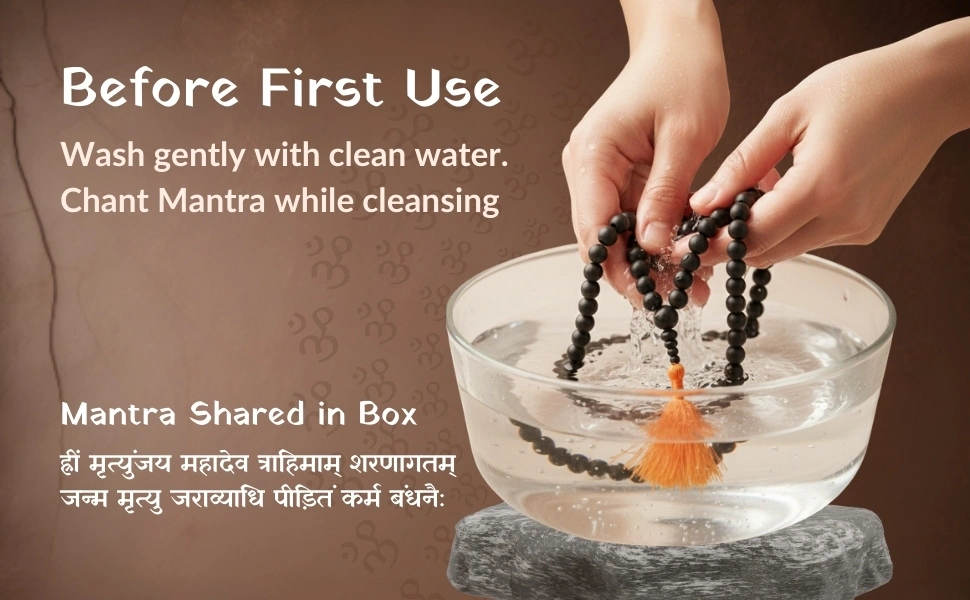
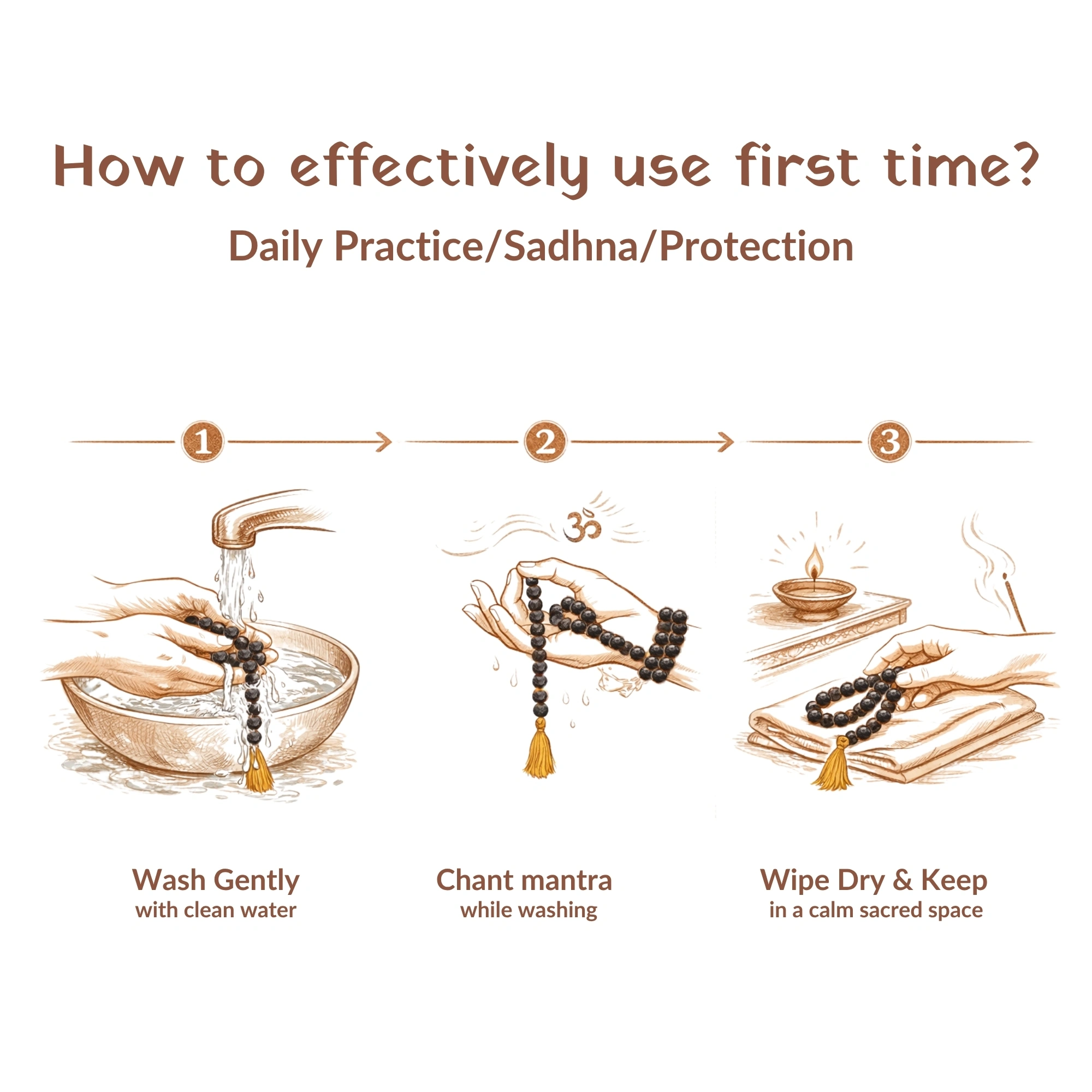
Step 2: Purify the Karungali Mala
Simple method (sufficient for most):
- Hold mala under clean running water
- Gently rinse each bead
- Pat dry with clean cloth
- Ensure completely dry before wearing
Elaborate method (for special occasions/vratham start):
- Fill bowl with clean water
- Add few drops of Ganga jal (if you have)
- Soak mala for 10-15 minutes
- Rinse and dry completely
Step 3: Create Sacred Space
At home altar (if you have):
- Light diya (ghee lamp)
- Burn incense (agarbatti — preferably sandalwood or jasmine)
- Place Ayyappa/Shiva/Murugan photo or idol
- Fresh flowers (optional)
Don't have altar?
- Clean corner of room
- Devotional photo on phone/tablet (acceptable)
- Just clean space with sincere intention
Step 4: Offer to Deity
Place mala before deity:
- Ayyappa devotees: "Swamiye Saranam Ayyappa" (स्वामी शरणम् अय्यप्पा)
- Shiva devotees: "Om Namah Shivaya" (ॐ नमः शिवाय)
- Murugan devotees: "Om Saravana Bhava" (ஓம் சரவண பவ)
Mental offering prayer: "Lord [Ayyappa/Shiva/Murugan], I offer this Karungali Mala at your feet. Please bless it and me. May it support my spiritual practice and protect me. Guide me to wear it with devotion and discipline."
Step 5: Chant the Mantra
For Ayyappa Devotees: "Swami Sharanam Ayyappa" (स्वामी शरणम् अय्यप्पा)
- Minimum: 18 times (significant Ayyappa number — 18 steps at Sabarimala)
- Better: 108 times (full mala round)
- Best: 1008 times (if you have time and devotion)
For Shiva Devotees: "Om Namah Shivaya" (ॐ नमः शिवाय)
- Minimum: 11 times
- Better: 108 times
- Best: 1008 times
For Murugan Devotees: "Om Saravana Bhava" (ஓம் சரவண பவ)
- Minimum: 6 times (six syllables, six abodes)
- Better: 108 times
- Best: 1008 times
How to chant:
- Sit comfortably (floor or chair)
- Close eyes or gaze at deity
- Chant clearly (out loud or mentally)
- Focus on sound and meaning
Step 6: Meditation (Optional but Powerful)
After chanting:
- Hold mala in hands (or wear it)
- Sit in silence for 5-15 minutes
- Feel the energy of the Karungali
- Set intention for your practice
Visualization (optional):
- Imagine golden light from deity entering the mala
- See the beads glowing with divine energy
- Feel protection and blessing surrounding you
Step 7: Wear with Devotion
How to wear:
Around neck (most common):
- Touch to forehead first (third eye — Ajna chakra)
- Then place over head
- Let it rest near heart (Anahata chakra)
Around wrist (bracelet style):
- If you have shorter mala or prefer wrist wearing
- Left or right hand (no strict rule — see below)
Mental prayer while wearing: "May this Karungali protect me, guide me, and keep me connected to [Ayyappa/Shiva/Murugan]. May I wear it with awareness and devotion."
You're ready. Begin your practice.
Daily Wearing Guidelines
Which Hand / Which Side?
For Necklace (around neck):
- No left/right issue
- Just wear around neck
For Bracelet (around wrist):
Traditional guidelines (debated):
- Some say right hand (active hand, giving energy)
- Others say left hand (receptive hand, receiving energy)
Practical reality:
- Wear on whichever hand feels comfortable
- Non-dominant hand often preferred (less likely to get damaged)
- Energy benefits are same either way
DevPunya recommendation: Try both, notice which feels better. Intention matters more than hand.
On Skin or Over Clothes?
Traditional method: On bare skin (under clothes)
Why skin contact:
- Karungali absorbs sweat and body oils (creates personalized bond)
- Direct energetic contact with your field
- Maximum grounding effect
Practical wearing:
- Under shirt/clothes — mala touches skin, but not visible (discreet)
- Over clothes — visible (some prefer this for accountability during vratham)
Both work, but skin contact enhances benefits.
🛒 Order Karungali for Daily Wear →
Do's and Don'ts of Wearing Karungali
DO's ✅
1. Wear with Respect
- Treat as sacred object, not just accessory
- Handle with clean hands
- Don't throw or drop carelessly
2. Remove Before Bathroom/Toilet
- Take off before entering bathroom
- Keep in clean place outside (pocket, hook)
- Wear again after washing hands
3. Remove During Intimate Relations
- Take off and keep respectfully aside
- For married couples during vratham: celibacy is required anyway
- Wear again after bath
4. Maintain with Care
- Weekly cleaning — wipe with damp cloth
- No oiling required (unlike Rudraksha)
- Store properly when not wearing
5. Touch During Challenges
- When facing temptation (breaking vratham vow)
- During difficult moments (stress, fear, doubt)
- Touch the beads, take breath, reconnect to intention
6. Chant Occasionally
- Not daily requirement, but good practice
- Weekly: Brief chanting session (18 or 108 repetitions)
- Monthly: Longer japa
- Maintains energetic charge
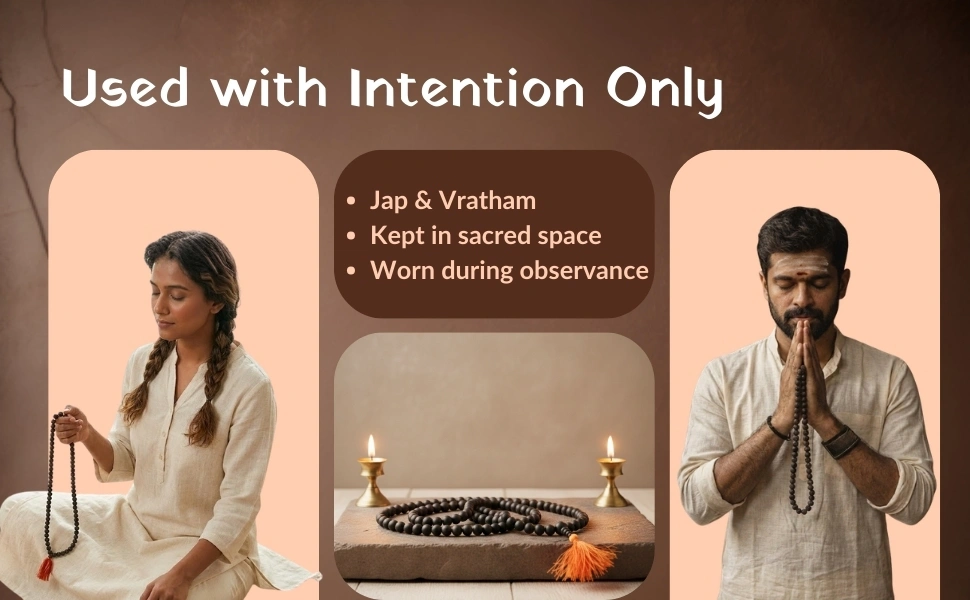
7. Wear During Puja/Meditation
- Enhances spiritual practice
- Use as japa mala for mantra counting
8. Wear During Important Events (Vratham Specific)
- All 41 days — never remove except bathroom/toilet/intimate relations
- During daily puja
- While attending Ayyappa satsang or temple visits
DON'Ts ❌
1. Don't Wear to Funeral/Cremation Grounds
- Intense negative/chaotic energy present
- Karungali will absorb this (undesirable)
- Remove before entering, wear again after bath and re-energization
2. Don't Share Your Karungali
- It's personalized to your energy (especially if Abhimantrit)
- Don't lend to others
- Family members should have their own
3. Don't Expose to Chemicals
- Remove before perfume/cologne application
- Remove during hair wash (shampoo contact)
- Avoid cleaning products contact
4. Don't Oil Karungali
- This is NOT Rudraksha — ebony doesn't need oil
- Oiling can damage the natural texture
- Just wipe with damp cloth
5. Don't Polish or Modify
- Unpolished texture is essential for energy
- Don't try to "improve" it by polishing
- Don't add extra beads or modify structure
6. Don't Wear While Consuming Non-Veg/Alcohol (Vratham)
- During Ayyappa vratham: Strict sattvic vegetarian diet required
- Remove if you break the diet (ideally don't break it)
- Outside vratham: Personal choice, but conscious consumption advised
7. Don't Sleep Wearing It (Debated)
Traditional views vary:
- Some say remove at night (rest period, no need for protection)
- Others say wear 24/7 during vratham (continuous vow)
DevPunya guidance:
- During intense vratham: Wear while sleeping (many Ayyappa devotees do)
- General daily practice: Personal preference — try both, see what feels right
- If mala is uncomfortable or tangled during sleep, remove
Can You Sleep Wearing Karungali?
Short answer: Yes, especially during vratham.
Benefits of sleeping with Karungali:
- Continuous protection throughout night
- Grounding energy may improve sleep quality
- Unbroken vow continuity (important for 41-day discipline)
- Wake up already wearing it (immediate morning practice)
Potential issues:
- Mala might get tangled in bedding
- Thread might fray faster from movement
- Some find it physically uncomfortable
Recommendation: Try it during vratham (when vow continuity matters most). For general practice, optional.
Special Situations: When to Remove Karungali
Must Remove:
✅ Bathroom/toilet (always)
✅ Intimate relations
✅ Funeral/cremation grounds
Should Remove (Traditional):
- Non-sattvic meals (if eating meat/alcohol during non-vratham times)
- Birth/death house (first 10 days)
- Heavy exercise/sports (to prevent damage)
Optional to Remove:
- While bathing (to avoid soap contact — but brief water rinse OK)
- While sleeping (comfort-based decision)
- During professional work (if environment is disrespectful)
No Need to Remove:
- General work throughout day
- Travel
- Light exercise/yoga
- Prayer/meditation (actually recommended to wear)
- Social situations
Japa Technique with Karungali (108-Bead Method)
What is Japa?
Japa (जप) = Repetitive mantra chanting
Purpose:
- Meditation through sound repetition
- Mind focus (prevents wandering thoughts)
- Deity invocation (calling divine energy)
- Energetic purification
How to Use 108-Bead Karungali for Japa
Preparation:
- Sit comfortably — floor (cross-legged) or chair (feet flat)
- Spine straight — allows energy flow
- Eyes closed or soft gaze at deity image
- Hold mala in right hand (traditional method)
Bead Movement Technique:
1. Starting Position
- Drape mala over middle finger of right hand
- Guru bead (larger 109th bead) hangs down at bottom
- Begin with first bead next to Guru bead
2. Moving the Beads
- Use thumb to pull each bead toward you (one at a time)
- One bead = one mantra repetition
- Index finger does not touch beads (considered inauspicious in some traditions)
- Move smoothly and rhythmically
3. Reaching the Guru Bead
- When you complete 108 beads, you reach Guru bead again
- Do NOT cross the Guru bead (like stepping over your guru — disrespectful)
- Reverse direction — flip the mala and continue backward
- Or stop if one round is your goal
4. Rhythm and Breath
- Coordinate with breath (optional but powerful)
- Inhale: Silent preparation
- Exhale: Chant mantra
- Move bead: On exhale completion
- Or chant at natural pace without forcing breath coordination
5. Focus Points
- Sound — hear the mantra clearly (internally or out loud)
- Meaning — understand what you're saying
- Feeling — connect emotionally to the deity
- Sensation — feel the bead under thumb (keeps you present)
Common Japa Mistakes to Avoid
❌ Mechanical counting — moving beads without awareness
❌ Racing through — speed doesn't equal power
❌ Mind wandering — thinking about other things while chanting
❌ Crossing Guru bead — sign of disrespect
❌ Using index finger — traditionally avoided (use thumb only)
❌ Irregular rhythm — creates mental agitation
✅ Do: Slow, steady, aware, devotional chanting
Mantras for Karungali Mala
For Ayyappa Devotees (Primary)
Main Mantra: "Swami Sharanam Ayyappa" (स्वामी शरणम् अय्यप्पा)
Meaning: "I surrender to Lord Ayyappa" or "Ayyappa is my refuge"
Daily practice:
- Minimum: 18 repetitions (18 steps significance)
- Standard: 108 repetitions (one mala round)
- Intensive: 1008 repetitions (during vratham)
When to chant:
- Morning: Before starting day (sets intention)
- Evening: Before bed (reflection and gratitude)
- Throughout day: Any moment you remember
Advanced practice:
- Some devotees chant 18,000+ times during 41-day vratham (multiple hours daily)
For Shiva Devotees
Main Mantra: "Om Namah Shivaya" (ॐ नमः शिवाय)
Meaning: "I bow to Shiva" or "Salutations to Shiva"
Five-syllable mantra: Na-Mah-Shi-Va-Ya (represents five elements)
Daily practice:
- Minimum: 11 times
- Standard: 108 times
- Advanced: 1008 times or more
Powerful for:
- Transformation (destroying old patterns)
- Liberation (moksha orientation)
- Inner peace
For Murugan Devotees
Main Mantra: "Om Saravana Bhava" (ஓம் சரவண பவ)
Meaning: "Om, to the one born in the sara vana (reed forest)" — refers to Murugan's birth story
Six-syllable mantra: Om-Sa-Ra-Va-Na-Bhava (represents six abodes of Murugan)
Daily practice:
- Minimum: 6 times
- Standard: 108 times
- Multiples of 6: 18, 54, 108 (all divisible by 6)
Powerful for:
- Removing obstacles
- Gaining clarity and wisdom
- Protection from enemies
Complete mantra guide with pronunciation →
Daily Practice Recommendations
Minimum Daily Practice (5 minutes)
Morning:
- Touch Karungali to forehead
- Chant chosen mantra 11-18 times
- Set intention for the day
Evening:
- Touch Karungali to forehead
- Chant chosen mantra 11-18 times
- Reflect and give thanks
Total time: 5 minutes
This maintains the energetic connection without overwhelming your schedule.
Standard Daily Practice (15-20 minutes)
Morning:
- Touch Karungali to forehead
- Full mala round (108 repetitions)
- Brief meditation (5 minutes)
Evening:
- Touch Karungali to forehead
- Half mala or full round
- Gratitude prayer
Total time: 15-20 minutes
This deepens benefits significantly.
Intensive Practice (Vratham — 1-2 hours daily)
Morning (before sunrise):
- Bath
- Multiple mala rounds (540-1080 repetitions)
- Extended meditation (30 minutes)
Evening:
- Multiple mala rounds
- Reading sacred texts (Ayyappa stories, Shiva Purana, etc.)
- Contemplation
Throughout day:
- Constant mantra awareness (mental chanting)
- Touching Karungali for grounding
Total dedicated practice: 1-2 hours (vratham requirement)
Wearing Karungali During Vratham vs General Practice
Ayyappa Vratham (41 Days) — Strict Mode
During vratham, Karungali is:
- Non-negotiable — wear 24/7 (except bathroom/toilet)
- Constant reminder of vow
- Energetic anchor for discipline
Additional requirements:
- Black clothes only
- Sattvic vegetarian diet (no onion/garlic)
- Celibacy (brahmacharya)
- No alcohol/tobacco
- Daily puja and extensive japa
- Early rising (before sunrise)
Karungali's role: Supports all of the above through grounding and protection.
General Spiritual Practice — Flexible Mode
For daily Shiva/Murugan devotion outside vratham:
- Wear when practicing (puja, meditation, japa)
- Optional throughout day (can remove during work if needed)
- Less strict dietary rules (but conscious eating advised)
- Japa as your schedule allows (even 11 repetitions daily is good)
Karungali's role: Spiritual companion for your practice, not drill sergeant.
What to Do If Karungali Breaks or String Frays
If String Breaks
Don't panic. String breakage is normal wear and tear.
What to do:
- Collect all beads carefully
- Re-string yourself (if you know how) or take to local bead shop
- Alternatively: Contact seller for re-stringing service
Spiritual meaning (traditional):
- Some say string breaking means mala absorbed major negativity and protected you
- Others say it's just physical wear
- Both views are valid
Prevention: Check thread condition monthly, replace if fraying.
If Beads Break
Rare but can happen (ebony is hard, but not indestructible).
What to do:
- Remove broken bead
- Respectfully dispose — immerse in river, plant in soil, or keep in altar
- Continue with remaining beads or replace broken bead
Can you still use mala with 107 beads? Yes, but traditionally 108 is ideal. Consider replacing the bead or getting new mala.
If Mala Gets Lost
Traditional view: The Karungali served its purpose and moved on.
Practical view: You lost it (happens).
What to do:
- Accept without guilt — don't see it as bad omen
- Order new mala when ready
- Learn mindful care for the next one
Re-Energizing Your Karungali
When to Re-Energize
Recommended: Annually on Maha Shivaratri
Also re-energize when:
- After major illness (yours or household member's)
- After negative event (accident, conflict, trauma)
- If you feel energy has diminished
- If mala was touched/worn by someone else
- Before starting new vratham (if you've used it before)
Simple Home Re-Energization
On Shivaratri, Monday, or Pradosh:
- Wash mala gently with clean water
- Dry completely
- Place before Ayyappa/Shiva/Murugan
- Light diya and incense
- Chant mantra — 108 or 1008 times
- Meditate holding mala (15-20 minutes)
- Wear again
This refreshes the energetic charge.
If it was Abhimantrit: Original temple energization remains. This is just maintenance/refreshing.
Frequently Asked Questions
Q: Can I remove Karungali during work?
A: For vratham: Wear 24/7 (except bathroom). For general practice: Can remove during work if environment is disrespectful or physically risky (heavy machinery, etc.).
Q: क्या सोते समय पहन सकते हैं?
A: हाँ, especially during vratham। Comfort के according decide करें। Many Ayyappa devotees सोते समय भी पहनते हैं।
Q: What if I accidentally wore it to bathroom?
A: Wash mala with water, mentally apologize to deity, continue. Accidents happen — intention matters more than perfection.
Q: Can women wear during menstruation?
A: Traditional taboo exists, but no scriptural prohibition for Karungali. Personal choice. If uncomfortable, remove and resume after.
Q: Should I wear Karungali or Rudraksha?
A: Vratham/intense discipline: Karungali. Daily general practice: Rudraksha. Want both benefits: 🛒 Hybrid mala.
Q: How long before I can stop wearing it?
A: Vratham: 41 days minimum. General practice: No time limit — many wear for years or life.
Summary: Simple Usage Practice
To start:
- Monday morning
- Wash, offer to deity
- Chant mantra (18 or 108 times)
- Wear with devotion
Daily:
- Wear throughout day (on skin preferred)
- Remove for bathroom/toilet
- Optional brief chanting (11+ repetitions)
Care:
- Weekly wipe with damp cloth
- No oiling needed
- Store respectfully when not wearing
Discipline (Vratham):
- Wear 24/7 (except bathroom/intimate relations)
- Extensive daily japa (multiple mala rounds)
- Strict sattvic lifestyle
Don't overthink. Wear with sincerity.
Related: What is Karungali | Benefits | Ayyappa Vratham Guide | Mantras