Karungali Mala for Ayyappa Vratham — Complete 41-Day Discipline Guide
Complete Ayyappa vratham guide with Karungali Mala. 41-day discipline framework, daily practices, mantras, rules, preparation for Sabarimala darshan.
Karungali Mala for Ayyappa Vratham — Complete 41-Day Guide
Full discipline framework · Daily practices · Mantras · Rules · Building steadiness over 41 days
What is Ayyappa Vratham?
Ayyappa Vratham is a 41-day spiritual discipline undertaken by devotees before the Sabarimala pilgrimage to seek darshan (divine vision) of Lord Ayyappa.
Key elements:
- Duration: 41 days (traditionally)
- Discipline: Celibacy, sattvic vegetarian diet, daily puja, mantra chanting
- Attire: Black clothes (or blue)
- Sacred items: Karungali Mala, Rudraksha, Tulsi mala
- Goal: Purification and preparation for sacred darshan
Who observes:
- Primarily men and boys (Ayyappa worship is traditionally male-oriented)
- Women of certain ages participate in some regions (debated tradition)
- Undertaken individually or in groups (സംഘം - sangham)
Why 41 days specifically?
- Represents 41 days Lord Ayyappa spent in forest during his life story
- 41 = 40 + 1 — 40 days of discipline + 1 day of darshan
- Scientifically: 41 days is enough to form deep habit (beyond the commonly cited 21 days)
Why Karungali Mala is Essential for Vratham
Karungali is NOT optional — it's a traditional requirement.
Reasons:
1. Physical Symbol of Vow
- Wearing Karungali = visible commitment to the vratham
- Other devotees recognize you're observing discipline
- Self-accountability — constant reminder of your vow
2. Grounding During Transformation
- 41 days of discipline = intense spiritual opening
- Body, mind, emotions undergo major shift
- Karungali's grounding energy prevents overwhelm
3. Energetic Protection
- Vulnerable period — old patterns breaking, new ones forming
- Negativity from environment could derail you
- Karungali absorbs and neutralizes harmful energies
4. Japa Tool
- Daily mantra chanting is vratham requirement
- 108 beads structure your practice
- Tactile focus keeps mind from wandering
5. Connection to Ayyappa
- Karungali carries Ayyappa's energy (especially when Abhimantrit)
- Wearing it = carrying the deity with you always
🛒 Order Karungali for Vratham →
The 41-Day Discipline Framework
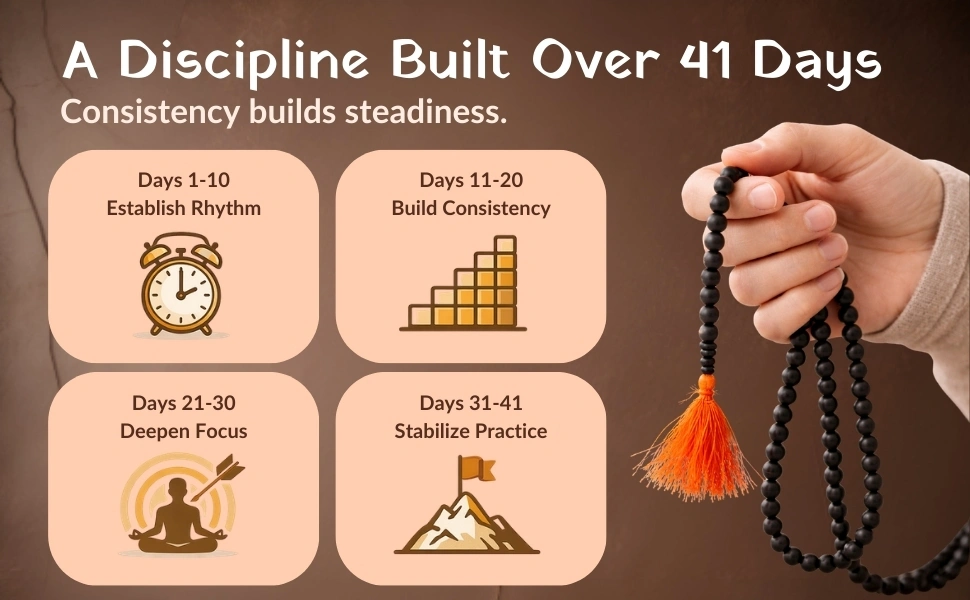
Vratham is not just "do this for 41 days." It's a structured journey with four distinct phases.
Understanding these phases helps you navigate challenges and stay committed.
Phase 1: Days 1-10 — Establish Rhythm
What's happening:
- Breaking old habits (non-veg, casual lifestyle)
- Forming new habits (early rising, daily puja)
- Initial resistance — mind rebels against change
- Physical adjustments — body adapts to new diet/schedule
Common challenges:
- Cravings (non-sattvic food, old habits)
- Fatigue (new wake-up time)
- Self-doubt ("Can I really do this for 41 days?")
- Social pressure (friends/family not understanding)
Karungali's role:
- Touch beads when tempted — moment of pause before breaking vow
- Grounding reduces cravings — stable energy = less food-seeking
- Physical reminder — "I'm wearing this for a reason"
Keys to success:
- Start strong — first 10 days set the tone
- One day at a time — don't think about all 41 days at once
- Simplify life — reduce social commitments that could trigger breaking vow
- Touchstone practice: Brief morning and evening chanting (minimum 18 repetitions)
Phase 2: Days 11-20 — Build Consistency
What's happening:
- Habits solidifying — practices become routine
- Boredom risk — initial enthusiasm fades, practice feels mechanical
- Fatigue sets in — novelty worn off, still 20+ days to go
- Mind tests your commitment — "This isn't that important, is it?"
Common challenges:
- Skipping practices ("Just one day won't matter")
- Mechanical execution (chanting without awareness)
- Comparison with others (some devotees seem more "serious")
- Life disruptions (work stress, family issues)
Karungali's role:
- Consistency anchor — wearing it keeps you on track even when motivation dips
- Absorbs frustration — when practice feels dry, mala provides grounding
- Tactile engagement during japa — prevents mechanical chanting
Keys to success:
- Deepen practice — increase japa rounds, read Ayyappa stories
- Connect with sangham — other devotees provide mutual support
- Vary approach — different mantras, meditation techniques (within tradition)
- Celebrate small wins — completed 10 days, 15 days, etc.
Phase 3: Days 21-30 — Deepen Focus
What's happening:
- Habits established — you've proven you can do this
- Deeper opening — spiritual insights may arise
- Vulnerability — old emotional patterns surfacing for healing
- Energetic shifts — you may feel different (lighter, clearer, more sensitive)
Common challenges:
- Ego inflation ("I'm so disciplined, look at me!")
- Spiritual bypassing (using practice to avoid real-life issues)
- Overwhelm — too much too fast (if intensified practice excessively)
- Unexpected emotions — crying, anger, fear surfacing
Karungali's role:
- Grounding prevents spiritual ego — keeps you humble
- Protection during emotional release — safe container for healing
- Stability anchor — when things get intense
Keys to success:
- Stay humble — this is preparation, not achievement
- Process emotions — don't suppress what arises
- Maintain balance — don't intensify practice beyond your capacity
- Trust the process — discomfort often precedes breakthrough
Phase 4: Days 31-41 — Stabilize Practice
What's happening:
- Final stretch — darshan is approaching
- Strengthening gains — integrating the transformation
- Anticipation — excitement about Sabarimala
- Completion energy — readying yourself for the pilgrimage
Common challenges:
- Premature celebration — thinking "I've basically done it" and relaxing discipline
- Anxiety — about the actual pilgrimage (logistics, worthiness)
- Overconfidence — dropping guard in final days
- Distraction — mind already at Sabarimala, not present in daily practice
Karungali's role:
- Steady reminder — don't break discipline early
- Grounding anticipation — excitement is good, but stay present
- Final purification — last days are crucial for energetic readiness
Keys to success:
- Maintain discipline through Day 41 — no early celebration
- Deepen devotion — final week is most sacred
- Prepare practically — pilgrimage logistics (if going to Sabarimala)
- Gratitude — for the strength to complete the vratham
🛒 Complete Your 41 Days with Karungali →
Daily Vratham Practice with Karungali
Morning Routine (Before Sunrise)
4:00-4:30 AM: Wake up (Brahma Muhurta)
4:30-5:00 AM: Bath (full head bath)
5:00-5:30 AM: Morning Puja
- Light diya and incense
- Offer flowers to Ayyappa photo/idol
- Chant "Swami Sharanam Ayyappa" — minimum 108 times (one mala round with Karungali)
- Advanced: 540 or 1080 repetitions (5-10 mala rounds)
5:30-6:00 AM: Meditation
- Sit in silence holding Karungali
- Visualize Ayyappa's form
- Contemplate his teachings (dharma, compassion, transcendence)
6:00 AM onward: Begin day (sattvic breakfast, work/study)
Throughout day:
- Wear Karungali 24/7 (except bathroom/toilet)
- Mental mantra — "Swami Sharanam Ayyappa" during idle moments
- Touch beads when challenged — instant reconnection to vow
Evening Routine
6:00-7:00 PM: Evening Puja
- Light diya
- Chant "Swami Sharanam Ayyappa" — 108 times minimum
- Read Ayyappa stories or listen to devotional songs
7:00-8:00 PM: Sattvic dinner (light, vegetarian, no onion/garlic)
8:00-9:00 PM: Reflection
- Journal (optional) — note insights, challenges, gratitude
- Brief meditation with Karungali
9:00-9:30 PM: Sleep preparation
- Can sleep wearing Karungali (many do during vratham)
- Or remove and place near pillow/altar
Total dedicated practice time: 2-3 hours daily (minimum)
Vratham Rules and Disciplines
Dietary Restrictions
Allowed (Sattvic):
✅ All vegetables (except onion, garlic)
✅ All fruits
✅ All grains (rice, wheat, millets)
✅ All lentils and beans
✅ Dairy (milk, ghee, yogurt — if not vegan)
✅ Mild spices (turmeric, cumin, coriander)
✅ Natural sweeteners (jaggery, honey)
Prohibited:
❌ All non-vegetarian food (meat, fish, eggs)
❌ Onion and garlic (considered rajasic/tamasic)
❌ Alcohol and tobacco
❌ Excessive spices (chili beyond mild level)
❌ Processed/junk food
Why these restrictions?
- Purifies body — easier to meditate with light food
- Calms mind — sattvic food = sattvic thoughts
- Reduces sexual energy (celibacy support)
Behavioral Disciplines
Celibacy (Brahmacharya):
- No sexual activity for 41 days (married or unmarried)
- Sexual energy redirected into spiritual practice
Speech:
- No lying
- No harsh/abusive language
- Minimize unnecessary talk (observe silence when possible)
Conduct:
- No violence (even verbal)
- No gambling or frivolous activities
- Respect all beings
Attire:
- Black or dark blue clothes (traditional vratham color)
- Simple, modest (no fashion focus)
Sleep:
- Floor sleeping (or hard mattress) — austerity
- Early to bed, early to rise
Social:
- Avoid crowded/chaotic places when possible
- Minimize entertainment (movies, TV, social media)
- Focus on spiritual company (sangham, satsang)
Daily Mantra Requirements
Minimum: 108 "Swami Sharanam Ayyappa" (one Karungali mala round)
Standard: 540 repetitions (5 rounds)
Intensive: 1080+ repetitions (10+ rounds)
Some devotees chant: 18,000+ times over the entire vratham (cumulative)
Mantras for Ayyappa Vratham
Primary Mantra
"Swami Sharanam Ayyappa" (स्वामी शरणम् अय्यप्पा)
Translation: "I surrender to Lord Ayyappa" / "Ayyappa is my refuge"
Pronunciation:
- Swami (स्वामी) = Lord / Master
- Sharanam (शरणम्) = Refuge / Shelter / Surrender
- Ayyappa (अय्यप्पा) = Name of the deity
How to chant:
- Clearly — each word distinct
- Devotionally — with feeling, not mechanical
- Rhythmically — steady pace (not rushed)
18 repetitions significance: 18 steps to Ayyappa's shrine at Sabarimala
Additional Mantras (Optional)
Ayyappa Gayatri Mantra:
"Om Bhutanathaya Vidmahe
Bhavaya Dhimahi
Tanno Shasta Prachodayat"
Meaning: "Om, Let me meditate on the lord of all beings, give me higher intellect, and let the God Shasta illuminate my mind."
Saranam Mantra (Extended):
"Swami Sharanam Ayyappa
Sharanam Ayyappa
Ayyappa Sharanam"
(Variations on the surrender theme)
Hariharaputra Stotram: More elaborate hymn to Ayyappa (son of Hari-Vishnu and Hara-Shiva)
Most devotees stick with "Swami Sharanam Ayyappa" — it's the most powerful and traditional.
Common Vratham Challenges and Solutions
Challenge 1: Intense Food Cravings
Why it happens:
- Body addicted to non-sattvic food (meat, spicy, processed)
- Mind associates food with pleasure/comfort
Karungali solution:
- Touch beads when craving arises — pause, breathe, reconnect
- Grounding reduces cravings — stable energy = less food-seeking
Additional tips:
- Eat filling sattvic meals (don't starve yourself)
- Drink plenty of water
- Remind yourself: "This is temporary discipline, not deprivation"
Challenge 2: Sexual Energy/Celibacy Difficulty
Why it happens:
- Biological drive doesn't disappear just because you took a vow
- Modern environment = constant sexual stimuli
Karungali solution:
- Grounding redirects energy upward (from lower to higher chakras)
- Touch Karungali during temptation — break the mental pattern
Additional tips:
- Avoid triggers (sexual content, provocative conversations)
- Increase japa — channel energy into mantra
- Cold water bath — reduces sexual heat (traditional method)
- Sleep on floor — discourages comfort-seeking
Challenge 3: Boredom/Mechanical Practice
Why it happens:
- Same routine for 41 days = monotony
- Initial enthusiasm fades
Karungali solution:
- Tactile engagement during japa — feel each bead, stay present
- Karungali's weight and texture prevent complete zoning out
Additional tips:
- Vary mantra rhythm (slow, medium, fast)
- Read Ayyappa stories — reconnect to meaning
- Attend satsang — group energy refreshes individual practice
Challenge 4: Social Pressure
Why it happens:
- Friends/family don't understand the discipline
- Invitations to events that would break vow (parties, etc.)
Karungali solution:
- Visible symbol — others see you're serious (reduces pressure)
- Touching beads during difficult conversations — grounding helps you stay firm
Additional tips:
- Politely decline — "I'm observing spiritual discipline"
- Find supportive community (sangham)
- Remind yourself: "41 days is temporary, my spiritual growth is permanent"
Challenge 5: Doubt ("Is this really working?")
Why it happens:
- No immediate visible results
- Mind questions the value of discipline
Karungali solution:
- Abhimantrit Karungali carries divine energy — trust the process
- Physical touch = reminder that you're supported
Additional tips:
- Results may be subtle — inner peace, clarity, strength
- Trust tradition — millions have done this before you
- Focus on present practice, not outcome
🛒 Stay Committed with Karungali →
Preparing for Sabarimala Darshan
After completing 41-day vratham:
Final Week Preparation
Days 36-41:
- Intensify practice — more japa, longer meditation
- Deepen devotion — read Ayyappa Mahatmya (life story)
- Practical preparation:
- Book travel to Kerala
- Arrange for Irumudi (pilgrimage bundle)
- Coordinate with sangham (group)
Sacred Items to Carry
Irumudi (Two-compartment bundle):
- Front compartment: Coconut with ghee (for breaking at Sabarimala)
- Back compartment: Personal items, offerings
Sacred items:
- Karungali Mala (wear throughout journey and darshan)
- Rudraksha Mala (optional secondary)
- Black clothes (extra sets)
- Vibhuti (sacred ash)
Journey to Sabarimala
Path:
- Trek through forest (traditional route — Pamba to Sannidhanam)
- Chant "Swami Sharanam Ayyappa" throughout trek
- Wear Karungali — protection during sacred journey
18 Sacred Steps:
- Final approach to temple = 18 steps
- Each step has significance
- Break coconut at top (symbolic ego destruction)
Darshan Moment
When you see Ayyappa:
- Overwhelming emotion common (tears, joy, surrender)
- Karungali on your heart — you carried devotion to this moment
- Silent prayer or "Swami Sharanam Ayyappa"
After darshan:
- Gratitude — you completed the journey
- Prasad — sacred offering distributed
- Return journey — continue discipline until you reach home
After Vratham: Integration
Post-Darshan
Immediately after:
- Maintain discipline for a few more days (gradual transition)
- Don't rush back to old habits
- Reflect on the 41-day experience — what did you learn?
Long-Term Integration
What to keep:
- Early rising (even if not 4 AM, earlier than before)
- Daily puja (even brief)
- Vegetarian or sattvic-leaning diet (doesn't have to be perfect)
- Regular mantra practice (even 18 repetitions daily)
Karungali Mala after vratham:
- Some continue wearing for spiritual support
- Others store respectfully and use during next vratham
- Can switch to 🛒 Rudraksha for daily wear (lighter, year-round suitable)
The goal: Vratham isn't just 41 days — it's a seed for lifelong transformation.
Frequently Asked Questions
Q: Can I do Ayyappa vratham without going to Sabarimala?
A: Yes. Many devotees observe vratham for spiritual discipline even without pilgrimage. The internal transformation matters most.
Q: What if I break the vratham accidentally?
A: Immediate confession and re-commitment. Traditional: restart 41 days. Modern: continue and complete with extra devotion. Karungali supports your re-commitment.
Q: क्या 41 दिन से कम में कर सकते हैं?
A: Traditionally no। But कुछ devotees 21 या 30 days करते हैं if 41 impossible। Full 41 ideal for complete preparation।
Q: Can women observe Ayyappa vratham?
A: Traditionally restricted to pre-menstrual girls and post-menopausal women. Varies by region — some allow all women now. Karungali mala itself has no gender restriction for Shiva/Murugan devotion.
Q: Should I wear Karungali or Rudraksha for vratham?
A: Karungali is traditional for Ayyappa vratham. 🛒 Rudraksha also acceptable. Some wear both. 🛒 Hybrid mala combines benefits.
Summary: 41-Day Vratham with Karungali
Framework:
- Days 1-10: Establish rhythm (break old habits)
- Days 11-20: Build consistency (overcome boredom)
- Days 21-30: Deepen focus (emotional release, insights)
- Days 31-41: Stabilize practice (prepare for darshan)
Daily minimum:
- Morning puja: 108 "Swami Sharanam Ayyappa"
- Evening puja: 108 "Swami Sharanam Ayyappa"
- Wear Karungali: 24/7 (except bathroom/toilet)
- Sattvic diet, celibacy, ethical conduct
Karungali's role:
- Grounding through intensity
- Protection during vulnerability
- Discipline support when motivation dips
- Energetic anchor throughout 41 days
🛒 Complete Your Vratham with Authentic Karungali →
Swami Sharanam Ayyappa 🙏
Related: What is Karungali | How to Use | Benefits | Mantras