🪔 Diwali 2026 is on Sunday, 8 November. Every year we clean our homes, light diyas, draw rangoli and worship Maa Lakshmi on the darkest night of Kartik. But if a child asks you "why do we celebrate Diwali?", the honest answer is longer than "Ram ji came home". Diwali is not one story. It is several stories that meet on the same night, and each one explains a different custom we still follow.
This guide tells the complete story of Diwali in simple words: what happened, which scripture or tradition it comes from, and why it is remembered on Kartik Amavasya. At the end, we answer the questions people ask most about the back story of Diwali.
- Main reason (North India): Shri Ram returned to Ayodhya after 14 years of exile and his victory over Ravana. Ayodhya lit lamps to welcome him.
- Why Lakshmi is worshipped: Maa Lakshmi appeared from the churning of the ocean (Samudra Manthan), and Diwali night is when she is invited into every clean, lit home.
- South India: Shri Krishna and Satyabhama defeated the demon Narakasura. This is remembered on Narak Chaturdashi.
- Other traditions: King Bali's yearly return, the Pandavas coming home, Bhagwan Mahavira's nirvana for Jains and Bandi Chhor Divas for Sikhs.
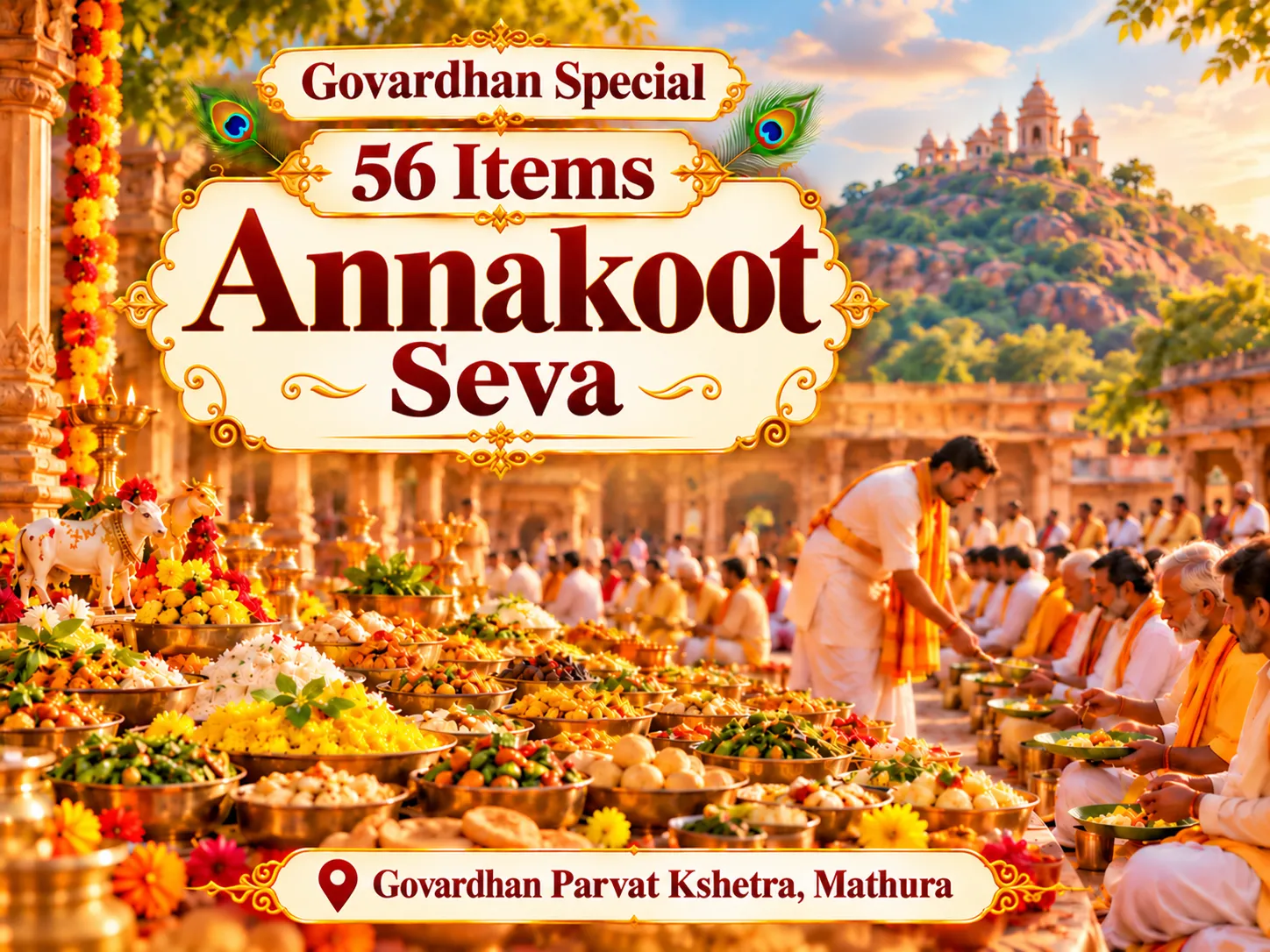
This Govardhan Puja, contribute to the 56-item Annakoot Seva
Govardhan Puja, 10 Nov · Govardhan, Braj · 56 bhog offered to Govardhan ji, then served as bhandara. From ₹251.
Why do we celebrate Diwali? The short answer
We celebrate Diwali to remember the victory of light over darkness and of dharma over adharma, and to welcome Maa Lakshmi, the goddess of wealth and well-being, into our homes. The word Deepavali comes from Sanskrit: deepa (lamp) and avali (a row). So Deepavali literally means "a row of lamps".
It falls on Kartik Amavasya, the new-moon night of the month of Kartik, which is the darkest night of the year in the Hindu calendar. Lighting a row of lamps on the darkest night is the whole message of the festival in one picture: however dark it gets, one small flame is enough to begin.
The complete story of Diwali: Shri Ram returns to Ayodhya
This is the story most of North India grows up with, told in the Ramayana.
The exile
King Dasharatha of Ayodhya had promised his queen Kaikeyi two boons. When the time came to crown his eldest son Ram, Kaikeyi asked for both: that her son Bharat be made king, and that Ram be sent to the forest for fourteen years. Bound by his word, Dasharatha agreed. Ram accepted without complaint. Sita ji and Lakshman ji refused to let him go alone.
Sita's abduction and the war in Lanka
In the thirteenth year, the demon king Ravana carried Sita ji away to Lanka. With Hanuman ji, Sugriva and the vanara sena, Ram built the Ram Setu across the ocean, fought the war and defeated Ravana. That victory is celebrated as Dussehra (Vijayadashami).
The journey home and the first Diwali
After the war, Ram, Sita and Lakshman flew back to Ayodhya on the Pushpak Vimana. The people of Ayodhya had waited fourteen years for this. When they heard their prince was coming home on the night of Kartik Amavasya, they cleaned every street and house and lit rows of ghee lamps so that he would not arrive in darkness. That night of lamps is remembered as the first Diwali.
This is why we clean the house, light diyas at the door and keep a lamp burning through the night. We are doing what Ayodhya did: getting the house ready for someone we love who is coming home.
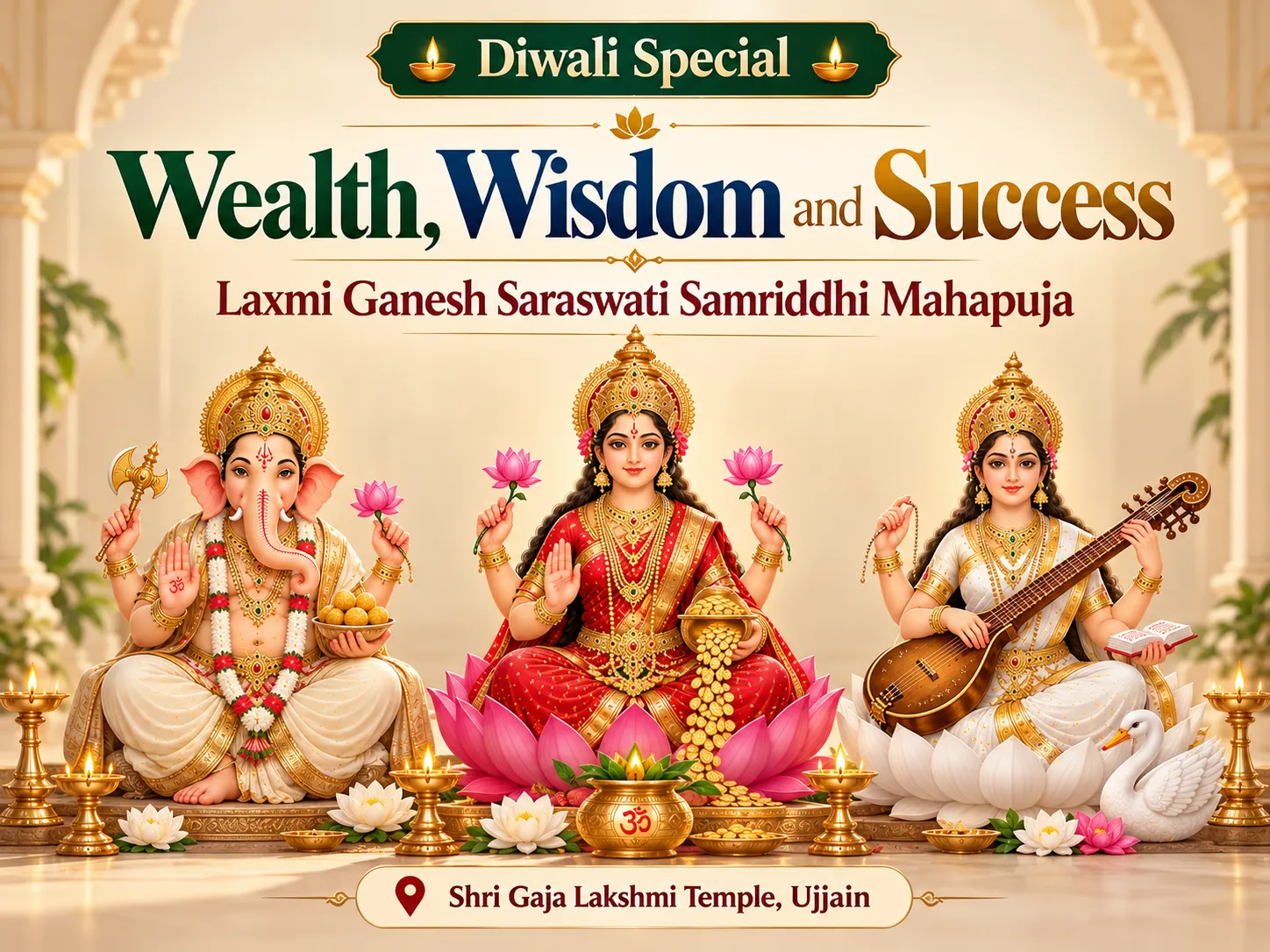
Welcome Maa Lakshmi home this Diwali with a temple puja in your name
Diwali, 8 Nov · Shri Gaja Lakshmi Temple, Ujjain · in your name and gotra, full HD video, prasad home. From ₹991.
Samudra Manthan: the story of how Maa Lakshmi appeared
If Diwali is about Ram, why do we worship Lakshmi and not Ram on Diwali night? The answer is a second, much older story from the Puranas.
Once, because of the anger of Rishi Durvasa, Indra and the devas lost their fortune and Lakshmi left heaven. To win back the amrit (nectar of immortality), the devas and asuras agreed to churn the ocean of milk together. Mount Mandara became the churning rod and the serpent Vasuki became the rope. Bhagwan Vishnu, as the tortoise Kurma, held the mountain on his back.
Many treasures came out of the ocean: the poison Halahal (which Shiva drank), the wish-fulfilling cow Kamadhenu, the Kalpavriksha tree, Dhanvantari with the pot of amrit, and finally Maa Lakshmi herself, seated on a lotus. She chose Bhagwan Vishnu as her consort. Many traditions hold that this appearance took place on Kartik Amavasya, which is why Diwali night is Lakshmi's night. Dhanvantari's appearance two days earlier is remembered as Dhanteras (see our Dhanteras 2026 guide).
This is also why the kamal (lotus) is the flower most loved by Maa Lakshmi. She rose from the ocean on one, and she is always shown seated on or holding one.
🪷 Offer a kamal to Maa Lakshmi this Diwali. Devpunya's pandits offer it in your name and gotra at Shri Gaja Lakshmi Mata Mandir, Ujjain, on 8 November, and you receive a video of the offering. Offer kamal to Maa Lakshmi (₹151) →
 Kamal (lotus) 🪔 8 Nov · Gaja Lakshmi, Ujjain From ₹151 Offer now → |  Coconut 🪔 8 Nov · Gaja Lakshmi, Ujjain From ₹151 Offer now → |
Shri Krishna and Narakasura: why South India celebrates a day earlier
In the South, and in many homes across India, Diwali is first about Shri Krishna. The demon Narakasura, king of Pragjyotisha, had grown arrogant with a boon. He had taken the earrings of Aditi, the mother of the devas, and imprisoned 16,100 women in his palace.
Shri Krishna rode out on Garuda with his wife Satyabhama. In the battle, Satyabhama, who is believed to be a form of Bhudevi, struck the final blow. Before he fell, Narakasura asked that people remember his end with lights and joy rather than mourning. That day became Narak Chaturdashi, also called Choti Diwali or Roop Chaudas.
The custom of abhyanga snan (an oil bath before sunrise) comes from this story: Krishna is said to have bathed with oil after the battle. In 2026, Chaturdashi is present at sunrise on 8 November, so the pre-dawn oil bath and Lakshmi Puja fall on the same day this year. The exact timings are in our Diwali 2026 muhurat guide.
King Bali and Bhagwan Vamana: the visit of a generous king
King Mahabali was a generous asura king whose power had grown so great that the devas feared him. Bhagwan Vishnu came to his yagya as Vamana, a small brahmin boy, and asked for only three steps of land. Bali agreed. Vamana grew to fill the universe, covered earth and sky in two steps, and Bali offered his own head for the third.
Pleased by his devotion, Vishnu sent Bali to rule Patala and granted that he could return to visit his people once a year. In Maharashtra, Gujarat and Karnataka, the day after Diwali is Bali Pratipada, which falls on the same day as Govardhan Puja and Annakoot. You can read that story in our Govardhan Puja 2026 guide.
Other stories behind Diwali
- The Pandavas return home: In the Mahabharata, the Pandavas came back to Hastinapur after twelve years of exile and one year in hiding. The people are said to have welcomed them with lamps.
- Kali Puja in Bengal, Odisha and Assam: The same Amavasya night is given to Maa Kali, who destroys darkness and fear.
- Jain Diwali: Bhagwan Mahavira, the 24th Tirthankara, attained nirvana at Pavapuri on this night. Jains light lamps because "the light of knowledge has gone, so we make a light of matter".
- Bandi Chhor Divas (Sikh): Guru Hargobind Sahib ji was released from Gwalior Fort with 52 kings, and reached Amritsar around Diwali. The Golden Temple is lit up on this day.
- Harvest and new year: Diwali comes at the end of the kharif harvest. For Gujarati traders, the day after is the new year, and new account books (chopda) are started with Lakshmi Puja.
🪔 Book Diwali pujas and offerings in your name
| Samriddhi Mahapuja 🪔 8 Nov · Gaja Lakshmi, Ujjain From ₹991 Book now → | Annakoot Seva 🍛 10 Nov · Govardhan, Braj From ₹251 Offer now → |
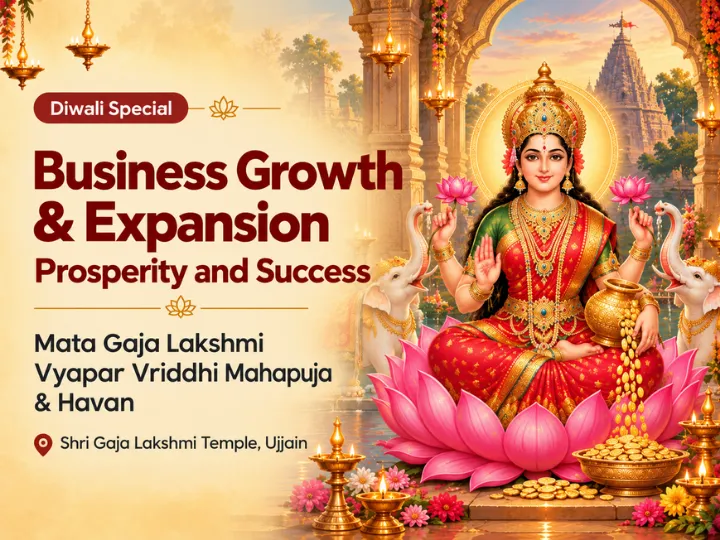 Vyapar Vriddhi Puja 🪔 8 Nov · Gaja Lakshmi, Ujjain From ₹991 Book now → | 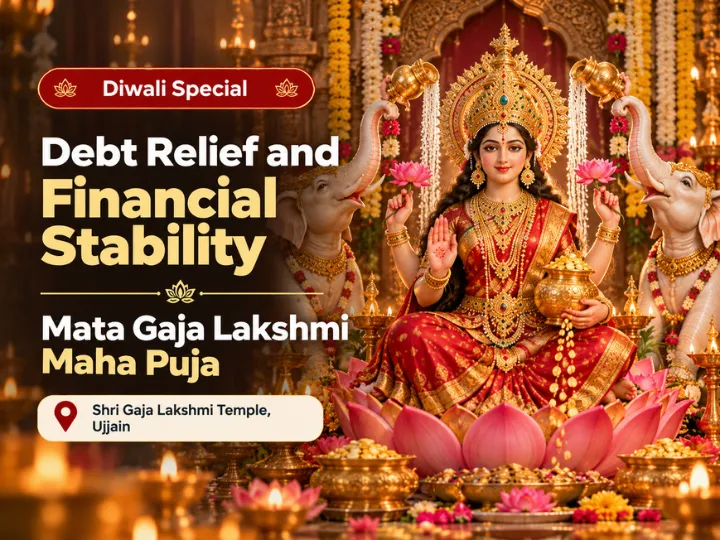 Rin Mukti Mahapuja 🪔 8 Nov · Gaja Lakshmi, Ujjain From ₹951 Book now → |
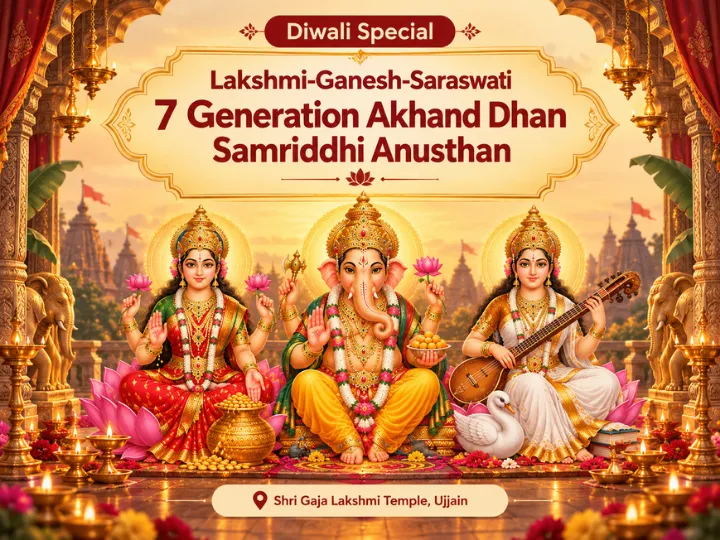 7 Generation Anusthan 🪔 8 Nov · Gaja Lakshmi, Ujjain From ₹991 Book now → | 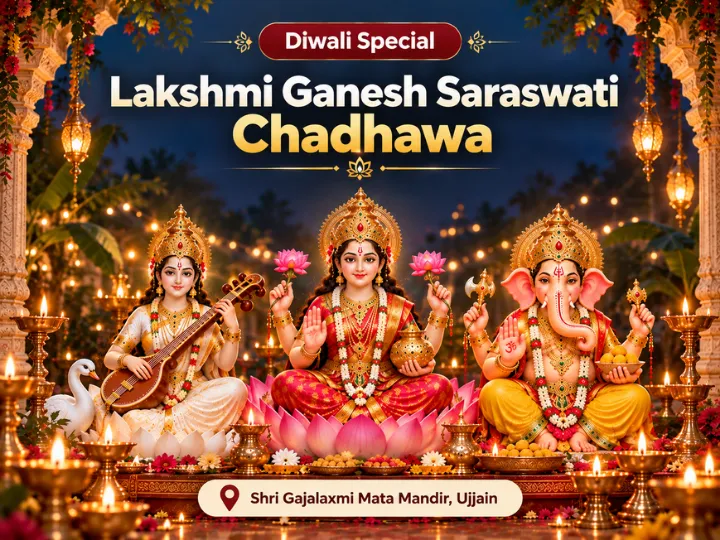 Diwali Chadhava 🪔 8 Nov · Gaja Lakshmi, Ujjain From ₹151 Offer now → |
Why are Lakshmi, Ganesh and Saraswati worshipped together on Diwali?
On Diwali we place Ganesh ji, Maa Lakshmi and, in many homes, Maa Saraswati side by side. There is a simple reason for this. Wealth (Lakshmi) without wisdom (Ganesh) does not last, and wealth without knowledge (Saraswati) is not used well. Ganesh ji is worshipped first because he removes obstacles. Lakshmi brings prosperity. Saraswati brings the understanding to keep it.
That is the idea behind the Lakshmi-Ganesh-Saraswati Samriddhi Mahapuja that Devpunya's pandits perform on Diwali at Shri Gaja Lakshmi Temple in Ujjain. Gaja Lakshmi is the form of Lakshmi bathed by elephants, and the temple is one of the oldest Lakshmi temples in Malwa.
🙏 Can't do a full puja at home this year? Book the Diwali Samriddhi Mahapuja at Shri Gaja Lakshmi Temple, Ujjain. Your name and gotra are taken in the sankalp, and you receive the full video. Book Samriddhi Mahapuja from ₹991 →
The five days of Diwali and what each one remembers
| Day (2026) | Festival | Story it remembers |
|---|---|---|
| Fri, 6 Nov | Dhanteras | Dhanvantari rises with the amrit; Yama deepdaan at the door |
| Sun, 8 Nov (dawn) | Narak Chaturdashi | Krishna and Satyabhama defeat Narakasura |
| Sun, 8 Nov (evening) | Diwali Lakshmi Puja | Ram returns to Ayodhya; Lakshmi's night |
| Tue, 10 Nov | Govardhan Puja and Annakoot | Krishna lifts Govardhan hill; King Bali's return |
| Wed, 11 Nov | Bhai Dooj | Yamuna feeds her brother Yama |
Because the tithis are compressed this year, Narak Chaturdashi and Diwali fall on the same day, and 9 November (Monday) is the end of Amavasya. For the exact puja windows, see the Diwali 2026 muhurat guide.
🗓️ Timings change by city. Check the exact Diwali muhurat, choghadiya, hora and your rashifal for your own city in the free Devpunya Panchang. Open Devpunya Panchang →
Questions people ask about the story of Diwali
Did Ram return on Diwali or on Dussehra?
Ram defeated Ravana on Vijayadashami (Dussehra). The journey back to Ayodhya, with stops to meet Bharadwaj Rishi and send word to Bharat, took about twenty days. So he reached Ayodhya on Kartik Amavasya, which is Diwali. In 2026 the gap is the same: Dussehra fell on 20 October and Diwali falls on 8 November, nineteen days later.
If Diwali is about Ram, why do we worship Lakshmi and not Ram?
Two different stories share one night. Ram's return explains the lamps and the joy. Lakshmi's appearance from the ocean explains the puja. Also, Sita ji is herself regarded as an avatar of Lakshmi, so welcoming Ram and Sita home is, in a way, welcoming Lakshmi and Narayan. Many families keep a Ram darbar near the Lakshmi-Ganesh idols for this reason.
Why is Diwali celebrated on Amavasya, the darkest night?
Because the point of a lamp is to be lit in darkness. Kartik Amavasya is believed to be the night Lakshmi moves through the world looking for homes that are clean, lit and open. A lamp on the darkest night says "this house is awake and ready".
Why do we light diyas and keep the door open?
Ayodhya lit lamps so Ram would not come home in the dark, and Lakshmi is welcomed into homes that are bright. Keeping the main door open and one diya burning through the night is the oldest Diwali custom. We have listed the rest in Diwali puja rules and do's and don'ts.
Why do we make rangoli at the door?
Rangoli is a welcome sign at the threshold, the "doormat" for a deity. Small footprints of Lakshmi are often drawn walking into the house, never out of it.
Why do we burst crackers on Diwali?
Crackers are a later custom, not part of the scriptures. The older idea is noise and light to celebrate a victory. Many families now prefer more diyas and fewer crackers, which keeps the spirit of the festival without the smoke.
Why do businesses start new account books on Diwali?
Because Lakshmi is worshipped as the giver of prosperity, traders begin the new financial year with Chopda Pujan: new books are marked with "Shubh-Labh" and a swastik and placed in the puja. We have a separate guide on Diwali Lakshmi puja for business growth and debt relief.
Why do people buy gold and utensils before Diwali?
That is a Dhanteras custom. What enters the home on Dhanteras is believed to multiply, so people buy gold, silver or at least a steel or brass vessel. See our Dhanteras 2026 guide for what to buy and when.
Why is the day after Diwali called Annakoot?
On the day after Diwali, Shri Krishna lifted Govardhan hill on his little finger to shelter the people of Braj from Indra's storm. In return, Braj offered a mountain of food (annakoot, also called chappan bhog, the 56 items) to Govardhan ji. In 2026, Govardhan Puja falls on Tuesday, 10 November.
🍛 Govardhan Puja offerings, in your name
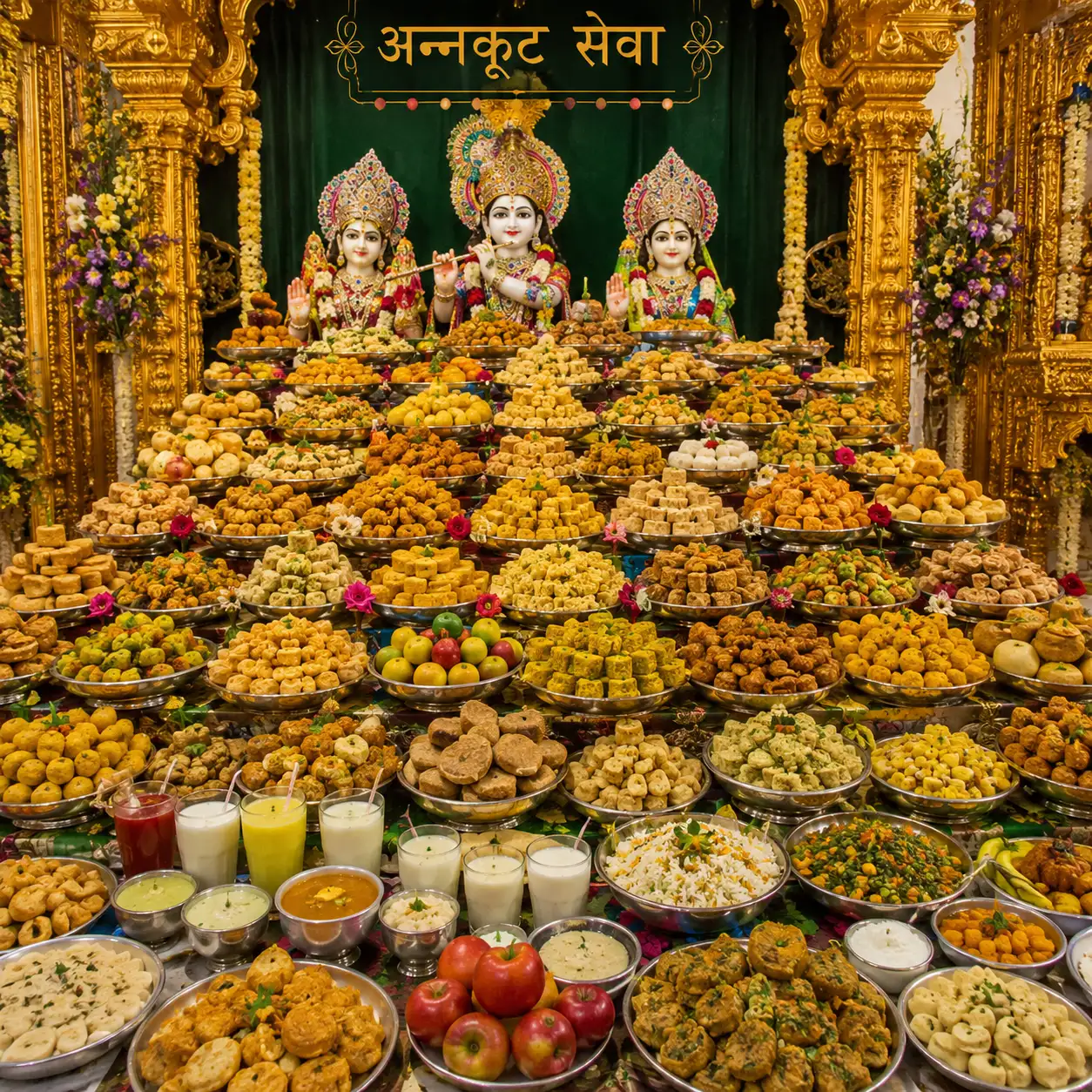 56 bhog Annakoot 🍛 10 Nov · Govardhan, Braj From ₹251 Offer now → | 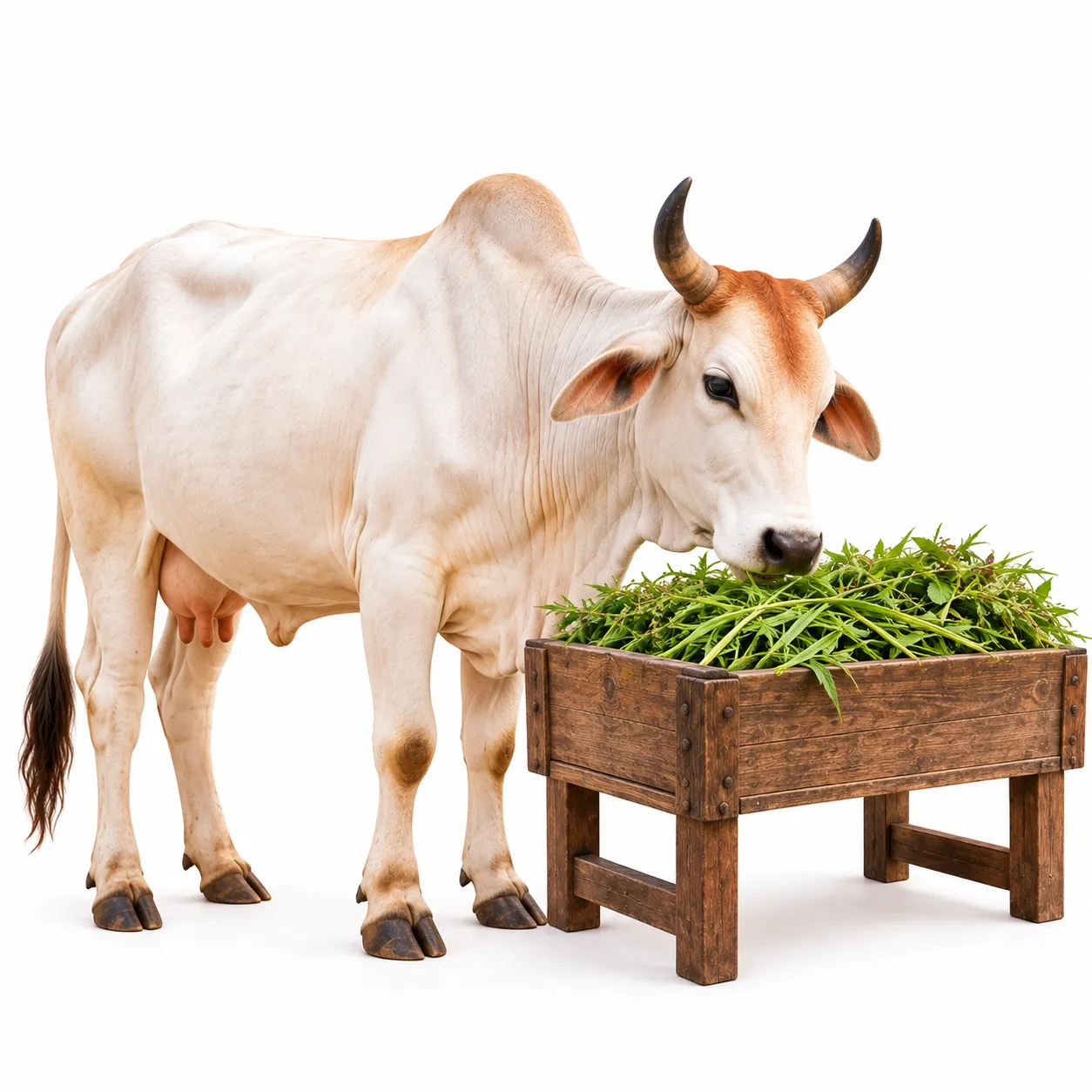 Gau seva 🍛 10 Nov · Govardhan, Braj From ₹201 Offer now → |
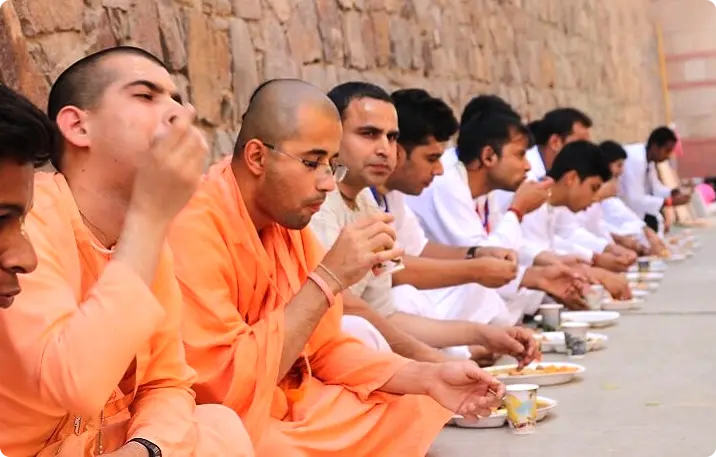 Brahmin bhoj 🍛 10 Nov · Govardhan, Braj From ₹501 Offer now → |  Land & home puja 🍛 10 Nov · Govardhan, Braj From ₹901 Offer now → |
How to live the story of Diwali this year
The stories all point the same way: clean the house, light the lamps, welcome the guest, and share what you have. On 8 November:
- Finish cleaning before evening and light the first diya at the main door at sunset.
- Do Lakshmi-Ganesh puja in the Pradosh Kaal (about 5:31 PM to 7:55 PM in Delhi). See the full Diwali 2026 muhurat guide.
- Follow the simple Diwali puja rules and do's and don'ts for the puja, and see how to attract Maa Lakshmi on Diwali for small things you can add.
- If you want step-by-step vidhi and samagri, read how to do Diwali puja at home.
- Share food: give to a cow, a needy family or a temple bhandara. Two days later, on Govardhan Puja, join the Annakoot.
🍛 Share the blessings of Diwali. On Govardhan Puja (10 November), a 56-item Annakoot is offered to Govardhan ji and served as bhandara. Add your name to the sankalp. Contribute from ₹251 →
📖 Read next in the Diwali 2026 series
- Diwali 2026 Best Tithi and Lakshmi Puja Muhurat (8 November)
- How to Attract Maa Lakshmi on Diwali: 21 Things to Do
- Diwali Puja Rules 2026: Do's and Don'ts for Lakshmi Pujan
- Govardhan Puja 2026: Date, Annakoot Story and 56 Bhog List
- Diwali Lakshmi Puja for Business Growth and Debt Relief
Book your Diwali Mahapuja at Shri Gaja Lakshmi Temple, Ujjain
Diwali, 8 Nov · Shri Gaja Lakshmi Temple, Ujjain · in your name and gotra, full HD video, prasad home. From ₹991.