Narsimha Jayanti 2026: Complete Guide - Date, Story, Puja, Significance & Homam
Everything about Narsimha Jayanti 2026 on April 30. Complete Prahlad-Hiranyakashipu story, Lord Narasimha's significance, Raksha Kavach Puja, Shatru Sanhar Yagya at Etteluthuperumal Temple Tirunelveli.
Narsimha Jayanti 2026: Complete Guide
Every year, on one specific evening, Hindus across the world pause and remember a moment that changed cosmic history. A child prayed. A tyrant struck a pillar in rage. And from that pillar emerged a form the universe had never seen before - half man, half lion - to prove that devotion is the strongest force in existence.
That moment is Narsimha Jayanti.
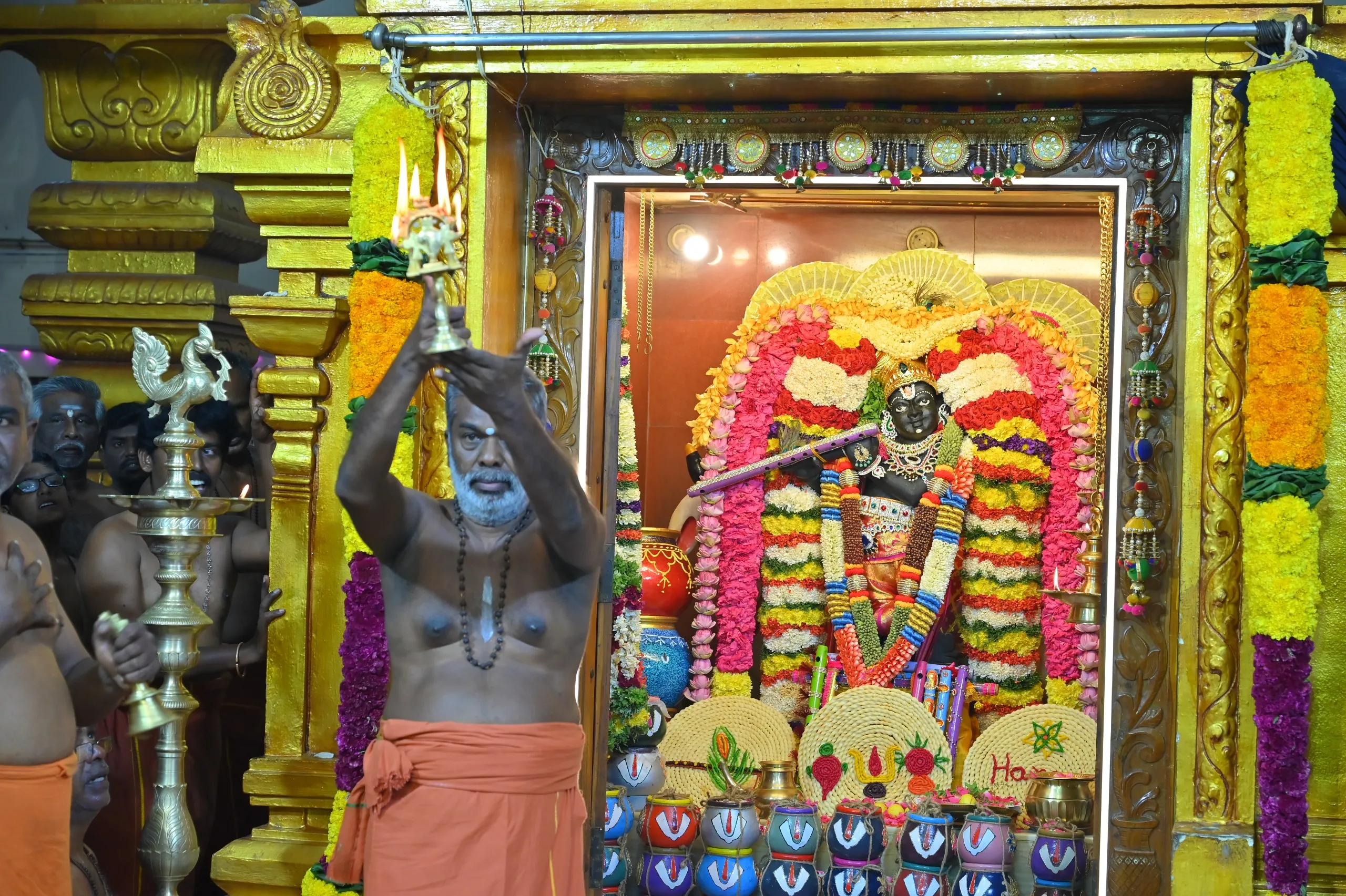 Aarti being performed at Etteluthuperumal Temple, Tirunelveli
Quick Navigation:
- What is Narsimha Jayanti?
- Narsimha Jayanti 2026 - Date & Timing
- Who is Lord Narasimha?
- The Complete Story: Prahlad, Hiranyakashipu & Divine Justice
- Why is This Day Considered So Powerful?
- About Etteluthuperumal Temple, Tirunelveli
- What is Shatru Samhara Homam?
- What is Raksha Kavach Puja?
- Who Should Perform This Puja?
- What Problems Can This Puja Help With?
- How to Observe Narsimha Jayanti at Home
- Narsimha Mantras
- How Puja is Performed - Complete Process
- Frequently Asked Questions
<span id="what-is-narsimha-jayanti">🦁 What is Narsimha Jayanti?</span>
Narsimha Jayanti is the day Lord Vishnu appeared on Earth as Narasimha - his fourth and most fierce avatar - to protect his devotee Prahlad and destroy the demon king Hiranyakashipu.
The word Jayanti means "birth anniversary" or "appearance day." So Narsimha Jayanti literally celebrates the day Lord Narasimha came into existence in the world - not as a gentle avatar, but as the most fierce and direct intervention of divine will in human history.
What happened on this day: The demon Hiranyakashipu had received a boon that made him nearly impossible to kill. He abused this power, declared himself god, and tried to murder his own son Prahlad for refusing to stop worshipping Lord Vishnu. When every attempt to kill Prahlad failed, Hiranyakashipu struck a palace pillar in rage and demanded to know where Prahlad's god was. From that pillar, Lord Vishnu appeared in the form of Narasimha (half-man, half-lion) and destroyed Hiranyakashipu - fulfilling every clause of the boon perfectly while still ending his life.
Why people observe this day:
This festival reminds every devotee of a truth that has held steady for thousands of years: When someone worships with genuine faith and is wronged unjustly, divine intervention follows. It may not come in the form you expect. It may not come when you think it will. But it comes.
Narsimha Jayanti is especially significant for people who are:
- Facing enemies who seem powerful or well-connected
- Going through legal battles where truth is on their side but the system is slow
- Experiencing fear, threats, or persecution
- Feeling spiritually unprotected or attacked
- Seeking courage and clarity in difficult times
The day is celebrated with fasting, prayer, mantra chanting, special temple pujas, and homam ceremonies across India - especially in South India where Narasimha temples are most active.
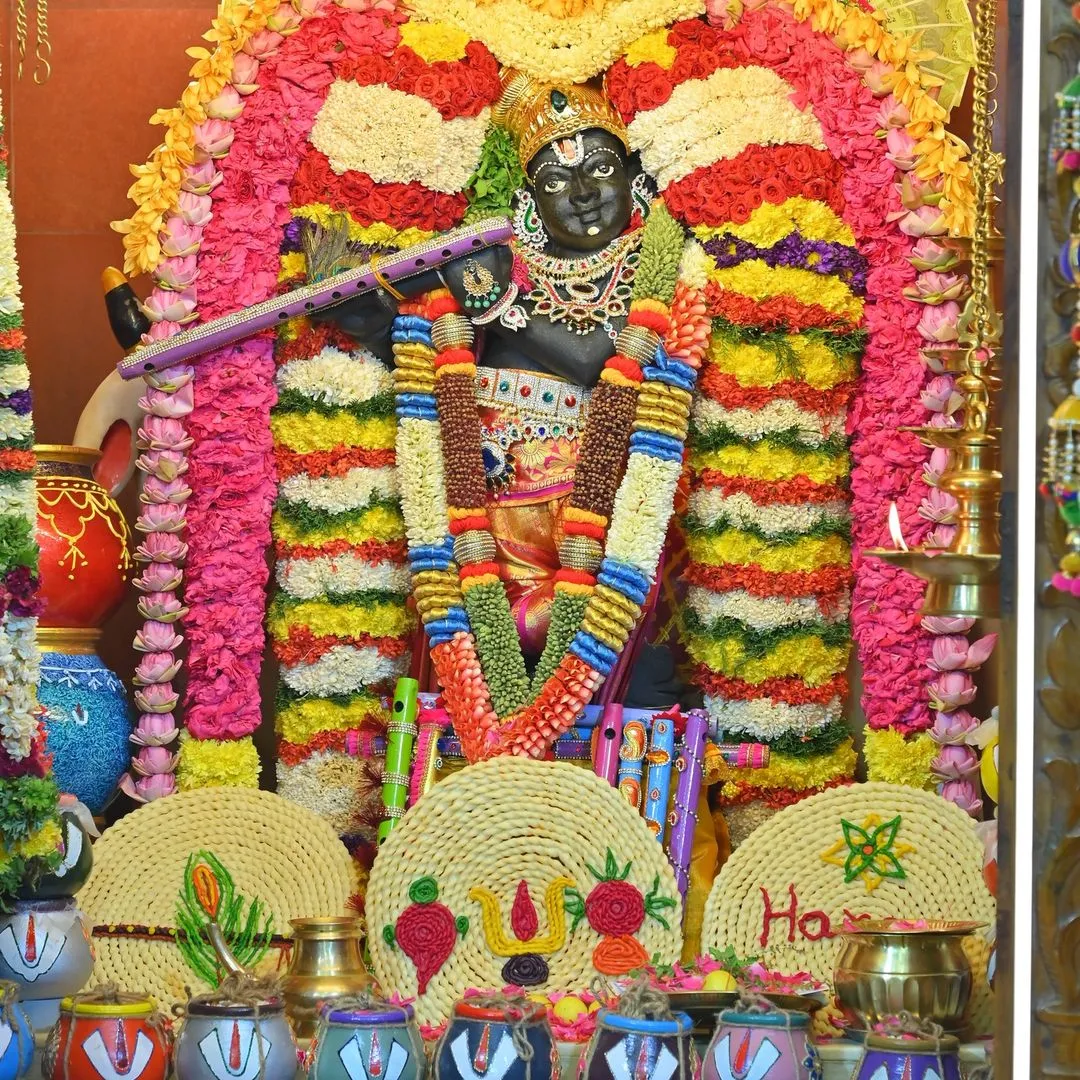 The sacred deity at Etteluthuperumal Temple, Tirunelveli adorned with flowers for the celebration
<span id="date-timing-2026">📅 Narsimha Jayanti 2026 - Date, Day & Timings</span>
When is Narsimha Jayanti in 2026?
Narsimha Jayanti 2026: Thursday, April 30, 2026
Tithi (Lunar Date): Vaishakh Shukla Chaturdashi (14th day of the bright fortnight of Vaishakh month)
Chaturdashi Begins: 7:51 PM on April 29, 2026 Chaturdashi Ends: 9:12 PM on April 30, 2026
Best Time for Puja on This Day
Madhyahna Muhurat (Most Auspicious): 11:19 AM to 1:53 PM on April 30
Why evening is also important: Lord Narasimha is traditionally believed to have appeared at twilight (Pradosh Kaal) - the threshold moment between day and night. This is why evening worship on Narsimha Jayanti carries special significance.
Parana (Breaking fast) time: After 6:11 AM on May 1, 2026
Why This Tithi?
Chaturdashi (14th lunar day) is sacred to Shiva and Vishnu's fierce manifestations. The Shukla Paksha Chaturdashi of Vaishakh is when the moon's energy is near its peak (just before Purnima) - making the cosmic environment especially receptive for intense protective pujas and homam ceremonies.
Is the Date the Same Every Year?
No. Narsimha Jayanti follows the Hindu lunar calendar, so the Gregorian date changes each year. It always falls on Vaishakh Shukla Chaturdashi, which typically lands in April or May.
Book puja on this powerful day: 🙏 Narsimha Jayanti Special Raksha Kavach Puja & Shatru Sanhar Yagya
DevPunya Guarantee: Not satisfied? Free reschedule or full refund - no conditions. WhatsApp: +91 9667101992
<span id="who-is-narasimha">⚡ Who is Lord Narasimha?</span>
The Name Explained
Narasimha = Nara + Simha
- Nara = Man/Human
- Simha = Lion
Lord Narasimha is the half-man, half-lion avatar of Lord Vishnu - his fourth incarnation among the ten principal avatars (Dashavatara).
He is worshipped as Ugra Narasimha (fierce form) and Prahlada Varada (the one who blessed Prahlad). He is simultaneously the most terrifying deity in the Vaishnava tradition and the most compassionate protector of his devotees.
His Divine Form
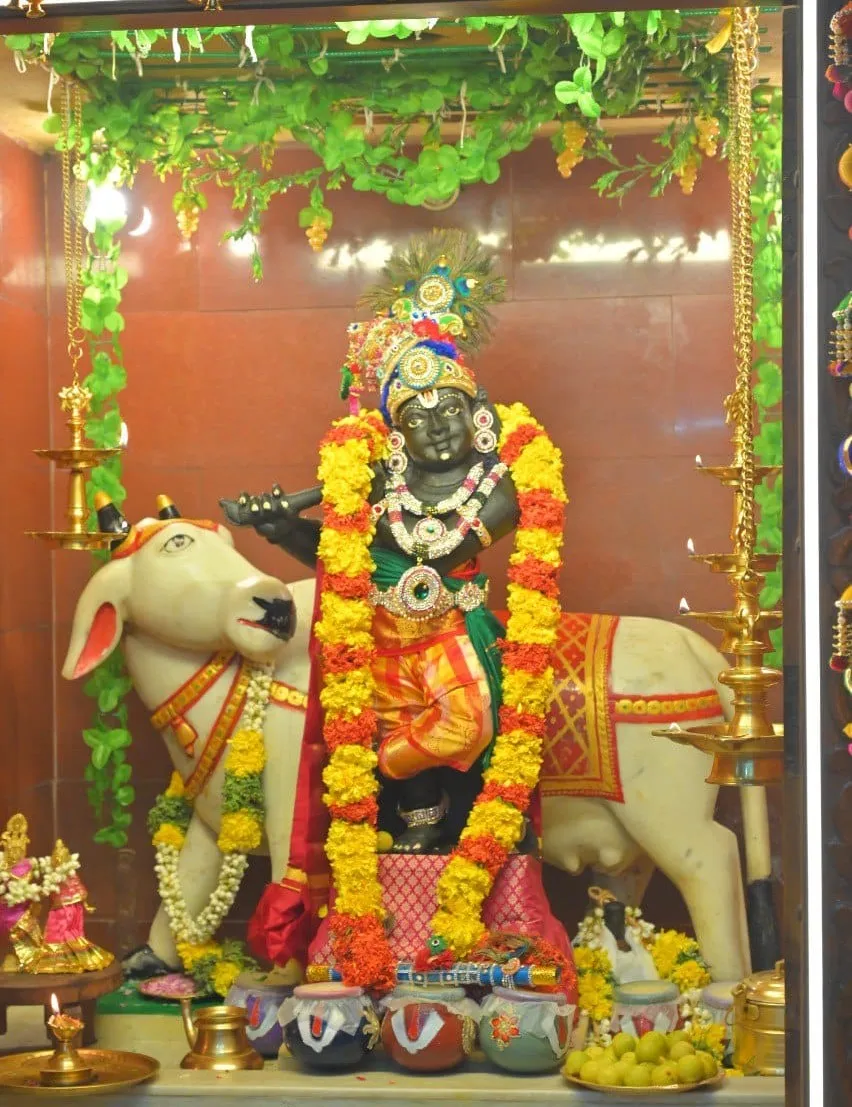 Lord Vishnu in his divine form at Etteluthuperumal Temple - the same deity who descended as Narasimha to protect devotees
Traditional depictions of Lord Narasimha show:
- Lion face with an open roaring mouth - representing divine anger against injustice
- Human body - representing accessibility and connection to devotees
- Multiple arms - holding Sudarshana Chakra (divine disc), conch, and other weapons
- Eyes blazing with fire - seeing through all deception
- Lakshmi Devi seated beside him - showing that fierce protection and divine grace go together
His form is intentionally beyond conventional categories - neither fully man nor fully animal. This was not random. It was specifically to fulfill the clause of Hiranyakashipu's boon while still destroying him.
The Four Avatars Before Narasimha
Understanding the sequence helps understand why Narasimha is so significant:
- Matsya (Fish) - Saved Vedic knowledge from cosmic flood
- Kurma (Tortoise) - Supported Mount Mandara during churning of cosmic ocean
- Varaha (Boar) - Saved Earth from Hiranyaksha (Hiranyakashipu's brother)
- Narasimha (Man-Lion) - Destroyed Hiranyakashipu and protected Prahlad
By the time Narasimha appeared, the divine was responding to a very personal situation - a father trying to murder his son for devotion to God. The fierce form was the appropriate response to extreme injustice.
What Narasimha Represents Spiritually
For devotees today, Lord Narasimha represents:
Divine Protection: He appeared from a pillar. He can appear from anywhere. No matter how trapped, isolated, or helpless a devotee feels - divine protection has no geographical or structural limitation.
Victory Over Impossible Odds: Hiranyakashipu was impossible to kill - by all conventional logic. Narasimha found the impossible solution. When every human approach has failed, divine intelligence works beyond logic.
Fearlessness: Prahlad was completely unafraid despite constant threats. This fearlessness came from faith. Narasimha worship is especially recommended for people living in fear.
Justice Against Arrogance: Hiranyakashipu declared himself god, demanded worship, persecuted the innocent. Narasimha's arrival was the cosmic correction. Genuine arrogance and injustice eventually face divine correction.
Karmic Clearance: Worshipping Narasimha on his Jayanti is traditionally believed to rapidly accelerate karmic clearing - removing accumulated negative karma that allows enemies and problems to persist.
<span id="prahlad-story">📖 The Complete Story: Prahlad, Hiranyakashipu & Divine Justice</span>
This is the story celebrated on every Narsimha Jayanti. Read it fully to understand why this festival is so powerful for people facing enemies, injustice, and impossible situations.
The Brothers Who Challenged Heaven
Long before the events of Narsimha Jayanti, there were two powerful demon brothers: Hiranyakashipu and Hiranyaksha. Both were sons of the sage Kashyap and his wife Diti.
The brothers performed intense austerities (tapasya) and pleased Lord Brahma, the creator. Brahma granted them extraordinary boons making them nearly invincible. Hiranyaksha used his power to steal and sink the Earth into the cosmic ocean. Lord Vishnu descended as Varaha (the Boar avatar) and defeated Hiranyaksha.
When Hiranyakashipu learned his brother was killed by Vishnu, his grief turned to rage. He vowed to destroy Vishnu himself.
The Impossible Boon
To gain enough power to destroy Vishnu, Hiranyakashipu performed the most extreme austerities. He stood on one toe for thousands of years. He exposed himself to fire, floods, and wind. He did not eat, drink, or rest.
Brahma was moved by this impossible discipline. He appeared and offered Hiranyakashipu a boon.
Hiranyakashipu asked to be protected from death - but he was clever about it. He asked to not be killed:
- By any human OR any animal
- During the day OR during the night
- Inside OR outside
- On the earth OR in the sky
- By any weapon
This seemed like complete invincibility. No creature, no timing, no location, no weapon could harm him.
With this boon, Hiranyakashipu conquered all three worlds. He drove the gods from heaven. He forced everyone to worship only him. He declared himself the supreme god and forbade worship of Vishnu.
The Son Who Would Not Comply
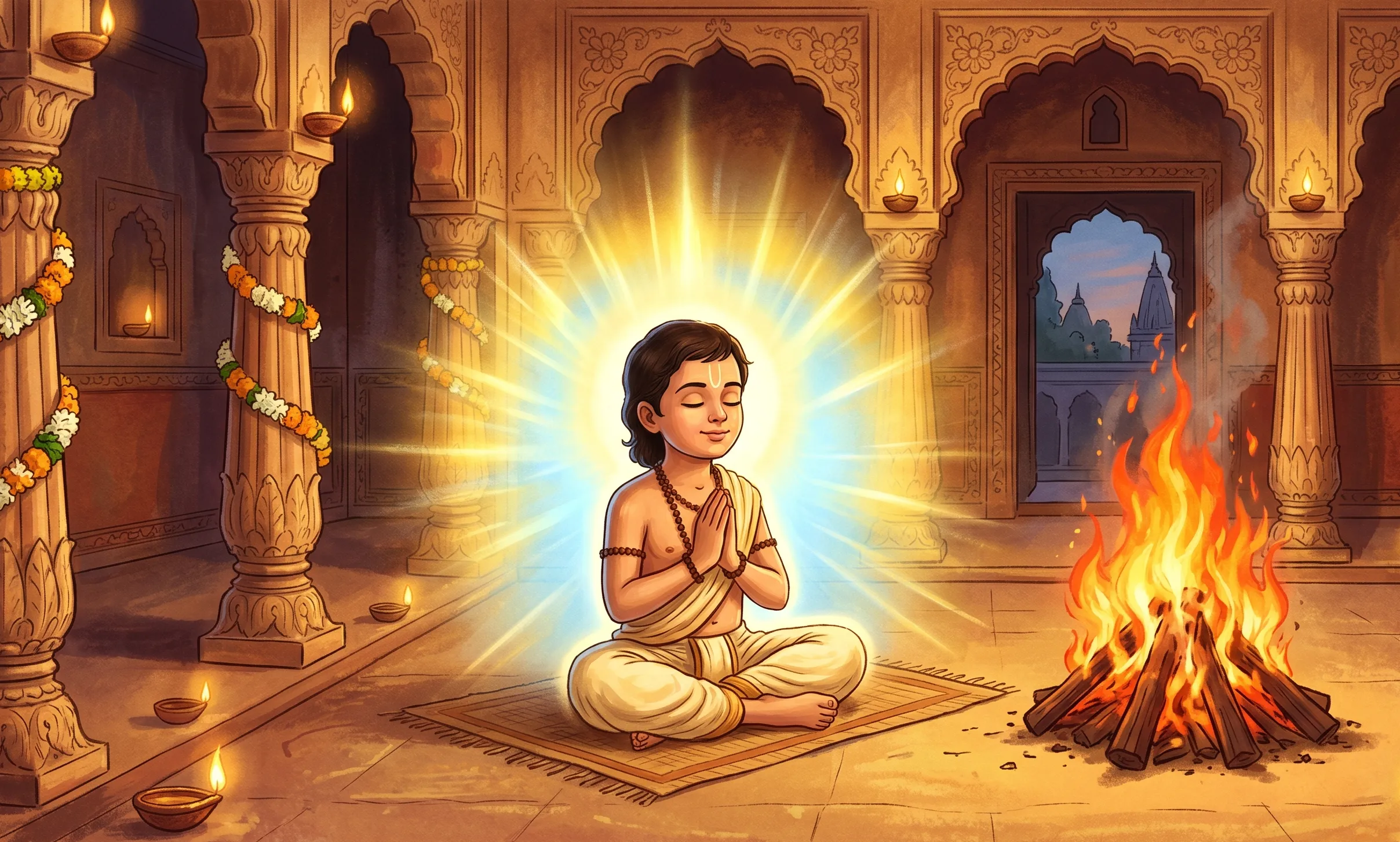 Prahlad, the devoted child who remained fearless in the face of his father's wrath
During this period, Prahlad was born to Hiranyakashipu and his wife Kayadhu.
Before Prahlad was born, while Kayadhu was carrying him, she stayed in the ashram of sage Narada for protection during her husband's long absence for tapasya. Narada's ashram was filled with constant stories and praise of Lord Vishnu. The unborn Prahlad absorbed all of this.
When Prahlad was born and grew into a young boy, his nature was entirely different from his father's. He was calm, compassionate, fearless, and completely devoted to Lord Vishnu.
His father noticed. He called Prahlad and asked: "Who is your teacher? Who has taught you this nonsense of worshipping Vishnu?"
Prahlad replied simply: "No one taught me, Father. Vishnu is everywhere. He is in all beings. He is in you and in me."
Hiranyakashipu was furious. He sent Prahlad to be taught by the family's preceptors - the two demons Shanda and Amarka - with strict instructions to teach Prahlad to worship the king instead of Vishnu.
The teachers tried. But Prahlad could not be changed. When he returned, Hiranyakashipu tested him again. Prahlad gave the same answer - Lord Vishnu is supreme, devotion to him is the only truth.
Book puja on this powerful day: 🙏 Narsimha Jayanti Special Raksha Kavach Puja & Shatru Sanhar Yagya
DevPunya Guarantee: Not satisfied? Free reschedule or full refund - no conditions. WhatsApp: +91 9667101992
The Seven Attempts to Kill His Own Son
What followed was one of the most dramatic sequences in all of Hindu mythology - a father trying every means to kill his own son.
Attempt 1: Throwing from a cliff Hiranyakashipu commanded his soldiers to throw Prahlad from a mountain. As Prahlad fell, he continued chanting Vishnu's name calmly. He landed safely, completely unharmed.
Attempt 2: Poisoning Poison was mixed in Prahlad's food. He consumed it while chanting Vishnu's name. It had no effect on him.
Attempt 3: Wild elephants Hiranyakashipu commanded his war elephants to trample Prahlad. The elephants refused to harm him - they sensed divine presence and turned away.
Attempt 4: Serpents Poisonous snakes were released around Prahlad. They coiled around him but did not bite. They too sensed what the elephants had sensed.
Attempt 5: Dark magic Skilled sorcerers performed powerful dark rituals meant to destroy Prahlad spiritually and physically. None had any effect. His devotion was an impenetrable shield.
Attempt 6: Holika's fire This is where the famous Holika Dahan story comes from. Hiranyakashipu had a sister named Holika who had a special boon - she could not be burned by fire. Hiranyakashipu commanded Holika to sit in a raging fire with Prahlad in her lap.
Holika sat in the fire. Prahlad continued to chant. The fire raged. When it died down, Holika had been burned to ash. Prahlad walked out completely unharmed.
(This event is now celebrated annually as Holika Dahan, the night before Holi.)
Attempt 7: The Pillar and Narasimha
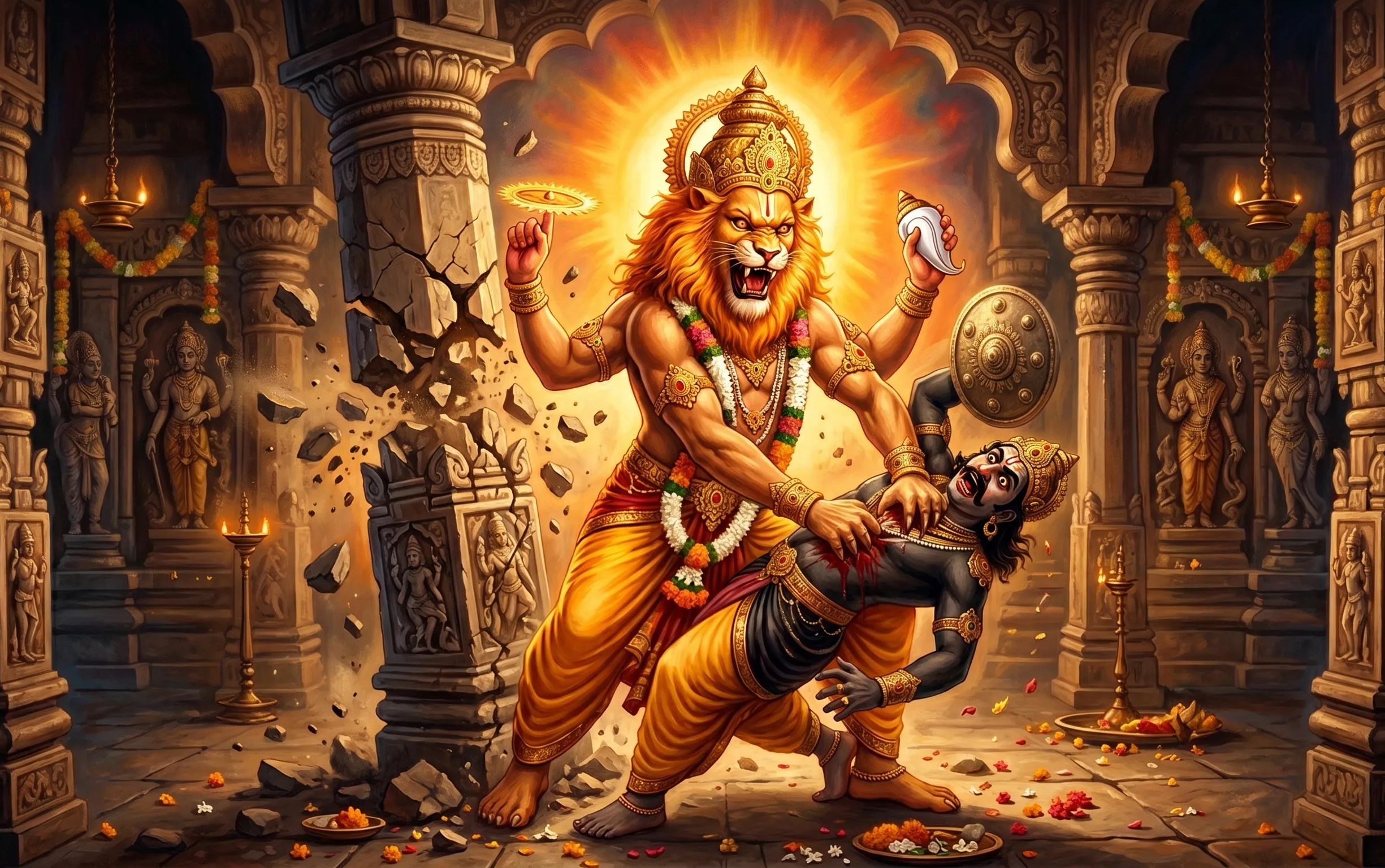 The moment Lord Narasimha emerged from the broken pillar - the most dramatic divine intervention in Hindu mythology
After every attempt failed, Hiranyakashipu was at the edge of his patience. He grabbed Prahlad and in a rage, screamed:
"Where is this Vishnu you keep worshipping? Show me! Is he in this pillar?"
Prahlad answered calmly: "He is everywhere, Father. Yes, he is in that pillar too."
Hiranyakashipu laughed in contempt and struck the pillar with his mace.
The pillar cracked. A sound like the end of the world emerged. And from within the pillar appeared Lord Narasimha - half man, half lion, blazing with divine fire, eyes like the sun, with a roar that shook all three worlds.
Hiranyakashipu faced him. He had his boon - he could not be killed. He was not afraid.
But Lord Narasimha had the answer to every clause:
- Neither man nor animal: Narasimha was both and neither - a form that existed in no category
- Neither day nor night: He appeared at twilight (Sandhyakaal) - the exact threshold between day and night
- Neither inside nor outside: He carried Hiranyakashipu to the threshold (doorstep) - neither inside the palace nor outside it
- Neither on earth nor in sky: He placed Hiranyakashipu across his own lap - not on the ground, not in the air
- No weapon: He used only his own nails - which were part of his body, not classified as weapons
Every single clause of the boon was honored. And Hiranyakashipu was destroyed.
Prahlad was safe. Righteousness was restored. The world was free.
After the Battle - The Calming of Narasimha
The story does not end there. After destroying Hiranyakashipu, Lord Narasimha's rage did not immediately subside. He sat on the throne, still fierce, still blazing.
The gods were afraid to approach him. Even Brahma and Shiva hesitated.
Only Prahlad stepped forward. The child who had never feared anything walked up to the terrifying form of Narasimha and offered prayers. The Lord's rage subsided in the presence of his devotee's pure love.
Lakshmi Devi then appeared and took her place beside Narasimha, and the fierce destroyer became once again the loving protector.
This detail matters: Even divine rage needs the softening touch of devotion. The day of Narasimha's appearance is a day of fierce protection, but underneath it is the story of love between devotee and God.
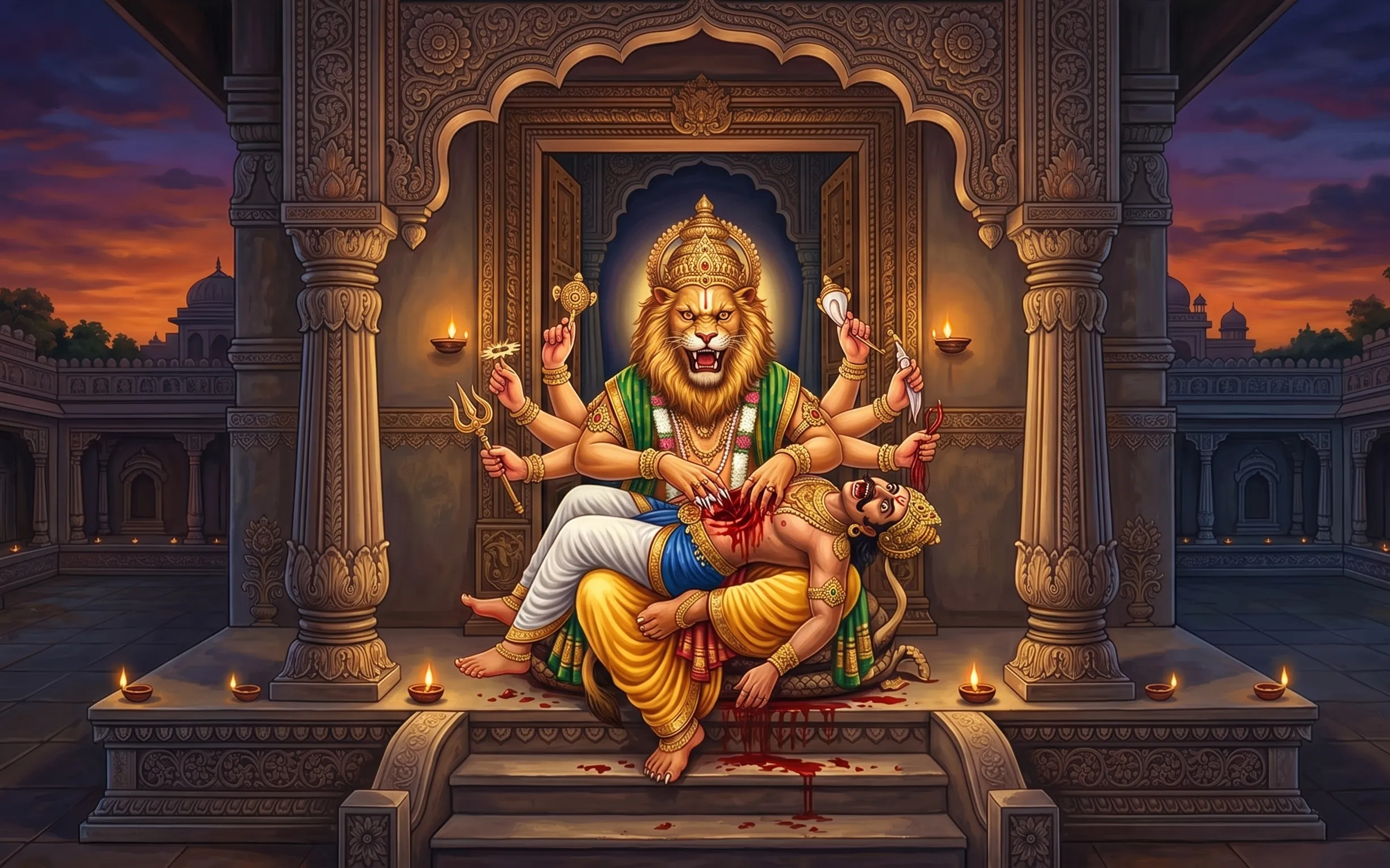 The moment of cosmic justice - Lord Narasimha at the palace threshold at twilight
<span id="why-powerful">🔥 Why is Narsimha Jayanti Especially Powerful?</span>
The Day Itself Carries the Energy
Narsimha Jayanti is not just a historical commemoration - it is the anniversary of a specific cosmic event that left an energetic imprint on time itself.
Just as anniversaries of significant events in human life carry emotional weight, in Vedic understanding, the annual recurrence of the cosmic alignment present when Narasimha appeared creates a window of amplified divine accessibility.
Every puja, mantra, and prayer on this day connects to that original event. The cosmic record of that moment - when divine will overrode every human and demoniac plan - becomes accessible.
Why Karmic Clearance Is Faster on This Day
Ancient texts describe Narsimha Jayanti as one of the most powerful days for karmic cleansing. Here's the traditional understanding:
Most problems in life - persistent enemies, repeated failures, unexplained obstacles - have karmic roots. They are not just external circumstances; they are the fruits of past actions (from this life or previous ones).
Normal spiritual practice cleanses karma gradually. But performing intense puja and homam on Narasimha Jayanti is believed to accelerate this clearance dramatically - the same way sunlight accelerates evaporation compared to room temperature.
The Bhagavata Purana states that observing this day with genuine devotion removes accumulated negative karma and protects from future accumulation.
Multiplied Spiritual Potency
From the DevPunya puja page: "Performing this powerful Homam on this day multiplies its spiritual potency, ensuring swift blessings and karmic clearance."
This is the core reason serious puja practitioners specifically time ceremonies for this day. A puja or homam that would normally take months to show results can show results much faster when performed on Narasimha Jayanti.
It Is Specifically for Those Facing Opposition
Unlike many festivals that celebrate prosperity or festivals of seasons - Narsimha Jayanti is specifically about protection under attack.
Prahlad's situation mirrors many real situations people face:
- A child facing persecution for righteous beliefs
- Someone facing an enemy far more powerful than themselves
- A person surrounded by forces trying to destroy them through various means
- Someone whose truth is not being recognized by the world
The day carries the specific energy of: your enemy is powerful, your situation is impossible, but divine justice is coming.
<span id="about-temple">🛕 About Etteluthuperumal Temple, Tirunelveli</span>
The Temple and Its Significance
Etteluthuperumal Temple is located in Tirunelveli, Tamil Nadu - one of the oldest temple cities in South India. The name itself carries meaning: "Ettu Ezhuthu Perumal" refers to the eight-syllable divine name of Lord Narayana (Vishnu) - "Om Namo Narayanaya" - making this a temple consecrated to the deity of the sacred eight-syllable mantra.
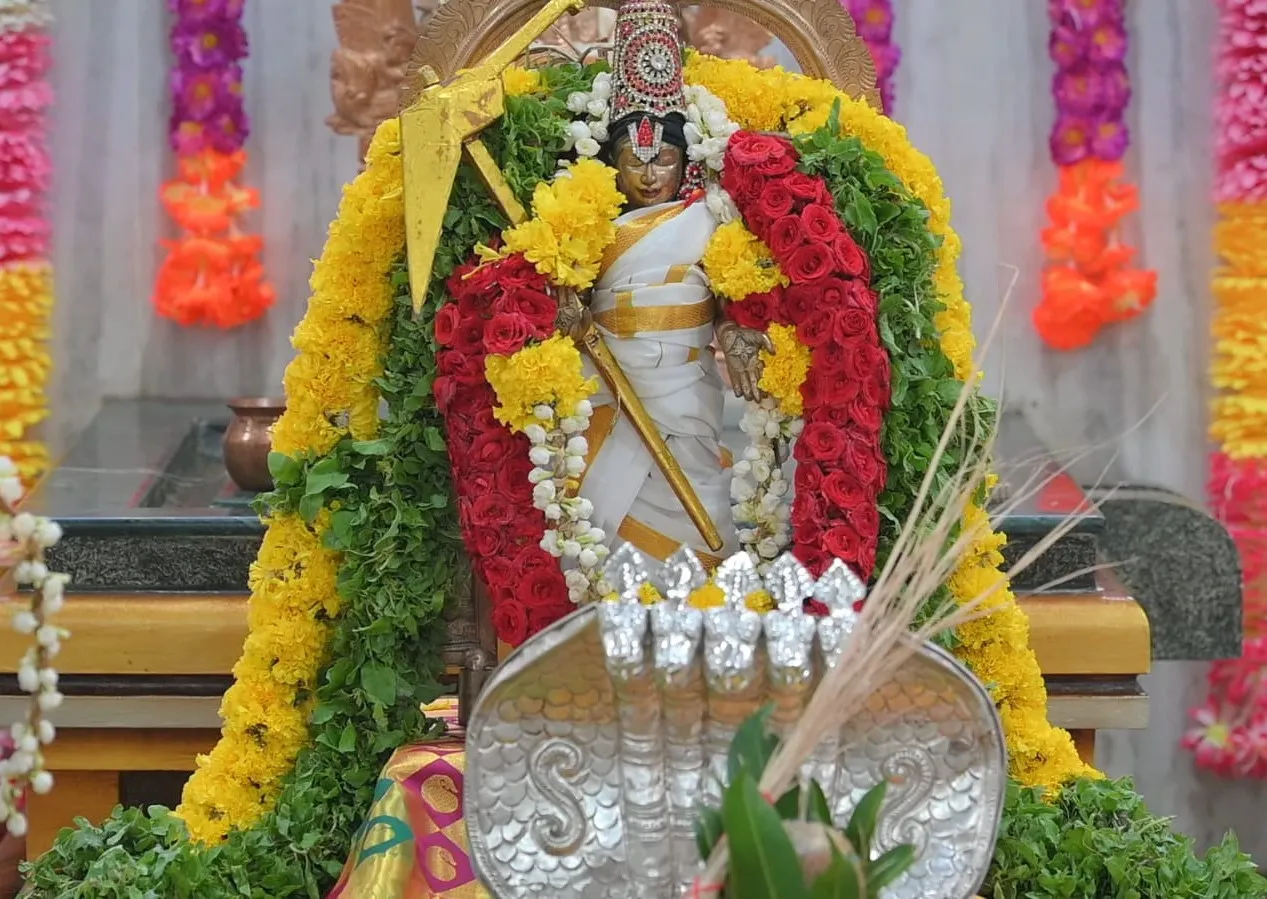 The sacred deity at Etteluthuperumal Temple - this ancient power spot is where the Shatru Samhara Homam is conducted
This temple is described as "one of the ancient power spots in Tamil Nadu, associated with Lord Vishnu and Murugan." It serves both Vaishnava and Shaiva devotional traditions - a rare combination that amplifies its spiritual accessibility.
What Makes This Temple a Power Spot
Ancient Tamil Nadu temples are not just buildings - they are consecrated energy centers where generations of prayer, ritual, and devotion have accumulated. The older a temple and the more continuously it has been worshipped, the more powerful its accumulated spiritual field becomes.
Etteluthuperumal Temple carries:
- Ancient association with Lord Vishnu (the protector aspect)
- Connection to Lord Murugan (the warrior deity - particularly significant for Shatru Samhara)
- Continuous active worship by trained temple priests
- Tirunelveli's broader sacred geography on the banks of the Thamirabarani River
The combination of Vishnu's protection energy and Murugan's warrior energy makes this temple uniquely suited for the specific purpose of Shatru Samhara Homam.
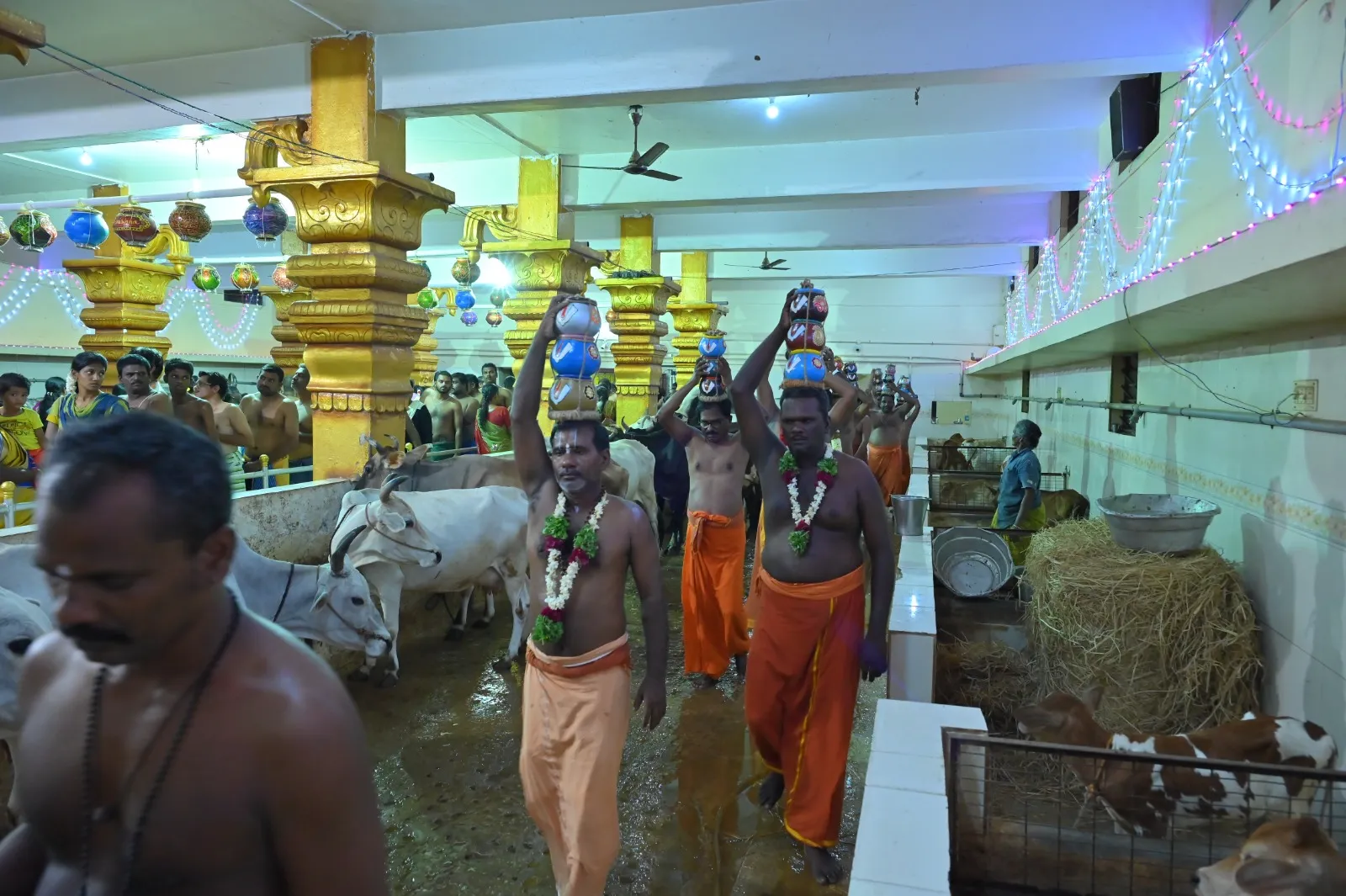 The temple interior during a ceremony - priests and devotees in the sacred space where pujas and homams are conducted
Tirunelveli - City of Sacred Temples
Tirunelveli is one of Tamil Nadu's most significant spiritual centers. The city and surrounding area contain some of the most important temples in South India, including the famous Nellaiappar Temple - one of the five Ambalam temples where Lord Shiva is said to have performed his cosmic dance.
This concentration of sacred energy in the Tirunelveli region amplifies every ritual performed here.
Why Perform Puja Here Rather Than a Local Temple?
A valid question. The answer has layers:
1. Specialized Power: Different temples have different accumulated energies and different divine presences. A temple where Shatru Samhara Homam has been performed for generations develops a specific accumulated power for that purpose.
2. Qualified Priests: The temple priests at Etteluthuperumal Temple have specific training in the procedures for Shatru Samhara Homam and Narasimha Kavach recitation. Not all priests know these procedures correctly.
3. Narsimha Jayanti Amplification: Performing the puja at this specific temple on Narasimha Jayanti - when the temple's energy is at its annual peak - creates a confluence of timing and location that maximizes effectiveness.
4. Ancient Consecration: A temple that has been consecrated and continuously worshipped for centuries carries different energy than one consecrated recently.
🙏 Book Narsimha Jayanti Special Puja at This Temple
DevPunya Guarantee: Your name and gotra will be clearly declared in the puja video. Not satisfied? Free reschedule or full refund, no questions asked. WhatsApp: +91 9667101992
Explore all DevPunya puja services: 🙏 devpunya.com/online-puja
<span id="shatru-samhara-homam">🔥 What is Shatru Samhara Homam (Shatru Sanhar Yagya)?</span>
The Name Explained
Shatru Samhara = Enemy Destruction Homam/Yagya = Sacred Fire Ceremony
Shatru Samhara Homam is a powerful Vedic fire ritual specifically designed for protection from enemies, defeat of adversaries, and removal of negative forces that are actively working against you.
The full name of DevPunya's offering is: Narsimha Jayanti Special Raksha Kavach Puja & Shatru Sanhar Yagya - combining two distinct powerful rituals into one comprehensive ceremony.
What Happens in a Shatru Samhara Homam?
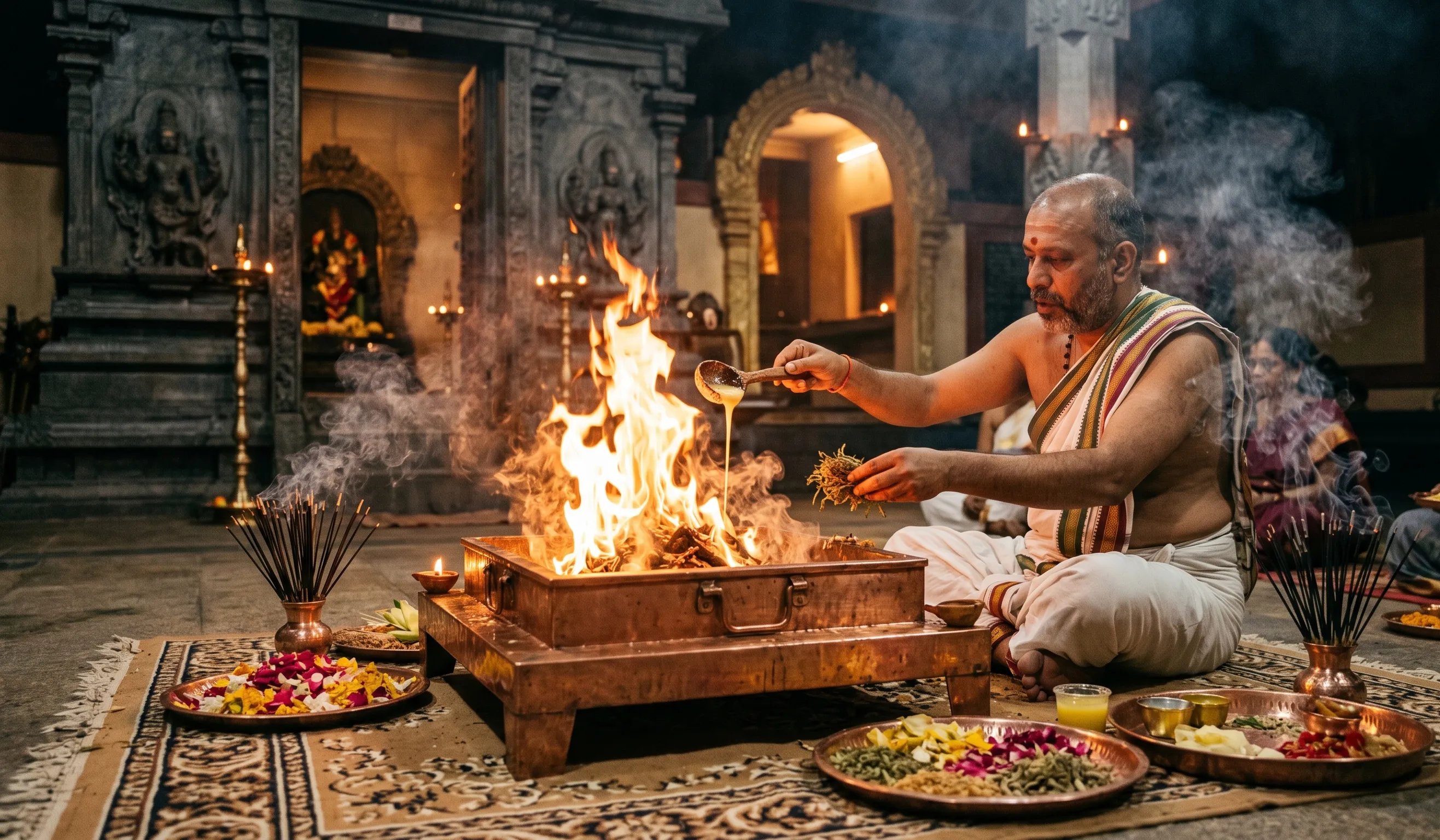 Sacred fire havan being performed - the fire carries prayers directly to the divine and burns away negative forces
1. Preparation of Sacred Space (Mandala): The priest prepares the ritual space with specific geometric patterns, copper vessels, and sacred items according to Vedic specifications. This creates a consecrated container for the intense energy that will be invoked.
2. Fire Establishment (Agni Sthapana): The sacred fire (Agni) is lit and invoked. In Hindu tradition, Agni is the divine messenger - it carries offerings directly to the intended deity. The type of fire established in this homam is specifically for Narasimha invocation.
3. Narasimha Invocation: Lord Narasimha is specifically invoked - not Vishnu in general, but his fierce Ugra Narasimha form. The mantras used are from the Narasimha Tapani Upanishad and specific Agama texts for this purpose.
4. Your Sankalp: Your name and gotra are declared before the sacred fire and in the presence of Lord Narasimha — establishing the ritual as specifically performed for you.
5. Specific Offerings (Aahutis): Multiple rounds of offerings into the fire while chanting specific mantras. Each offering invokes a specific protection or removes a specific form of negative energy.
6. Completion (Poornahuti): The final major offering that completes and seals the ceremony. This is when the accumulated energy of the entire ritual is directed toward your specific situation.
What Specifically Does Shatru Samhara Homam Address?
Traditional understanding of what this homam targets:
External Enemies: People actively working against you - through legal means, social means, financial means, or direct physical/psychological harm.
Invisible Attacks: Negative energy sent through black magic, evil eye (nazar), or intentional harm wishes from jealous or malicious people.
Planetary Malefic Influences: Specific planetary configurations can create windows of vulnerability to enemy attacks and life setbacks.
Accumulated Negative Karma: Past karma that manifests as persistent enemies and recurring opposition in the current life.
Spiritual Obstacles: Forces that block spiritual growth and create confusion, fear, and weakness in the devotee.
Why Fire (Agni) is the Right Medium
In Vedic understanding, fire transforms. It does not merely destroy - it transforms. Offerings made into fire are transformed from physical substance into divine energy and carried to the intended recipient.
When specific mantras and specific intentions are combined with fire, the result is a transformation of the negative energy field around a situation.
The Shatru Samhara Homam specifically asks Lord Narasimha - the deity who destroyed the most powerful enemy in creation - to apply his transformative power to your specific enemies and obstacles.
How Long Does It Take and What Are the Results?
The homam itself: The ceremony typically takes 1.5-2 hours for a properly conducted ritual.
Results: Traditional texts and practitioner experience suggest:
- Reduction in active enemy aggression (enemies become less focused on harming you)
- Situations that were stuck begin to move
- Clarity in thinking and decision-making returns
- A sense of fear or oppression lifts
- In legal matters, movement toward truth-based resolution
Important: Results depend on the situation's complexity, your karma, and divine timing. No ritual can override divine will or your own karmic responsibility. But sincere performance on the right day at the right temple by qualified priests creates the most favorable conditions for resolution.
<span id="raksha-kavach-puja">🛡️ What is Raksha Kavach Puja?</span>
Kavach - The Divine Armor
Kavach literally means armor - a protective covering. In spiritual tradition, Raksha Kavach Puja invokes a divine protective shield around the devotee through specific mantra recitation.
The Narasimha Raksha Kavach is one of the most powerful protective texts in the Vaishnava tradition. It comes from the Brahma Vaivarta Purana and describes Lord Narasimha's protection covering every part of the devotee's body and every aspect of their life.
Why "Raksha"? Raksha means protection. The full name - Raksha Kavach - is a double emphasis: protective armor. The repetition emphasizes that this is specifically defensive, not offensive - it is about creating an impenetrable spiritual shield.
What the Kavach Text Does
The Narasimha Kavach is structured as a systematic invocation:
- Narasimha protects your head
- Narasimha protects your eyes
- Narasimha protects your ears
- Narasimha protects your speech
- Narasimha protects your chest and heart
- Narasimha protects your arms
- Narasimha protects your legs and path
- Narasimha protects you in all directions - east, west, north, south, above, below
- Narasimha protects you during travel
- Narasimha protects you during sleep
- Narasimha protects you from enemies on earth and in the subtle realms
When this is recited by a qualified priest on your behalf at a powerful temple on Narsimha Jayanti - the protection being invoked is amplified by the accumulated energy of the day and the sacred space.
Kavach Path + Homam = Complete Protection System
DevPunya's offering combines both:
Raksha Kavach Path (recitation) → Establishes the protective armor around you Shatru Sanhar Yagya (fire ceremony) → Actively destroys the negative forces threatening you
Think of it as: defense + offense working simultaneously. The Kavach creates the shield. The Homam addresses the sources of threat.
This combination is why this specific puja is particularly comprehensive for people facing serious problems with enemies or negative forces.
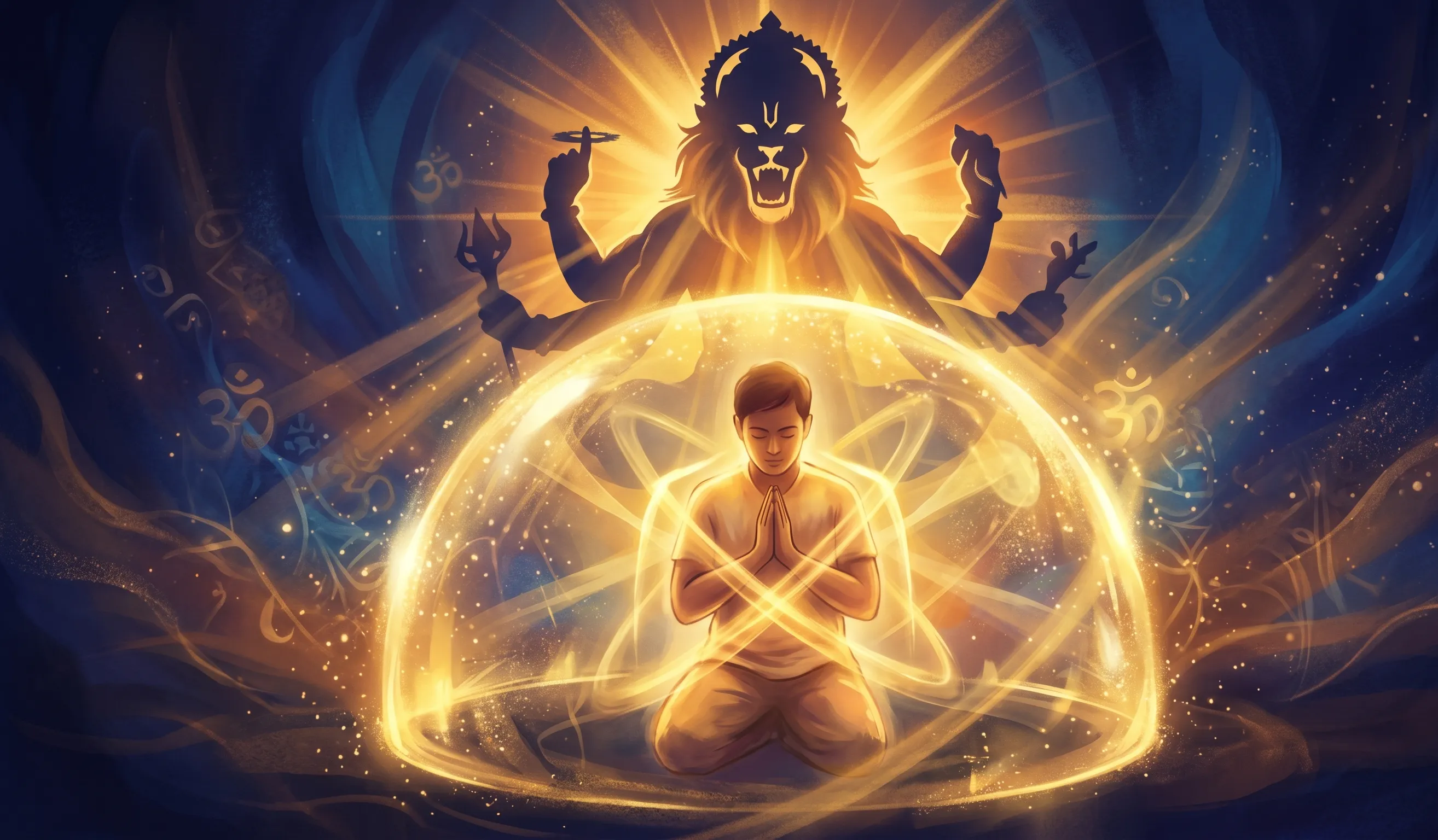 The divine protection of Lord Narasimha - an impenetrable shield around sincere devotees
🙏 Book This Combined Puja for Your Protection
Your name and gotra are declared in the video. Watch it before you pay if you prefer. WhatsApp: +91 9667101992 | DevPunya Guarantee: Free reschedule or full refund, no questions asked.
<span id="who-should-perform">🙏 Who Should Perform This Puja?</span>
From the Temple's Own Description
The temple and DevPunya specifically mention this puja is for:
"Anyone facing legal issues, enemy troubles, life setbacks, or seeking strength, clarity, and family welfare should perform this Homam to receive divine support from Lord Narsimha."
Let's break down each category:
People Facing Legal Issues
Situations this applies to:
- False criminal cases filed against you
- Property disputes where truth is on your side but the legal process is slow
- Cases where the opponent is well-connected or has more resources
- Situations where evidence is being suppressed or manipulated
- Divorce/custody cases where the other party is using unfair means
- Business disputes, contract violations, fraud cases
Why Narasimha specifically for legal issues:
Narasimha is called Dharma-Rakshaka - Protector of Righteousness. He appeared specifically to restore justice when all conventional means had failed. He is invoked when you are on the right side but the system isn't working.
He does not guarantee outcomes - but he is the deity specifically associated with truth eventually being recognized and righteousness being restored.
People Facing Enemy Troubles
Situations this applies to:
- Business rivals using unfair or unethical means
- Jealous family members working against your interests
- Workplace politics, sabotage, or character assassination
- Dangerous individuals threatening physical or reputational harm
- People who have done black magic or evil eye on you or your family
Why Narasimha for enemies:
He is the most direct deity for enemy-related issues in the Vaishnava tradition. His Ugra (fierce) form specifically neutralizes enemy energy. The Shatru Samhara Homam invokes exactly this aspect.
People Facing Life Setbacks
Situations this applies to:
- Career stagnation despite genuine effort and qualification
- Business repeatedly failing for unexplained reasons
- Financial drains that continue despite good income
- Health issues that aren't responding to treatment
- Family problems that have continued for a long time
- A general sense that something is blocking your progress
Why Narasimha for life setbacks:
Many persistent setbacks have karmic roots or are being worsened by negative energy from others (intentional or unintentional). Narasimha Jayanti puja is specifically described as creating karmic clearance - removing the accumulated residue that allows obstacles to persist.
People Seeking Strength, Clarity, and Family Welfare
Situations this applies to:
- Feeling afraid, uncertain, or overwhelmed by circumstances
- Making an important decision and needing mental clarity
- Starting a new venture, job, or life phase and wanting divine blessing
- Children facing important exams or career transitions
- Family going through a difficult collective period
- Wanting to establish ongoing divine protection for the household
Why Narasimha for strength and clarity:
Prahlad's most remarkable quality was not that he won - it was that he remained completely calm and fearless throughout. That fearlessness came from genuine faith in divine protection. Invoking Narasimha on his Jayanti specifically cultivates this quality of fearless clarity.
Who This Puja is NOT For
Being honest is important:
This puja is not a tool for harming others, reversing the consequences of your own wrongdoing, or gaining power over innocent people. The deity invoked - Lord Narasimha - specifically protects the righteous and punishes injustice. Using his energy against the innocent would be spiritually counterproductive.
If you are genuinely on the side of truth and righteousness in your situation - regardless of how impossible it seems - this puja is for you.
<span id="problems-solved">💪 What Problems Can This Puja Help With?</span>
Q: Does this puja help with court cases?
A: Yes. This is one of the most commonly cited reasons people perform Shatru Samhara Homam on Narasimha Jayanti. The deity is specifically associated with truth being recognized and justice being delivered against seemingly impossible odds. Prahlad's situation - where every conventional approach had failed and only divine intervention worked - maps directly onto many court case situations.
This does not guarantee a court verdict. It creates favorable conditions - enemies become less effective in their attacks, truth has better conditions to emerge, and your own clarity and courage to pursue the case is strengthened.
Q: Will this help if someone has done black magic on me?
A: This is one of the specific areas the homam addresses. The combination of Kavach path (protective shield) and Shatru Samhara Homam (destroying the enemy's ability to harm) directly addresses black magic attacks. When performed at a qualified temple with proper procedures, it is believed to:
- Break the connection of the negative energy sent to you
- Return the negative energy to its source
- Establish a protective shield preventing future attacks
Q: My business keeps failing - will this help?
A: If the business failure is due to enemy actions, black magic, evil eye, or accumulated negative karma - yes, this puja addresses those root causes. If the failure is purely due to business model problems or personal choices that need to be corrected, the puja creates spiritual clarity and removes obstacles but cannot replace sound business judgment.
Many people find that after performing this puja, their thinking becomes clearer and opportunities that were blocked begin to open.
Q: Can this puja help with fear and mental disturbance?
A: Yes - this is an underappreciated benefit. Many people experience chronic fear, anxiety, or mental disturbance because of ongoing threats, negative energy in their environment, or spiritual attacks. The Raksha Kavach specifically invokes protection at every level - including mental and emotional.
After this puja, many people report a significant reduction in fear and a return of clarity and confidence.
Q: Is this effective for family problems?
A: If the family problems are being caused or worsened by enemy action, black magic, negative energy, or external interference - yes. If they are purely relational/communication problems, the puja helps with clarity and removal of negative influences but cannot replace direct communication and relationship work.
Q: I am not facing specific enemies - can I still do this puja?
A: Yes. This puja also invokes general divine protection, courage, success in career, and family welfare. You don't need to be in active conflict to benefit. Proactively establishing Narasimha's protection before problems arise is a traditional approach.
Q: How quickly do results appear?
A: There is no universal timeline. Some people report seeing changes within days. Others see gradual shift over weeks or months. The Narsimha Jayanti day amplifies the speed of results compared to performing the same puja on a regular day.
Your sincerity and the accumulated karma involved all affect timing. What the puja does is create the most favorable conditions - the actual timing of results is divine will.
Book puja on this powerful day: 🙏 Narsimha Jayanti Special Raksha Kavach Puja & Shatru Sanhar Yagya
DevPunya Guarantee: Not satisfied? Free reschedule or full refund - no conditions. WhatsApp: +91 9667101992
<span id="observe-at-home">🏡 How to Observe Narsimha Jayanti at Home</span>
Even if you are booking a temple puja, these home practices on the same day amplify your connection to the ritual and the deity.
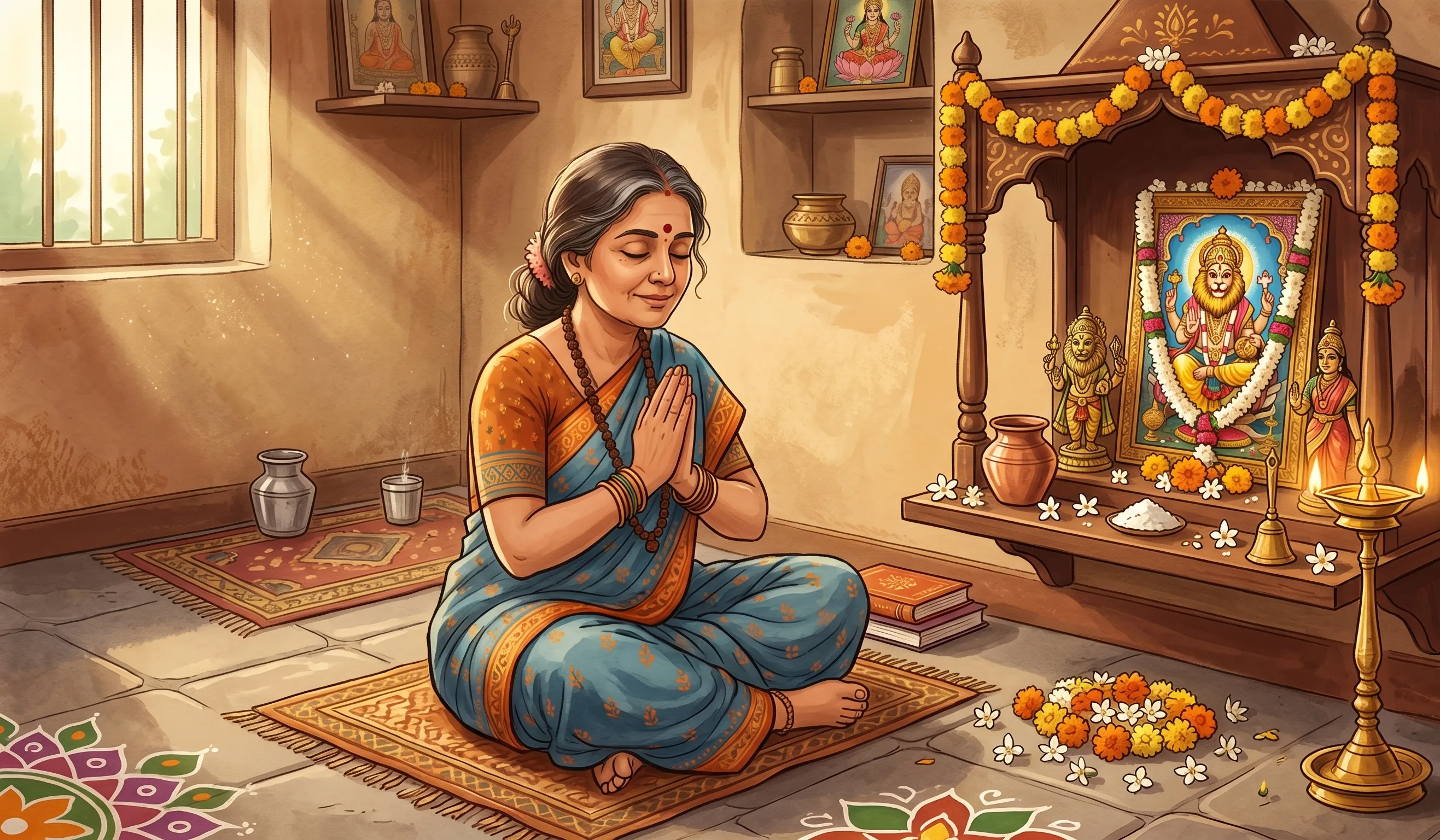 Simple home worship on Narsimha Jayanti - a personal connection that amplifies the temple puja
Morning Practices
1. Wake up before sunrise Bath before sunrise is considered especially purifying on this day. Offer water to the sun (Surya Arghya) while facing east.
2. Set up your altar Place an image or idol of Lord Narasimha (or Lord Vishnu) at your altar. Decorate with fresh flowers - yellow and orange are associated with Narasimha. Light a ghee lamp and incense.
3. Read or listen to Prahlad's story This is the most important practice of the day. Read the story in full (we've provided it above) or listen to it in audio/video format. Understanding what the day celebrates connects you to its energy.
4. Chant mantras (covered below) Begin with 108 repetitions of the Narasimha Beej Mantra on an empty stomach. This is traditionally the most potent practice for this day.
The Fast
Fasting on Narsimha Jayanti is traditional but not mandatory. Options:
Strict fast: No food or water from sunrise to after sunset worship Partial fast (Phalahaar): Only fruits, milk, and water throughout the day Sattvic fast: No grains, no non-vegetarian food, no onion/garlic. Simple vegetarian meals.
Breaking the fast: After evening worship, ideally after 9:12 PM when Chaturdashi tithi ends, or the next morning after Parana time (6:11 AM on May 1).
If fasting is difficult due to health reasons or medication - don't force a full fast. The intention and devotion matter more than strict physical discipline.
Evening Practices (Most Important)
Evening is when Lord Narasimha appeared - Pradosh Kaal (twilight) is the peak energy moment.
Around sunset (approximately 6:30-7:30 PM depending on location):
- Light ghee diya before the deity
- Offer fresh flowers, especially yellow/orange
- Chant the Narasimha Chalisa or Narasimha Kavacha
- Read the Narasimha Ashtakam (eight verses in praise)
- Offer fruits and simple sweets as prasad
- Conclude with aarti
Mantra Count for This Day
- Morning: 108 repetitions of Narasimha Mantra
- Evening: 108-1008 repetitions depending on your capacity and intent
- Throughout day: Keep chanting mentally while doing other activities
What to Avoid on This Day
- Non-vegetarian food
- Alcohol
- Arguments and negative speech
- Sleep during the day (breaks the energy of the fast)
- Entertainment that is not devotional in nature
<span id="mantras">🕉️ Narsimha Mantras - Complete Guide</span>
1. Narasimha Mool Mantra (Most Powerful)
Sanskrit:
उग्रं वीरं महाविष्णुं ज्वलन्तं सर्वतोमुखम्।
नृसिंहं भीषणं भद्रं मृत्युमृत्युं नमाम्यहम्॥
Transliteration:
Ugram Viram Maha Vishnum Jvalantam Sarvatho Mukham
Nrisimham Bhishanam Bhadram Mrityur Mrityum Namamy Aham
Meaning: "I bow to Lord Narasimha - the fierce, the brave, the great Vishnu, blazing in all directions, frightening in form, auspicious in nature, the death of death itself."
Significance: The phrase "Mrityur Mrityum" (death of death) is remarkable - it means Narasimha conquered even the concept of death. Enemies, illness, negative forces - all are forms of destruction. This mantra invokes the one who destroys destruction itself.
How to chant: 108 times daily on this day. Use a rudraksha mala to count. Sit facing east. Chant with clear pronunciation.
2. Simple Narasimha Mantra (For Beginners)
Sanskrit:
ॐ नमो नारसिंहाय
Transliteration: Om Namo Narasimhaya
Meaning: "Om, I bow to Lord Narasimha"
For: Those new to Narasimha worship or those who find the longer mantra difficult. Completely valid and powerful.
Count: 108 times minimum. 1008 for more intensive practice.
3. Narasimha Gayatri Mantra
Sanskrit:
ॐ वज्रनखाय विद्महे तीक्ष्णदंष्ट्राय धीमहि।
तन्नो नृसिंहः प्रचोदयात्॥
Transliteration:
Om Vajranakhaya Vidmahe Tikshadamshtraya Dhimahi
Tanno Nrisimhah Prachodayat
Meaning: "We know the one with diamond nails. We meditate on the one with sharp fangs. May that Narasimha inspire us and direct us."
For: Spiritual upliftment, intelligence, and clarity. Particularly good for students and people making important decisions.
4. Narasimha Kavach Mantra (For Protection)
Sanskrit:
ॐ नमो भगवते नरसिंहाय।
नमस्तेजस्तेजसे आविराविर्भव।
वज्रनख वज्रदंष्ट्र सर्वान् दारयाम्।
नरसिंह उग्र उग्र उग्र उग्र।
॥ ॐ नमो भगवते नरसिंहाय ॥
Transliteration:
Om Namo Bhagavate Narasimhaya
Namaste Tejas-Tejase Avir Avirbhava
Vajranakha Vajradamshtra Sarvan Darayama
Narasimha Ugra Ugra Ugra Ugra
Om Namo Bhagavate Narasimhaya
Meaning: "Om, salutations to Lord Narasimha. O blazing brilliance, appear! O diamond-nailed, diamond-fanged one, pierce through all. Narasimha, fierce, fierce, fierce, fierce! Om, salutations to Lord Narasimha!"
For: Direct protection invocation. Chant when feeling under threat or attack.
5. Prahlad's Mantra (Faith Under Pressure)
Sanskrit:
ॐ नमो नारायणाय
Transliteration: Om Namo Narayanaya
Significance: This is the eight-syllable mantra that Prahlad chanted throughout all his trials. When you use this mantra, you are literally using the same prayer that Prahlad used - the one that summoned Narasimha from the pillar.
For: All-purpose Vishnu devotion, fearlessness, general protection.
Correct Way to Chant Mantras
Preparation:
- Bath first or at minimum wash hands and face
- Sit in a clean, quiet space
- Face east (or north)
- Use rudraksha mala for counting if available
Technique:
- Chant clearly but not loudly - audible to yourself
- Focus on the meaning with each repetition
- Do not rush - quality over speed
- Complete the full count without interruption if possible
What to visualize: Visualize Lord Narasimha's fierce form and simultaneously feel his protective energy surrounding you. Hold in mind the specific protection or problem you are bringing to him.
After chanting: Sit silently for a few minutes. Offer your specific prayer simply and directly in your own words. Express gratitude regardless of current circumstances.
Book puja on this powerful day: 🙏 Narsimha Jayanti Special Raksha Kavach Puja & Shatru Sanhar Yagya
DevPunya Guarantee: Not satisfied? Free reschedule or full refund - no conditions. WhatsApp: +91 9667101992
<span id="puja-process">⚙️ How Puja is Performed - Complete Process</span>
The DevPunya Service Process
Step 1: Select Puja Package Choose based on how many family members you want included:
- 1 Member (individual)
- 2 Members (couple)
- 4 Members (family)
- 6 Members (joint family)
All packages include the same quality ritual - difference is number of names declared.
Step 2: Enter Name and Gotra After confirming the booking, you enter your name(s) and gotra. These will be declared during the puja.
Unknown gotra? We use Kashyap gotra - widely accepted when gotra is not known.
Step 3: Confirm Puja Booking Complete payment to confirm. Pay-after-video option available - contact WhatsApp +91 9667101992.
Step 4: Receive Puja Day Guidelines You receive contact information coordination and guidelines before the puja day.
Step 5: Get Puja Video on WhatsApp After the puja is performed at Etteluthuperumal Temple, you receive a complete video showing:
- Temple setting (actual Etteluthuperumal Temple)
- Pandit Ji conducting the Raksha Kavach Path and Shatru Sanhar Yagya
- Your name and gotra declared during the ritual
- Sacred fire (havan) being performed
- Major ritual steps visible
Step 6: Prasad Delivered at Home Puja prasad is delivered to your home within 8-10 days of the puja.
What Puja Day Looks Like
The sacred fire ritual conducted by qualified priests at the temple - exactly how this homam is performed
On the day of the puja (April 30, 2026 - Narsimha Jayanti):
Morning preparation: Priest purifies himself and the ritual space, establishes the sacred fire, invokes Lord Narasimha
Main ritual: Raksha Kavach Path recited completely, Shatru Samhara Yagya conducted with all required offerings
Your name/gotra: Declared at the beginning (sankalp declaration) and throughout where required
Completion: Sacred ash (vibhuti) and prasad prepared for dispatch
Video: Complete documentation of the ritual captured
What You Receive After Puja
Video proof: Complete puja video showing your name was declared and ritual was performed correctly
Vibhuti (Sacred Ash): From the havan fire, to be applied to forehead daily
Other prasad items: Blessed items from the ritual
Spiritual benefit: The protection and blessings invoked on your behalf through proper ritual at the correct temple on the most powerful day for this purpose
🙏 Book Narsimha Jayanti Puja - Limited Availability on April 30, 2026
Name and gotra clearly declared in video | Pay after video option available WhatsApp: +91 9667101992 DevPunya Guarantee: Free reschedule or full refund - no conditions, no questions
Explore all DevPunya pujas: 🙏 devpunya.com/online-puja Explore chadhawa offerings: 🙏 devpunya.com/chadhaava Visit DevPunya: devpunya.com
<span id="faq">❓ Frequently Asked Questions (FAQ)</span>
About Narsimha Jayanti
Q: Narsimha Jayanti 2026 कब है? (When is Narsimha Jayanti 2026?)
A: 30 April 2026, Thursday को है। Vaishakh Shukla Chaturdashi tithi को यह festival मनाया जाता है। Chaturdashi tithi April 29 की शाम 7:51 PM से शुरू होकर April 30 की रात 9:12 PM तक रहेगी। Puja का सबसे auspicious time: 11:19 AM - 1:53 PM (Madhyahna Muhurat)। Evening twilight time भी very powerful है।
Q: Why is Narsimha Jayanti celebrated?
A: It celebrates the day Lord Vishnu appeared as Narasimha (half-man, half-lion) to protect his devotee Prahlad and destroy the demon king Hiranyakashipu. The festival commemorates the triumph of devotion over arrogance, truth over lies, and divine protection over all opposition.
Q: Narsimha Jayanti हर साल कब आती है? (When does it come every year?)
A: यह Vaishakh month (April-May) में Shukla Paksha की Chaturdashi (14th lunar day) को आती है। Date हर साल बदलती है क्योंकि Hindu calendar lunar calendar follow करता है। 2026 में 30 April को है।
Q: Is fasting on Narsimha Jayanti compulsory?
A: Fasting is traditional and highly recommended but not compulsory. You can do a strict fast (no food/water), a fruit fast (fruits and milk only), or a sattvic diet (vegetarian, no grains). Devotion and sincerity matter more than rigid physical discipline. If health doesn't permit fasting, offer worship without fasting - it is completely valid.
Q: Which is the most important ritual on this day?
A: Traditional texts emphasize these in order: (1) Reading or listening to Prahlad's story (Narasimha Katha), (2) Chanting Narasimha mantras, (3) Visiting Narasimha temple, (4) Fasting, (5) Performing or sponsoring a puja/homam at a qualified temple.
Q: Can women observe Narsimha Jayanti fast?
A: Yes, completely. There is no gender restriction. Women can observe the fast, chant mantras, and participate fully in all Narsimha Jayanti practices.
Q: Narsimha Jayanti और Holika Dahan में क्या connection है? (What is the connection between Narsimha Jayanti and Holika Dahan?)
A: Both are connected to Prahlad's story। Holika Dahan (night before Holi) celebrates the incident where Holika tried to burn Prahlad but herself was burned। Narsimha Jayanti (Vaishakh Chaturdashi) celebrates the final event when Narasimha appeared and destroyed Hiranyakashipu। दोनों same story के different chapters हैं।
About Lord Narasimha
Q: Narasimha किस form में appear हुए? (In what form did Narasimha appear?)
A: Half-man, half-lion form। Human body, lion face। Neither fully human nor fully animal। इस form को specifically Hiranyakashipu के boon को circumvent करने के लिए choose किया गया - जो न man से, न animal से मारा जा सके। Narasimha was both और neither।
Q: Why did Narasimha appear at twilight?
A: Hiranyakashipu's boon said he couldn't be killed during the day OR during the night. Twilight (Sandhyakaal) is neither - it is the threshold moment. This is why Lord Narasimha appeared specifically at dusk. This is also why evening worship on Narsimha Jayanti is especially powerful.
Q: Why did Narasimha use nails instead of weapons?
A: The boon said no weapon could kill Hiranyakashipu. Lord Narasimha's nails are part of his body - not classified as weapons. Every clause of the boon was respected while still ending Hiranyakashipu's life. This shows that divine intelligence works beyond human understanding.
Q: Narasimha is fierce - should devotees fear him?
A: No. Narasimha's fierceness is directed at injustice and enemies of righteousness - not at sincere devotees. For devotees, he is the ultimate protector. Prahlad had no fear of him at all. The same Lord who terrified the gods with his roar held Prahlad gently. Devotees approach him with love and trust, not fear.
Q: क्या Narasimha को सिर्फ Vaishnavas ही पूजते हैं? (Do only Vaishnavas worship Narasimha?)
A: Narasimha is technically a Vaishnava deity (Vishnu's avatar), but he is worshipped across traditions. In South India especially, many Shaivites also worship Narasimha at temples like Etteluthuperumal where Vishnu and Murugan are both present। किसी भी devotee who sincerely seeks protection can approach Lord Narasimha।
About Etteluthuperumal Temple
Q: Etteluthuperumal Temple कहाँ है? (Where is Etteluthuperumal Temple?)
A: Tirunelveli, Tamil Nadu में है। Tirunelveli South India के सबसे important spiritual centers में से एक है। Temple specifically Lord Vishnu और Murugan दोनों को dedicated है।
Q: This temple is in Tamil Nadu - is it relevant for those in North India?
A: Yes. Spiritual power has no geographical limitations. The accumulated energy of an ancient temple, the qualification of its priests, and the specific divine presence consecrated there are accessible through properly performed ritual regardless of where you physically are. Many people across India book temple pujas at distant temples specifically because those temples have particular power for specific purposes.
Q: Why is this specific temple used for Shatru Samhara Homam?
A: The temple is described as "one of the ancient power spots in Tamil Nadu." Its association with both Lord Vishnu (protector) and Lord Murugan (warrior deity) makes it particularly suited for the combination of protection and enemy-defeat that Shatru Samhara Homam requires. Not all temples have qualified priests for this specific ritual.
Book puja at Etteluthuperumal Temple on this powerful day: 🙏 Narsimha Jayanti Special Raksha Kavach Puja & Shatru Sanhar Yagya
DevPunya Guarantee: Not satisfied? Free reschedule or full refund - no conditions. WhatsApp: +91 9667101992
About the Puja Service
Q: क्या puja में मेरा नाम और gotra लिया जाएगा? (Will my name and gotra be taken in puja?)
A: हाँ - आपका नाम और gotra video में clearly declare किया जाएगा। Pandit Ji ritual के दौरान आपका नाम और gotra लेंगे। Video में आप clearly सुन सकते हैं।
Q: Gotra नहीं पता है तो क्या होगा? (What if I don't know my gotra?)
A: कोई problem नहीं। हम Kashyap gotra use करते हैं जो shastra में unknown gotra के लिए widely accepted है। Puja equally effective रहती है।
Q: Video proof में क्या दिखेगा?
A: Etteluthuperumal Temple premises, Pandit Ji conducting puja and homam, your name and gotra being declared, sacred fire (havan kund), ritual steps. Complete documentation - you can verify everything.
Q: Puja ke baad prasad kab milega? (When will prasad be delivered?)
A: Puja के 8-10 दिन के अंदर आपके address पर deliver किया जाएगा। Vibhuti (sacred ash) और अन्य blessed items included होंगी।
Q: Pay after video option कैसे लें? (How to avail pay after video?)
A: WhatsApp करें +91 9667101992 पर booking से पहले। हम arrange कर देते हैं। Video मिलने के बाद payment करें। यह option सभी genuine devotees के लिए available है।
Q: अगर satisfied नहीं हुए तो? (What if not satisfied?)
A: Full refund या free reschedule - आपकी choice। No questions asked. No conditions. यह DevPunya की unconditional guarantee है।
Q: Can I book this puja for a family member?
A: Yes, absolutely. Provide their name and gotra. Puja benefits them. Video sent to you. This is very commonly done - parents booking for children, children for elderly parents, spouses for each other.
Q: क्या यह puja सिर्फ April 30 को होगी? (Will this puja only happen on April 30?)
A: Narsimha Jayanti Special puja specifically on April 30, 2026. DevPunya conducts other pujas throughout the year. But this specific day is the most powerful for this purpose - same puja on another day will not have the same amplification.
Q: How many days in advance should I book?
A: As soon as possible. Availability on Narsimha Jayanti is limited. Earlier booking ensures your slot. Don't wait until last minute.
Q: क्या NRI (Non-Resident Indians) book कर सकते हैं? (Can NRIs book?)
A: हाँ। Video internationally WhatsApp और email पर sent होती है। Prasad India address पर deliver होता है। Puja globally accessible है।
About Mantras and Home Practice
Q: Which mantra is best for someone completely new to Narasimha worship?
A: Start with Om Namo Narayanaya (Prahlad's own mantra) or Om Namo Narasimhaya. Simple, powerful, and completely accessible for beginners. Once comfortable, add the Mool Mantra.
Q: Can I chant mantras without initiation (diksha)?
A: The mantras given above (Mool Mantra, Om Namo Narasimhaya) are open mantras that don't require formal initiation. They can be chanted by anyone with sincere devotion. Some advanced Narasimha practices do require initiation but the standard mantras do not.
Q: How many times should mantras be chanted on Narsimha Jayanti?
A: Minimum: 108 times (one mala). Ideal: 1008 times for serious situations requiring intensive prayer. Even 21 times with complete focus is better than 108 times done mechanically.
Q: क्या mantra chanting के साथ puja भी book करनी चाहिए? (Should I book puja along with mantra chanting?)
A: Both work together beautifully। Home chanting creates your personal devotional connection। Temple puja by qualified priests at sacred temple with proper procedures creates the ceremonial intervention। Combined approach is most effective। Think of it as: your prayer at home + qualified priest's ritual at powerful temple = complete approach।
Q: Narsimha Chalisa कहाँ मिलेगा? (Where to find Narsimha Chalisa?)
A: Available online on several devotional websites and apps like Jai Maa Jai Baba, Bhakti Bharat, etc. Also available on YouTube in audio format. Search "Narsimha Chalisa" or "Narasimha Chalisa" - both spellings are used.
Deeper Questions
Q: अगर problem already बहुत बड़ी है तो क्या एक puja काफी होगी? (If problem is already very big, will one puja be enough?)
A: It depends on the complexity and depth of the karmic roots. For serious situations:
- One puja on Narsimha Jayanti: Creates significant clearing and establishes protection - most people see meaningful change
- Continued practice: Monthly puja + home mantra practice maintained
- Realistic expectation: The puja creates favorable conditions. The actual resolution of complex situations involves both spiritual and practical effort working together.
Q: पिछले कई सालों से enemies बहुत powerful हैं और जीत नहीं पा रहा। क्या यह पूजा help करेगी? (Enemies have been very powerful for many years and I haven't been able to win. Will this puja help?)
A: Lord Narasimha appeared specifically in an impossible situation - when Prahlad had been under attack for years with no resolution. The longer a situation has continued, the deeper the karmic roots. This puja addresses those roots, not just the surface symptoms.
Prahlad didn't win quickly - he endured for years before Narasimha appeared. But when the divine intervention came, it was total and complete. Sincerity, consistency, and patience alongside the puja is the combination that works.
Q: क्या इस पूजा में enemies को directly harm करने की prayer होती है? (Does this puja include direct prayers to harm enemies?)
A: No. The Shatru Samhara Homam asks for neutralization of enemy capability - not their death or destruction. The goal is that enemies become unable to harm you. What happens to the enemy after that is a matter of divine justice. You are not directing their fate - you are asking for your protection.
Narasimha destroyed Hiranyakashipu - but this was cosmic justice, not personal revenge. The intention in this puja is justice and protection, not hatred.
Q: Prahlad was a child - his faith was simple. My faith wavers. Can I still benefit?
A: Yes. Prahlad's consistency was remarkable, but the texts also show human beings with imperfect faith receiving divine help throughout. What matters is genuine sincerity, not perfect unwavering faith.
When you approach Lord Narasimha with your actual situation - fears, doubts, struggles included - that honesty itself is a form of devotion. The mantra "Ugram Viram Maha Vishnum" includes asking for courage (Ugram = fierce, Viram = brave) - acknowledging that we need this because we currently lack it.
Active worship at Etteluthuperumal Temple - where your Narsimha Jayanti puja will be performed
🙏 Final Note
Narsimha Jayanti 2026 falls on April 30, 2026 - Thursday. It is one of the most powerful days in the Hindu calendar for anyone facing enemies, injustice, fear, or life setbacks.
The story of Prahlad is not mythology frozen in ancient time. It is a living template - showing that when someone holds genuine faith in the face of genuine threat, divine protection follows. It may not come immediately. It may not come in the form expected. But it comes.
Whether you observe this day through home prayer, fasting, mantra chanting, or by having a qualified puja performed at an ancient temple on your behalf - what matters most is the sincerity of your approach.
Lord Narasimha appeared from a stone pillar. He can appear in any situation.
Book Narsimha Jayanti Special Puja at Etteluthuperumal Temple, Tirunelveli:
🙏 Raksha Kavach Puja & Shatru Sanhar Yagya - April 30, 2026
Your name and gotra declared in puja video | Pay after video option available | Prasad delivered home
DevPunya Guarantee: Not satisfied for any reason? Free reschedule or full refund. No questions asked.
WhatsApp: +91 9667101992 | Email: ✉️ help@devpunya.com
Explore More:
🙏 All Puja Services - DevPunya | 🙏 Chadhawa Offerings | DevPunya Home