Sri Etteluthu Perumal Ghosalai, Tirunelveli — Complete Guide | Gau Seva, Temple History & Divine Blessings
Complete guide to Sri Etteluthu Perumal Ghosalai, Tirunelveli — Ashtakshara mantra origin, Jatayu Theertham, 1000+ cows, Gau Seva significance, temple history, and how to offer Gau Seva online with video proof.
Sri Etteluthu Perumal Ghosalai, Tirunelveli — Complete Guide
Dharmapathi, Tirunelveli, Tamil Nadu | One of India's Most Extraordinary Living Goshalas
Quick Navigation
- What is Sri Etteluthu Perumal Ghosalai?
- What Does "Etteluthu" Mean? — The Ashtakshara Connection
- The Origin Story — Sage Mayandi Siddhar's Vision
- The Jatayu Connection — Ancient Sacred Ground
- The Thamirabarani River — Sacred Waters of South Tamil Nadu
- The Deity — Lord Sri Etteluthuperumal
- The Goshala — India's Gokulam in Tirunelveli
- What is Gau Seva? — The Tradition Explained
- What the Scriptures Say About Gau Mata
- 5 Benefits of Offering Gau Seva
- Which Gau Seva is Best For...
- Temple Pooja Timings & Daily Schedule
- How to Reach Sri Etteluthu Perumal Ghosalai
- DevPunya Gau Seva Service
- How to Book
- DevPunya Guarantee
- FAQ
- Mantra & Closing
<span id="what-is"></span>
What is Sri Etteluthu Perumal Ghosalai?
There are temples. There are goshalas. And then, rarely, there is a place that is both at once — a living, breathing sacred complex where the deity is worshipped in the sanctum and where over a thousand cows are cared for as living embodiments of the divine, just a few steps away.
Sri Etteluthu Perumal Ghosalai in Tirunelveli, Tamil Nadu is exactly this.
Located in Dharmapathi, Tirunelveli district, on the banks of the sacred Thamirabarani River, this complex is one of the most extraordinary places of active Gau Samrakshanam (cow protection) in South India. Over 1,000 cows and 500 bulls live here, cared for daily with the full resources and devotion of the temple. Abandoned cows, elderly cows, cows that can no longer be milked, cows that would otherwise have nowhere to go — they come here and stay for life.
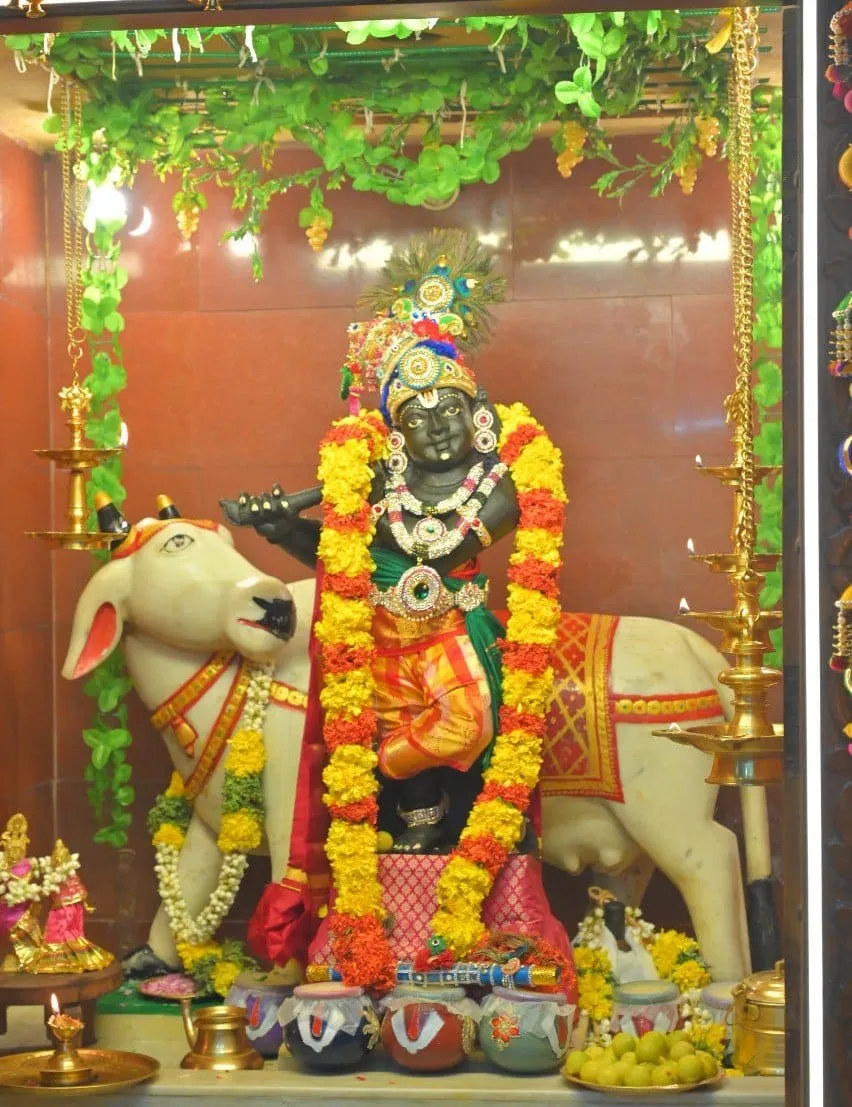
The founders describe it as a replica of Gokulam — the sacred village of Lord Krishna's childhood, where the divine himself walked among the cows, tended them, called them by name, and loved them with the complete affection of both God and a child who grew up with them.
But the Ghosalai is not only a cow sanctuary. It is a temple complex with a deep origin story — one that goes back to the Treta Yuga, to Rama's age, to the liberation of Jatayu on this very ground. The deity worshipped here — Lord Sri Etteluthuperumal — carries one of the most profound names in all of Vaishnav tradition: the Eight-Letter Lord, named after the Ashtakshara mantra, the eight-syllable prayer that is considered the foundation of all Vaishnav devotion.
When you offer Gau Seva here — when you contribute to the care of these cows at this ancient, sacred place — you are doing something that touches multiple dimensions of the tradition at once. Serving what Krishna and Vishnu love. Fulfilling a duty that scriptures describe as among the highest acts of merit. And doing it at a place that has been sacred since before living memory.
FAQ: Is Sri Etteluthu Perumal Ghosalai a well-known temple or a smaller one? The Ghosalai is deeply respected in the Tirunelveli region and among devotees across Tamil Nadu. Over 1,000 people visit daily. Its work in cow protection — sheltering over 1,500 cattle including bulls — has brought it national recognition. It is not yet as widely known outside Tamil Nadu as the great Divya Desam temples, but among those who know it, it is held in the highest regard for the authenticity of its Gau Seva mission.
<span id="etteluthu-meaning"></span>
What Does "Etteluthu" Mean? — The Ashtakshara Connection
The name of this temple carries one of the most profound meanings in all of Hindu tradition.
"Etteluthu" is a Tamil word. Ettu means eight. Ezhuthu means letters (aksharas). Together: the Eight Letters.
What are the eight letters? The Ashtakshara Mantra — the eight-syllable divine prayer:
ॐ नमो नारायणाय Om Namo Narayanaya
This mantra — eight syllables, eight letters — is considered the foundational mantra of Vaishnavism. In the Sri Vaishnav tradition (the tradition of Ramanujacharya), the Ashtakshara is not merely a prayer. It is the essential truth of existence compressed into eight sounds: the acknowledgment of the Supreme, the surrender to him, and the naming of Narayana as the one to whom surrender is made.
The mantra has a specific power recognized across sampradayas. It was upon the Ashtakshara that Ramanujacharya — the great reforming acharya of Vaishnavism — built his entire theological system. He famously climbed the tower of the Thirukoshtiyur temple and shouted the Ashtakshara to everyone present, sharing the secret mantra that his own guru had given him under strict confidence, because he felt the salvation of all was more important than his personal dharma.
This temple's deity is named after this mantra. Lord Sri Etteluthuperumal is the Eight-Letter Lord — the one who is invoked by the very utterance of those eight syllables. The temple's name carries the entire theology of Vaishnavism in it.
When you offer Gau Seva at this temple — when you contribute to the care of the cows at the feet of the Eight-Letter Lord — your name and gotra are offered alongside one of the most ancient and powerful prayers in the Vaishnav tradition.
FAQ: Can anyone chant the Ashtakshara mantra, or is it restricted? The Ashtakshara ("Om Namo Narayanaya") is the universal mantra of Lord Vishnu-Narayana — one of the most widely chanted mantras in Hindu tradition. It is available to all devotees without restriction. The famous act of Ramanujacharya — sharing it openly from the tower — is traditionally cited as the specific moment when this mantra became universally accessible. Chanting it with devotion, especially while thinking of Lord Etteluthuperumal and the cows at his Ghosalai, builds a deep connection with the deity.
🙏 Offer Gau Seva at Sri Etteluthu Perumal Ghosalai, Tirunelveli →
📱 For Pay-After-Video or any queries: WhatsApp / Call +91 9667101992
DevPunya Promise: Video proof within 72 hours • Your name & gotra in the video • Authentic Gau Seva at Sri Etteluthu Perumal Ghosalai, Tirunelveli • Not satisfied? Full reschedule or complete refund — no questions asked.
<span id="origin"></span>
The Origin Story — Sage Mayandi Siddhar's Vision
Every great temple begins with a moment of contact between the human and the divine. At Sri Etteluthu Perumal Ghosalai, that moment is precisely remembered.
Sage Mayandi Siddhar — a deeply devoted spiritual seeker from Tirunelveli — was performing intense penance on the Vallanadu hill near Tirunelveli. He sat in tapasya, withdrawn from the world, his mind directed entirely toward the divine.
On one of those days, something unexpected happened.
An old man appeared. Simply dressed, unassuming, ordinary — and yet not ordinary at all. The old man offered the sage milk porridge — a bowl of nourishment in the middle of his austerities. And then the old man gave him a command:
Go back to your village. Establish a shrine there.
The sage recognized who had come to him. This was not a wandering stranger. This was Lord Sri Etteluthuperumal himself — the Eight-Letter Lord — appearing in the form of an old man to give his devotee both food and direction. The deity had come in a form the sage could receive, bearing the simplest and most human of gifts (milk and nourishment), to give the most cosmic of instructions (establish my house on earth).
The sage returned. He established a shrine — simple at first, a small structure — and began the worship that would grow, over decades and generations, into the extraordinary complex that stands today.
The meaning of this story is not lost on those who come to the Ghosalai. The deity who appeared to the sage as an old man offering milk — milk, the gift of the cow — is the same deity whose temple complex now shelters over a thousand cows. The connection between the founding vision (an old man offering milk) and the present mission (caring for the animals who give milk) is not coincidental. It is the thread running through the entire history of this place.
The present goshala was formally established in 2004 CE by Sri Varatharajaperumal, who carried forward the lineage and mission of the founding sage. Since its establishment, the Goshala has grown continuously — receiving abandoned and elderly cows from across the region, caring for them with the full resources of the temple.
FAQ: Is the deity idol old or recently installed? The primary deity — Lord Sri Etteluthuperumal — was consecrated in the year 2000 CE. The idol is made of sandalwood, stands six feet tall, and is adorned in silver attire. While the consecration is relatively recent, the sacred ground and the tradition of worship here go back to Sage Mayandi Siddhar's era and, according to the tradition, to the Treta Yuga. The idol represents a spiritual presence that is far older than the carved form.
<span id="jatayu"></span>
The Jatayu Connection — Treta Yuga Sacred Ground
The origin story of this temple does not begin with Sage Mayandi Siddhar. It begins much earlier — in the Treta Yuga, in the time of the Ramayana.
Dharmapathi, the location of the Ghosalai, holds the memory of one of the most moving moments in the Valmiki Ramayana: the liberation of Jatayu.
Jatayu was the great eagle — the devotee of Lord Rama who encountered Ravana while the demon was carrying Sita away. Jatayu fought Ravana with everything he had — his wings, his talons, his beak, the full ferocity of his divine bird-nature — to stop the abduction of Sita. He failed. Ravana cut off his wings and left him dying on the earth.
When Rama and Lakshman found Jatayu, he was barely alive. He had used every last resource he possessed in the service of Rama and Sita. And in his dying moments, he told Rama which direction Ravana had gone.
Rama performed the last rites for Jatayu — the same rites that a son performs for a father. He said to Jatayu: You have done what even I could not prevent. You fought for Sita with your last breath. I will give you what I give my own father.
And Jatayu received moksha — liberation — at Rama's hands.
The sacred water tank at Sri Etteluthu Perumal Ghosalai is called "Jatayu Theertham" — the sacred waters of Jatayu's liberation. The tradition holds that this ground was the site of Jatayu's departure and his liberation by Lord Rama. The theertham (sacred tank) marks the spot where the divine eagle was freed from the cycle of rebirth.
This is why Dharmapathi is described as an Adhinarayana site from the Treta Yuga — a place that was already sacred, already connected to the divine story, before any temple was built here. The ground was consecrated by Rama's love for Jatayu. The water in the Jatayu Theertham carries the memory of that liberation.
When you come to this Ghosalai, you are standing on ground where Lord Rama stood, where he knelt beside a dying devotee, where he performed the final rites of love for a being that gave everything for him. That is the energy of this land.
FAQ: Why did Rama perform last rites for a bird? Is this story in the Ramayana? Yes — the liberation of Jatayu is a central episode in the Valmiki Ramayana (Aranya Kanda). Rama performing the antim rites for Jatayu is one of the most emotionally powerful moments in the entire text. Rama explicitly says that Jatayu is like a father to him — and he fulfills the son's duty of performing the funeral rites. The theological significance is that Jatayu's complete, self-sacrificing devotion earned him the liberation that is the highest goal of any human lifetime. The fact that he was a bird was irrelevant. Bhakti has no species.
🙏 Offer Gau Seva at Sri Etteluthu Perumal Ghosalai, Tirunelveli →
📱 For any queries or Pay-After-Video: WhatsApp / Call +91 9667101992
DevPunya Promise: Video proof within 72 hours • Your name & gotra in the video • Authentic Gau Seva at Sri Etteluthu Perumal Ghosalai, Tirunelveli • Not satisfied? Full reschedule or complete refund — no questions asked.
<span id="thamirabarani"></span>
The Thamirabarani River — Sacred Waters of South Tamil Nadu
The temple complex sits on the western bank of the Thamirabarani River — one of the most sacred rivers in South India and one of the few perennial rivers in Tamil Nadu.
The Thamirabarani (also spelled Tamirabarani) holds an extraordinary place in Tamil culture and in Hindu tradition. It is described in ancient Tamil Sangam literature — some of the oldest surviving poetry in the world — as a river of abundance, surrounded by fertile fields, flowing clean and full while other rivers dried in the summer heat.
In the Puranic tradition, the Thamirabarani is connected to Skanda (Murugan) and to the entire sacred geography of the Tamil south. The river flows from the Agasthya Malai mountains — the forests where Sage Agastya, one of the great Vedic rishis, established his hermitage — down through Tirunelveli to the sea. The water carries the energy of both the mountains and the ancient saints.
The significance of a temple beside a sacred river: In Hindu tradition, the meeting of a powerful deity, a sacred forest or site, and a flowing river creates what is called a Punya Kshetra — a field of merit. The river's continuous flow is understood as a living purification, constantly renewing the sanctity of the site. Bathing in the Thamirabarani before visiting the Ghosalai is considered deeply auspicious.
There is also a specific prophecy associated with the Thamirabarani and the temple: the tradition here holds that Lord Sri Mahakrishna will manifest near the Thamirabarani riverbanks at the end of the Kali Yuga — connected to the arrival of Kalki, the tenth avatar of Vishnu. This eschatological significance gives the river and the temple an additional dimension of cosmic importance in the belief of the Ghosalai's devotees.
FAQ: Is the Thamirabarani River connected to any Vedic or Puranic stories? Yes — the Thamirabarani appears in the Ramayana in connection with Agastya Muni's hermitage in the mountains at its source. Sage Agastya — who famously swallowed the ocean and subdued the Vindhya mountains — chose the Agasthya Malai forests as his ashram. The river that flows from those mountains carries his energy. Additionally, the Thamirabarani basin is one of the historically richest regions of Tamil civilization, with continuous human habitation going back thousands of years. The sacred river and the sacred land have been inseparable from the beginning.
<span id="deity"></span>
The Deity — Lord Sri Etteluthuperumal
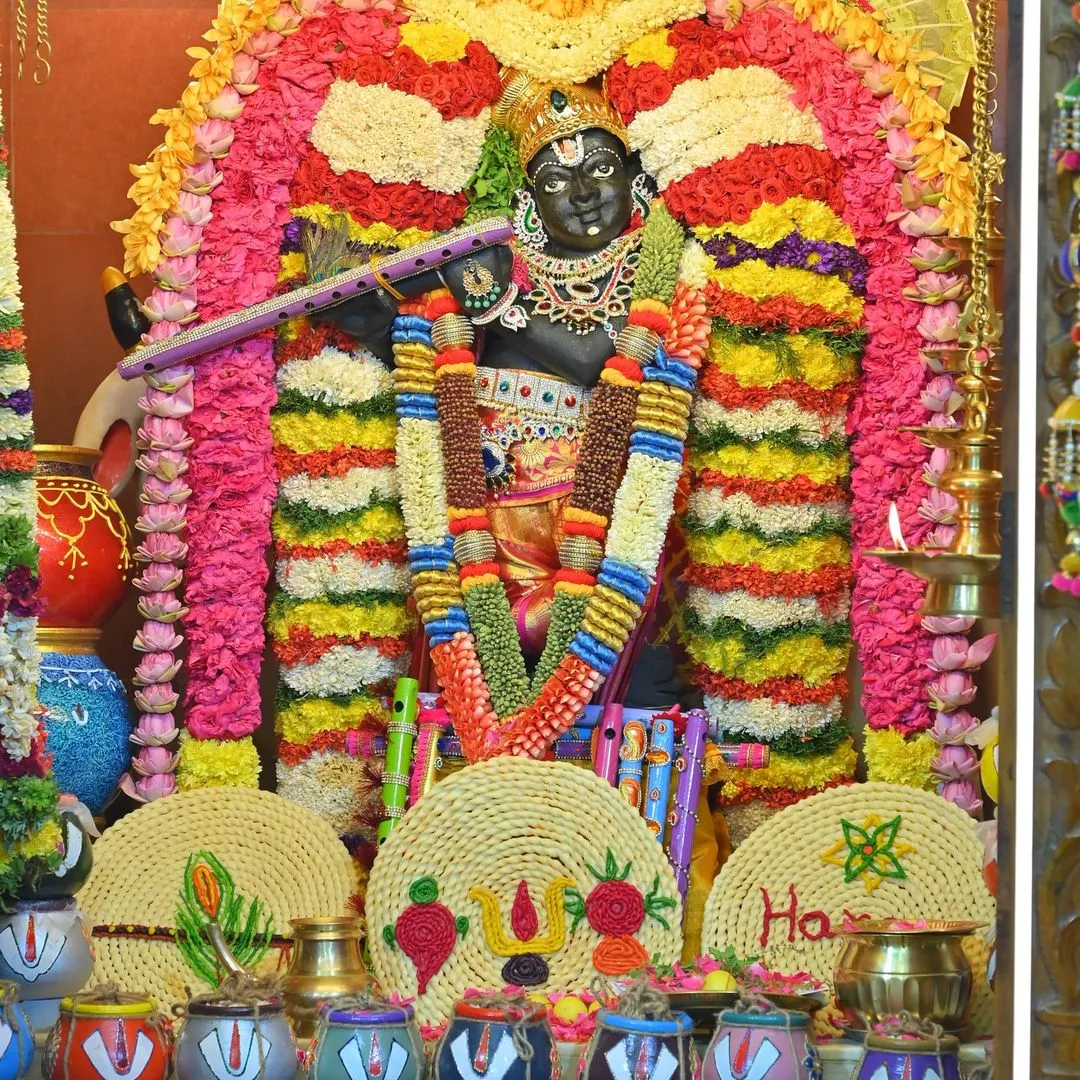
The presiding deity of Sri Etteluthu Perumal Ghosalai is Lord Sri Etteluthuperumal — Lord Vishnu in the specific form invoked by the Ashtakshara mantra.
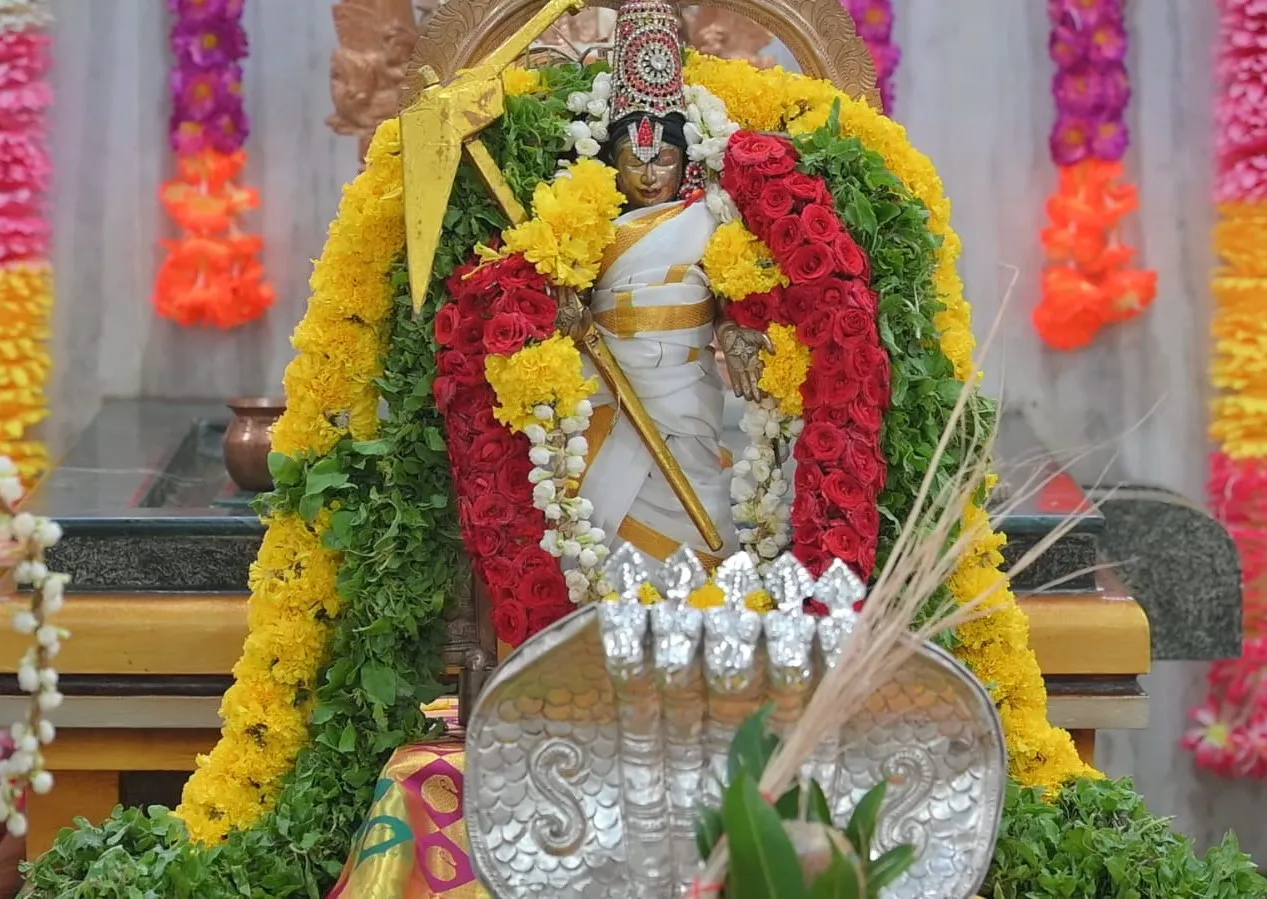
He stands six feet tall, carved from sandalwood, adorned in silver attire. The idol was consecrated in 2000 CE after the modern phase of temple development — but the spiritual presence it represents is timeless, rooted in Sage Mayandi Siddhar's original vision and in the ancient sanctity of the Dharmapathi ground.
In the temple's goshala, alongside the main deity, is Lord Sri Mahadeva Gopala Krishnar — a form of Krishna as the divine cowherd, Gopal. The placement is meaningful: in the same space where over a thousand cows are cared for, the deity worshipped is Krishna in his Gopal form — the one who herded cows, called them by name, protected them from childhood. The living cows and the idol of the divine cowherd share the same space.
There is also a Sri Shakthi Natha Spadiga Lingam (installed 2022) within the complex — a crystal Shiva Linga — honoring the tradition that Vishnu and Shiva are not divided but complementary, that the complete divine encompasses both the preserver and the transformer.
The daily worship: Lord Sri Etteluthuperumal receives full daily pooja — six sessions from the pre-dawn Viswaroopa Darshanam through the night worship. The 9:00 AM cow worship session is specifically listed as open for couples seeking Mahalakshmi Puja blessings for children, longevity, prosperity, and business growth. This is a rare and deeply meaningful offering — a puja performed in the presence of the living cows and the divine cowherd together.
FAQ: Why is there both a Vishnu deity and a Shiva Linga in the same temple complex? This is a beautiful expression of Tamil temple tradition, which has always been more inclusive and less sectarian than the philosophical debates might suggest. The Sthala Purana (the local tradition) of many Tamil temples holds that Vishnu and Shiva are aspects of the same Supreme — that worshipping one is never a rejection of the other. Sri Etteluthu Perumal Ghosalai explicitly honors both traditions. The crystal Lingam was installed in 2022 as a deliberate addition — welcoming all Hindus who come with devotion, regardless of which aspect of the divine draws them.
🙏 Offer Gau Seva at Sri Etteluthu Perumal Ghosalai, Tirunelveli →
📱 For any queries or Pay-After-Video: WhatsApp / Call +91 9667101992
DevPunya Promise: Video proof within 72 hours • Your name & gotra in the video • Authentic Gau Seva at Sri Etteluthu Perumal Ghosalai, Tirunelveli • Not satisfied? Full reschedule or complete refund — no questions asked.
<span id="goshala"></span>
The Goshala — India's Gokulam in Tirunelveli
The word Goshala (or Ghosalai in Tamil) means: a place where cows are sheltered. But what exists at Sri Etteluthu Perumal Ghosalai is far more than a shelter.
This is a living Gokulam — the founders' own description, and an accurate one.
Gokulam was Krishna's village — where he grew up among cows, where every morning he led them out to the forests, where every evening the cows came back to his call. Gokulam was not just a place. It was a quality of life — a way of existing where the human, the cow, and the divine were not separated but woven together in the same daily rhythm.
Sri Etteluthu Perumal Ghosalai attempts to recreate that quality. And by the numbers, it succeeds:
- 1,000+ cows in lifelong shelter
- 500 bulls — including those who can no longer work, abandoned by farmers
- Total facility: approximately 20,000 square feet, continuing to expand
- Mission: to provide food, healthcare, and compassionate care to every cow, for life
Who are the cows that come here?
These are not cows kept for production. They are cows that would have no home anywhere else.
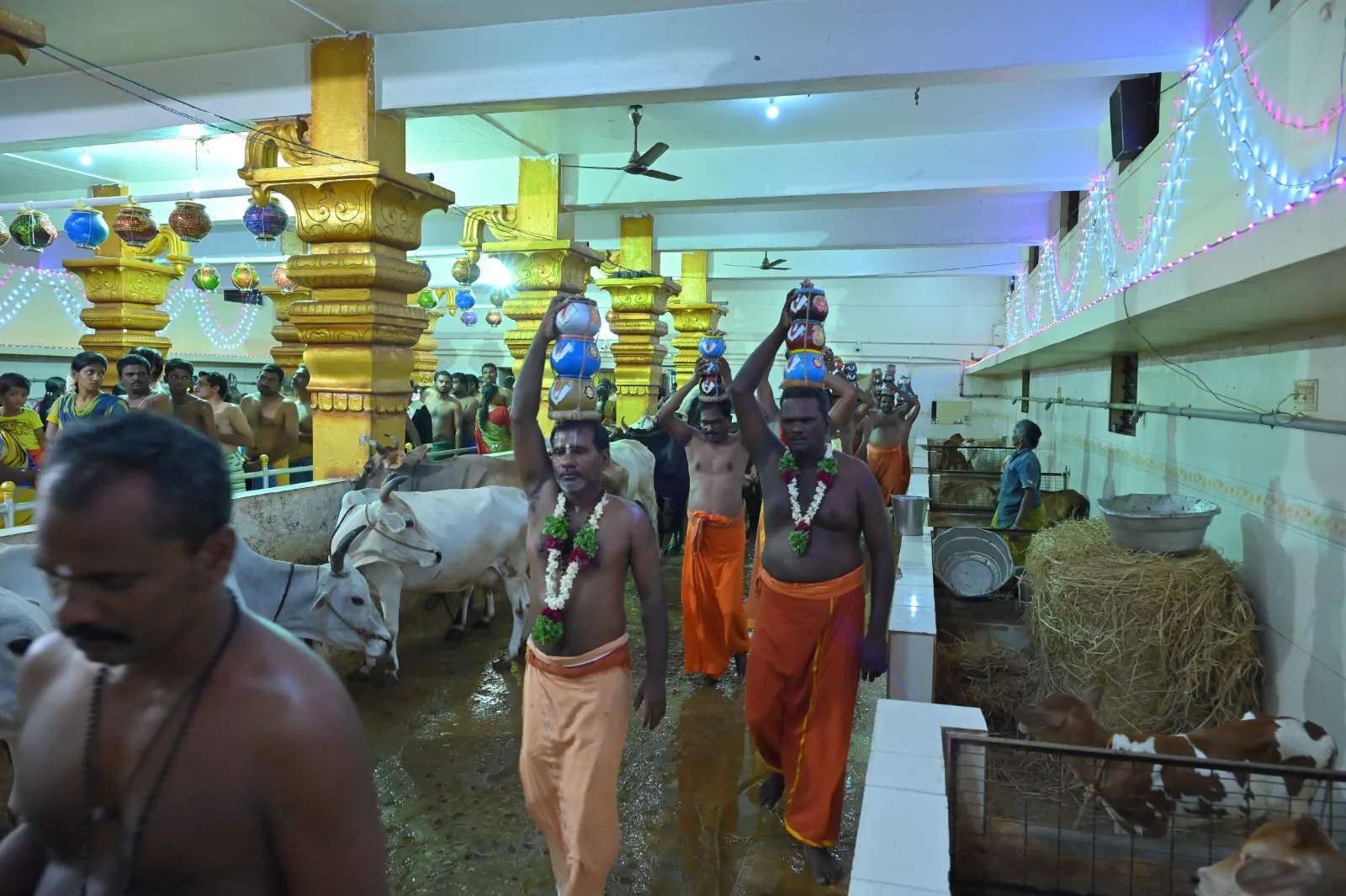
The abandoned ones — found on roadsides, turned out when their milk production dropped. The elderly ones — who spent their lives in service and now need care. The sick ones — who need medical attention that no one else will provide. Every single cow that comes to the Ghosalai stays for life. There is no culling, no selling, no removal. Once a cow is received into the Ghosalai, she is family.
The temple teaches: "The cow is the seventh mother to every human being." In Vedic tradition, a child's seven mothers include his birth mother, the earth, rivers, forests — and the cow, who gives milk that nourishes life from its very first weeks. To abandon a mother is adharma. To protect her is dharma.
The work of the Ghosalai is, at its core, the work of fulfilling this dharma — on a scale that most of us cannot manage in our individual lives.
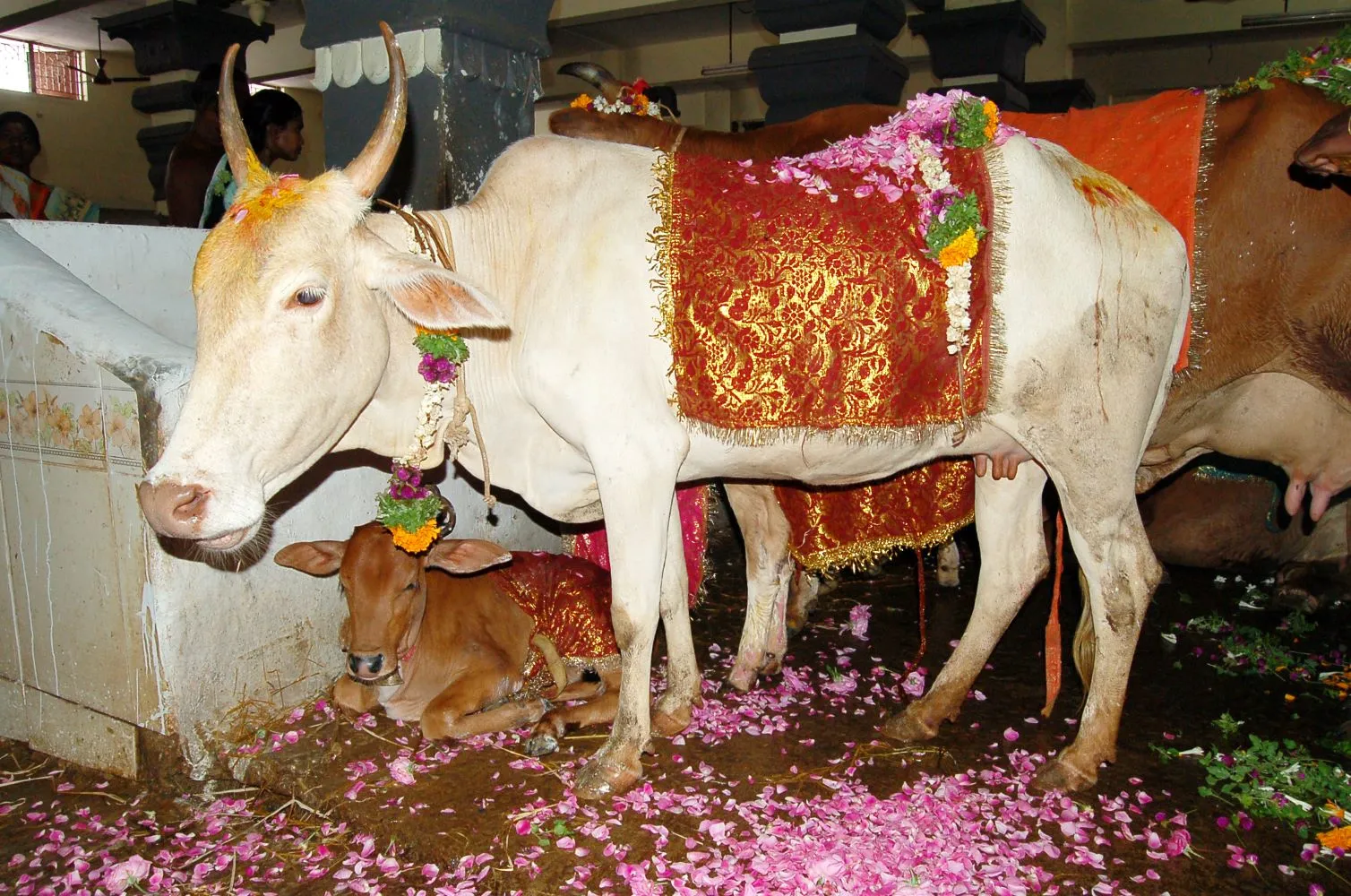
FAQ: What happens to sick and elderly cows at the Goshala? The Ghosalai provides full healthcare — veterinary care, medicines, special food for ill or elderly animals — as part of its standard operations. Elderly cows who can no longer walk freely receive special attention. The philosophy is unconditional: every cow is cared for regardless of age, health, or productive capacity. This mirrors the founding tradition — Gau Mata is not valued for what she gives. She is valued because she is Gau Mata.
FAQ: Does the Goshala accept cows from the public? Yes. One of the temple's active services is receiving abandoned or endangered cows from across the region. If you know of a cow in distress — found on a road, abandoned by a farmer, injured — the Ghosalai can be contacted. This rescue and protection mission is a core part of the complex's spiritual work.
<span id="gau-seva-meaning"></span>
What is Gau Seva? — The Tradition Behind Cow Service
Gau Seva (गौ सेवा) means: service to the cow. Not worship — service. Active, physical care. Feeding. Tending. Healing. Protecting.
The distinction matters. Cows in India are widely described as sacred, as symbols of abundance, as objects of reverence. But the tradition is consistent that reverence without service is incomplete. What the scriptures repeatedly honor is not the devotee who says the cow is divine but never acts on it — it is the devotee who feeds, cares for, and protects the living cow.
Krishna is Gopal — not the one who contemplated the cow, but the one who actively herded them, ran after them when they strayed, lifted them when they fell. His childhood in Gokulam was spent in the daily physical work of cow care. The divine chose to spend his Vrindavan years in seva — not in meditation, not in discourse, but in the active, embodied service of animals.
What Gau Seva involves at Sri Etteluthu Perumal Ghosalai:
Every day at the Ghosalai, hundreds of cows need to be fed — in the morning, at noon, in the evening. They need clean water, medical attention when sick, space to move, rest, and the specific care of the old and the frail. The cost of this daily operation — food, staff, veterinary care, facilities — is substantial. It is the offerings of devotees from across India and the world that make it sustainable.
When you offer Gau Seva through DevPunya, your contribution directly supports the feeding, care, and wellbeing of the cows at the Ghosalai, in your name and your gotra. The offering is not symbolic. The cows are real. The food they receive because of your seva is real. The seva you are contributing to is being done every single day at this extraordinary place.
FAQ: What is the difference between donating to a general cow shelter and offering Gau Seva at a specific sacred site like this? Both are meritorious. The specific dimension of Gau Seva at a Punya Kshetra — a site with the ancient sacred history that Sri Etteluthu Perumal Ghosalai carries — is that the merit generated is connected to the spiritual energy of the place. Gau Seva performed at Gokulam's equivalent, at the feet of Lord Etteluthuperumal and Lord Gopala Krishnar, at a site sacred since the Treta Yuga — this is what the tradition specifically honors when it describes the extraordinary results of Gau Seva. The cow is the same. The place amplifies the intention.
🙏 Offer Gau Seva at Sri Etteluthu Perumal Ghosalai, Tirunelveli →
📱 For Pay-After-Video or any queries: WhatsApp / Call +91 9667101992
DevPunya Promise: Video proof within 72 hours • Your name & gotra in the video • Authentic Gau Seva at Sri Etteluthu Perumal Ghosalai, Tirunelveli • Not satisfied? Full reschedule or complete refund — no questions asked.
<span id="scriptures"></span>
What the Scriptures Say About Gau Mata — The Tradition of Cow Protection
The importance of Gau Seva in Hindu tradition is not a modern invention or a cultural sentiment. It runs through the Vedas, the Puranas, the Mahabharata, and the Bhagavatam in specific, explicit terms.
From the Srimad Bhagavatam: The Bhagavatam — the text that contains the fullest telling of Krishna's life and philosophy — describes the cow as inseparable from the prosperity and wellbeing of any community. In the Bhagavatam's vision, Gau Mata is not merely an animal. She is described as Kamadhenu's lineage — the descendant of the divine wish-fulfilling cow, carrying within her the capacity to nourish and sustain life.
From the Mahabharata: The Anushasana Parva of the Mahabharata contains extensive teachings on the merit of Gau Seva. Bhishma Pitamah, lying on his bed of arrows, speaks at length about the cow's sacredness: "Among all gifts, the gift of a cow is the greatest. In all acts of virtue, the protection of the cow is preeminent."
The Tradition's Direct Statement: The temple itself quotes: "Those who take part in caring for cows at Dharmapadhi, and in cow worship, will receive long life, prosperity, and family growth."
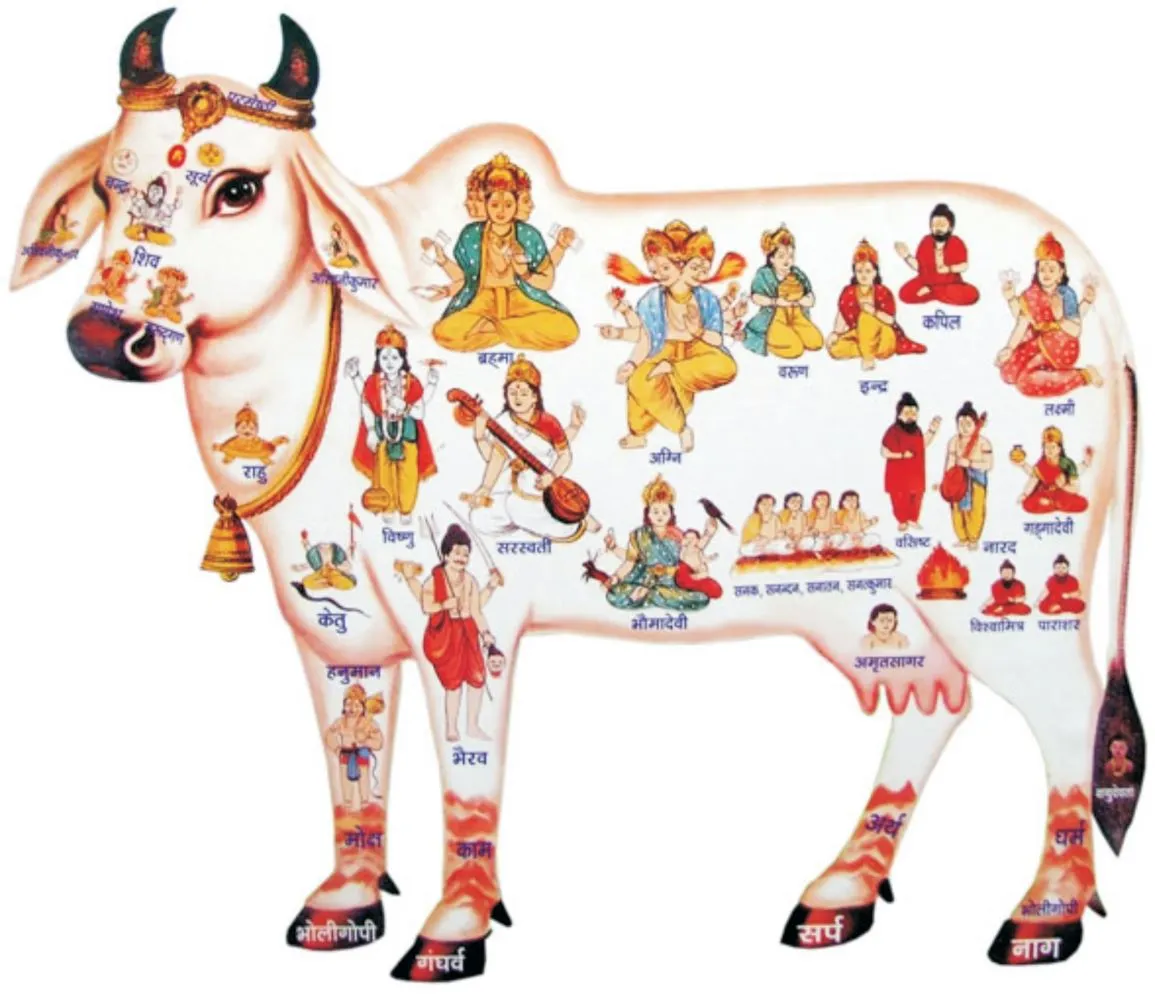
Why is the cow specifically connected to Vishnu and Lakshmi? Goddess Lakshmi — the deity of abundance, prosperity, and divine grace — is specifically associated with the cow in Vaishnav iconography. The cow's giving nature — providing milk, butter, ghee, and nourishment without condition — mirrors Lakshmi's quality of effortless abundance. When you protect and serve the cow, you are serving the living expression of Lakshmi's quality in the physical world. The tradition says Lakshmi specifically blesses those who care for cows.
FAQ: Does the merit of Gau Seva extend to family members or only to the person who performs it? The tradition is generous on this point. When Gau Seva is performed with a name and gotra — as it is at DevPunya — the merit extends to the entire family lineage identified by that gotra. The gotra traces through the patrilineal line and encompasses the entire family. The offering is addressed: from this family, for this family. The tradition says that merit earned through dharmic acts at sacred sites benefits not just the individual but the lineage they represent.
<span id="five-benefits"></span>
5 Benefits of Offering Gau Seva at Sri Etteluthu Perumal Ghosalai
<span id="divine-karma"></span>
1. Divine Blessings & Positive Karma
The devotional understanding: Karma — the principle that every action generates a corresponding energy that returns to the actor — is not a system of punishment and reward. It is a system of resonance. Dharmic actions generate dharmic resonance. Actions aligned with the divine will generate a quality of life that carries divine grace.
Gau Seva is consistently described in the tradition as one of the purest generators of positive karma. Why? Because the cow asks for nothing. She cannot advocate for herself, cannot protect herself from abandonment, cannot express her suffering in ways that demand human attention. Caring for her is a choice made entirely from dharma, without any worldly return. The tradition says such selfless acts — especially directed at what Krishna and Vishnu love — generate punya that is deep, clean, and sustained.
At Sri Etteluthu Perumal Ghosalai, your Gau Seva offering is received in the name of Lord Sri Etteluthuperumal — the Eight-Letter Lord — amplifying it with the energy of one of the oldest sacred sites in South India.
🙏 Offer Gau Seva for Divine Blessings →
📱 WhatsApp / Call +91 9667101992 DevPunya Promise: Video in 72 hours • Your name & gotra in the video • Full refund if not satisfied, no questions asked
<span id="prosperity"></span>
2. Wealth, Prosperity & Abundance
The devotional understanding: The cow is Kamadhenu — the wish-fulfilling cow of the gods. The Puranas describe how Kamadhenu, when properly cared for, fulfills every desire of the household she is associated with. In a real Goshala, in the physical world, the cow is the living descendant of this tradition.
Goddess Lakshmi, the deity of prosperity, is specifically invoked through Gau Seva. The Mahabharata's Anushasana Parva explicitly lists material prosperity among the direct fruits of cow protection. Not as a guaranteed transaction, but as the natural resonance of dharmic action in the domain that Lakshmi governs — the domain of abundance and wellbeing.
For those seeking divine grace in their financial life, their business, their household's material wellbeing — Gau Seva at a sacred site where Lord Vishnu (Lakshmi's consort) is worshipped alongside Gopal Krishnar is the tradition's specific answer.
🙏 Offer Gau Seva for Prosperity →
📱 WhatsApp / Call +91 9667101992 DevPunya Promise: Video in 72 hours • Your name & gotra in the video • Full refund if not satisfied, no questions asked
<span id="obstacles"></span>
3. Removal of Obstacles & Negative Energies
The devotional understanding: Obstacles in life — the repeated closing of doors that should open, the patterns of difficulty that appear across different areas — often have roots that are not visible on the surface. Some are karmic (the result of past actions, one's own or the lineage's). Some are energetic (a quality of heaviness or block in the household's atmosphere). And some are simply the difficulty of living in a world where not everything is aligned with one's purpose.
Gau Seva at a powerful sacred site addresses all of these dimensions. The positive karma generated dissolves negative karma accumulated in the past. The punya earned at a Punya Kshetra like Dharmapathi creates a protective energy around the devotee and their family. The act of service — of giving without condition — shifts the internal quality from fear and contraction to generosity and openness.
The tradition says: the cow's forgiveness is total. She receives care from whoever offers it, without asking about their past, without remembering wrongs. Serving her transfers something of that quality to the devotee.
🙏 Offer Gau Seva to Remove Obstacles →
📱 WhatsApp / Call +91 9667101992 DevPunya Promise: Video in 72 hours • Your name & gotra in the video • Full refund if not satisfied, no questions asked
<span id="health"></span>
4. Health, Peace & Well-being
The devotional understanding: Health in the Hindu tradition is not purely physical. It is the quality of balance — between body, mind, and the subtle energies that the tradition calls prana. When prana is flowing well, health follows. When it is blocked, disrupted, or depleted, illness enters.
The tradition specifically associates Gau Seva with the restoration of prana. The cow's products — milk, ghee, panchagavya — are prescribed in Ayurveda as the most nourishing and purifying substances. The energy of caring for the cow is considered to generate a quality of internal health and peace that extends through the family.
The temple's own tradition states it directly: "Feeding and caring for cows promotes good health, peace of mind, and overall well-being for the devotee."
For families dealing with recurring health concerns — for those seeking the wellbeing of elderly parents, the health of children, or their own sustained vitality — Gau Seva at the Ghosalai is an ancient and trusted practice.
🙏 Offer Gau Seva for Health & Well-being →
📱 WhatsApp / Call +91 9667101992 DevPunya Promise: Video in 72 hours • Your name & gotra in the video • Full refund if not satisfied, no questions asked
<span id="moksha"></span>
5. Moksha & Spiritual Growth
The devotional understanding: Moksha — liberation from the cycle of birth and death — is the highest goal of the dharmic life. The tradition describes many paths to moksha: Jnana (knowledge), Bhakti (devotion), Karma (right action). Gau Seva is placed within the Karma Yoga path — the path of righteous action performed without attachment to results.
The Bhagavatam's famous statement on this: serving Gau Mata is a path to Moksha and increases spiritual growth and divine connection. Not as metaphor — as a literal description of the karmic mechanism. Serving the cow — who represents both Kamadhenu and Lakshmi and the living tradition of Gokulam — generates punya so pure and so sustained that it builds the conditions for liberation over time.
For the devotee who is not primarily focused on worldly results but on the quality of their spiritual life — on their connection to the divine, their inner peace, their gradual movement toward the highest goal — Gau Seva at a site like Sri Etteluthu Perumal Ghosalai is a practice that works on the deepest level.
🙏 Offer Gau Seva for Spiritual Growth & Moksha →
📱 WhatsApp / Call +91 9667101992 DevPunya Promise: Video in 72 hours • Your name & gotra in the video • Full refund if not satisfied, no questions asked
<span id="which-gau-seva"></span>
Which Gau Seva is Best For... — Honest Answers Based on Tradition
These are the questions devotees ask when they hear about Gau Seva. The answers are rooted in what the tradition says, not in what any service wants to sell.
Which offering is best for someone dealing with delayed marriage?
Gau Seva at Sri Etteluthu Perumal Ghosalai.
The tradition connects delayed marriage with blocked energy in the family — often rooted in ancestral karma or in a quality of contraction around the family's wellbeing. Lakshmi, who governs abundance and auspicious timing, is specifically associated with the cow. When you offer Gau Seva in her name at a Vishnu temple, you are appealing to the deity of divine timing and abundance at her own sacred site.
The tradition says Lakshmi blesses those who protect cows with Saubhagya — the state of complete auspiciousness, which includes a good marriage and a harmonious household.
Keep your heart open. Keep meeting people. Keep doing your part. The seva works alongside your own effort.
Offer Gau Seva → 🙏 devpunya.com/chadhaava/v2/15 📱 +91 9667101992
Which offering is best for business growth and financial stability?
Gau Seva at Sri Etteluthu Perumal Ghosalai.
The Kamadhenu tradition — the divine wish-fulfilling cow — is specifically about material abundance. The Mahabharata is explicit: cow protection brings prosperity. At this Ghosalai, over a thousand cows are cared for in the name of Lord Etteluthuperumal, whose very name carries the Ashtakshara mantra — the mantra of Lord Narayana, who governs the sustained flourishing of all that exists.
Offering Gau Seva with the intention of your business's growth is an act of inviting Lakshmi's quality — abundance, flow, the removal of the blocks that stop prosperity from reaching its destination.
Your effort is still required. The seva aligns divine grace with your work. Prabhu does what is best for his devotees — keep working, and trust his timing.
Offer Gau Seva → 🙏 devpunya.com/chadhaava/v2/15 📱 +91 9667101992
Which offering is best for children — conceiving, health of children, their future?
Gau Seva at Sri Etteluthu Perumal Ghosalai.
Gau Mata is the seventh mother — the one who nourishes every child from birth through her milk. The tradition specifically connects Gau Seva to blessings for children and family growth. The temple's own teaching states that those who care for cows receive "long life, prosperity, and family growth."
For couples seeking children, for parents seeking the health and wellbeing of their existing children, for families who want divine grace over the children in the household — Gau Seva at a Goshala of this scale and sanctity is the tradition's specific answer.
Offer Gau Seva → 🙏 devpunya.com/chadhaava/v2/15 📱 +91 9667101992
Which offering is best for health and overcoming illness?
Gau Seva at Sri Etteluthu Perumal Ghosalai.
The connection between Gau Seva and health is one of the most consistently described relationships in the tradition — from the Ayurvedic view (cow products as healing substances) to the karmic view (seva generates prana-restoring merit). The temple's own tradition is direct: caring for cows promotes health, peace of mind, and well-being.
For those seeking health — one's own, a family member's, or a parent's — Gau Seva is offered here as a sincere act of service that generates the quality of divine support for wellbeing.
Do not abandon medical care. The seva works alongside the body's healing, alongside medical treatment — not instead of it.
Offer Gau Seva → 🙏 devpunya.com/chadhaava/v2/15 📱 +91 9667101992
Which offering is best for peace of mind and reducing anxiety?
Gau Seva at Sri Etteluthu Perumal Ghosalai.
Service — genuine, active service — is one of the oldest remedies for the kind of anxious self-preoccupation that traps the mind. The Gita speaks about this: action performed without attachment to results releases the mind from the cycle of worry. Gau Seva is precisely this — an act directed entirely outward, toward beings who cannot ask for it or thank you for it. The mind that has done something genuinely good, for a being that needed it, carries a different quality for the rest of the day.
Multiply this across regular offerings, regular connection to a sacred site and a sacred practice — and the tradition says the quality of the inner life changes sustainably. Not immediately. Not dramatically. But genuinely, over time.
Offer Gau Seva → 🙏 devpunya.com/chadhaava/v2/15 📱 +91 9667101992
🙏 Offer Gau Seva at Sri Etteluthu Perumal Ghosalai, Tirunelveli →
📱 For Pay-After-Video or any queries: WhatsApp / Call +91 9667101992
DevPunya Promise: Video proof within 72 hours • Your name & gotra in the video • Authentic Gau Seva at Sri Etteluthu Perumal Ghosalai, Tirunelveli • Not satisfied? Full reschedule or complete refund — no questions asked.
<span id="timings"></span>
Temple Pooja Timings & Daily Schedule
Sri Etteluthu Perumal Ghosalai maintains a full daily worship schedule — both for the deity in the sanctum and for the cows in the Goshala.
| Time | Service |
|---|---|
| 6:00 AM | Sri Mahadeva Gopala Krishnar — Viswaroopa Darshanam |
| 9:00 AM | Special cow worship; couples' Mahalakshmi Puja (for children, longevity, prosperity) |
| 12:00 PM | Noon offerings |
| 6:00 PM | Evening pooja |
| 7:00 PM | Night cow worship |
Note on the 9:00 AM service: The special cow worship at 9:00 AM is open to couples who want to perform a Mahalakshmi Puja specifically seeking blessings for children, longevity, prosperity, and business growth. This is a distinctive feature of the Ghosalai — a puja performed in the actual presence of the living cows, with Gopala Krishnar as the presiding deity.
Annual Festivals:
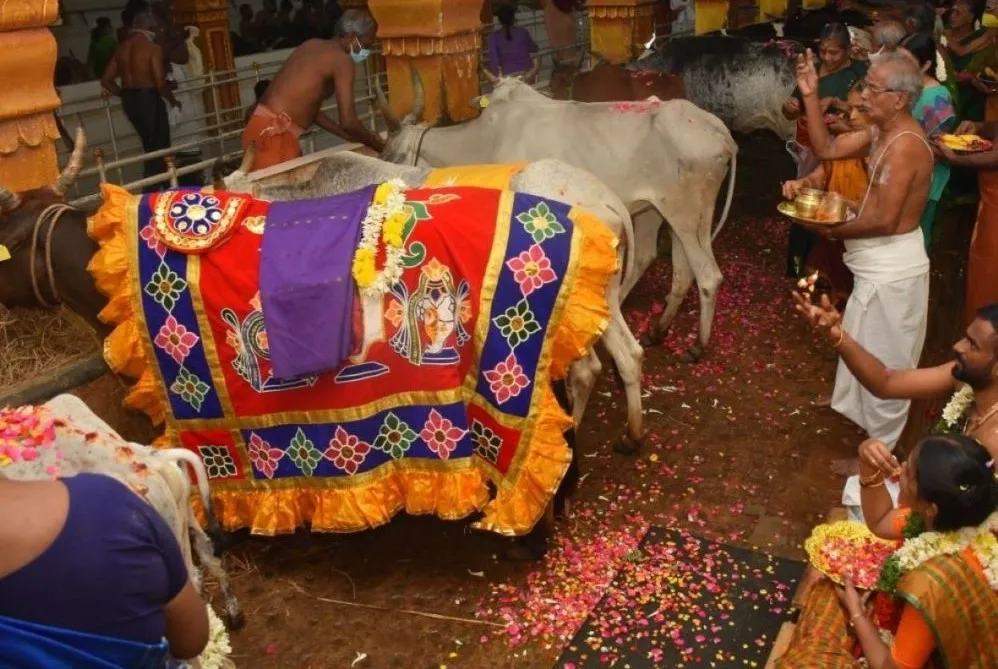
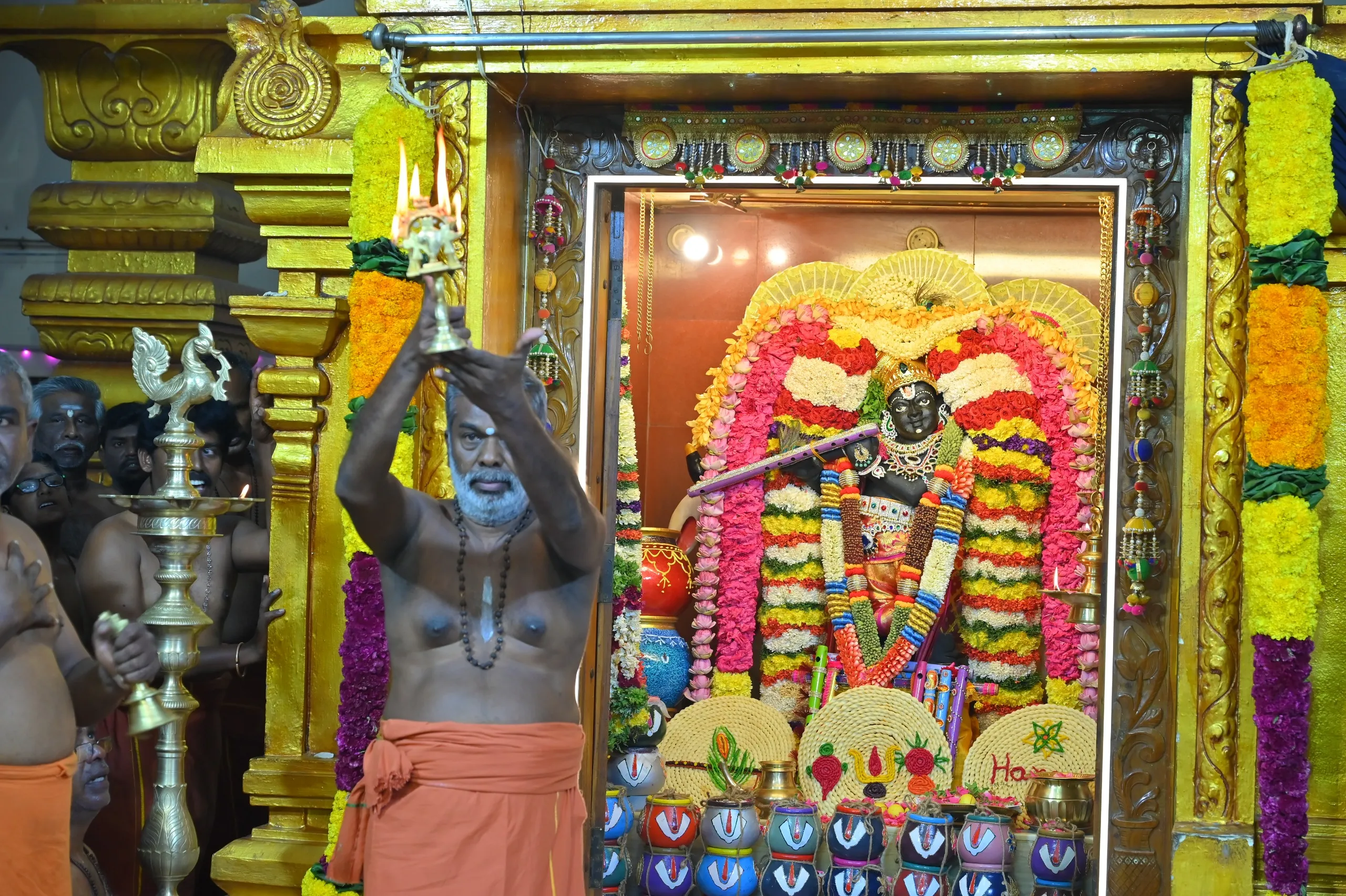
- Sri Krishna Jayanti (Janmashtami): The most important festival — celebrating Krishna's birthday. The Goshala becomes the center of devotion, with the cows decorated and honored. Devotees gather for singing, dancing, and communal celebration in the spirit of Gokulam.
- Pongal: The Tamil harvest festival. The Ghosalai's Pongal celebration specifically honors Gau Mata — as the provider of milk and nourishment, she is the living embodiment of what Pongal thanks the divine for.
- Shivaratri: Night vigils for Lord Shiva, honoring the Sri Shakthi Natha Spadiga Lingam.
- Chithirai Thiruvilla: The great Tamil festival month, marking the Tamil New Year. Special celebrations are held at the Ghosalai during this period.
FAQ: Can I attend the 9:00 AM cow worship in person? Yes. The temple welcomes visitors for all its pooja timings. The morning cow worship is open for devotees — you can witness and participate in the feeding and ritual honoring of the cows. Couples specifically interested in the Mahalakshmi Puja should contact the temple in advance to coordinate with the priests.
<span id="how-to-reach"></span>
How to Reach Sri Etteluthu Perumal Ghosalai, Tirunelveli
Address: 89 Mangammal Salai, Arugankulam Melur, Senthimangalam Post, Tirunelveli, Tamil Nadu 627358
By Air: The closest operational airport is Tirunelveli Airport (TRV) — with select domestic connections. For more flight options, Madurai Airport (IXM) is approximately 160 km away, well-connected to major Indian cities. From Madurai, take a train or taxi to Tirunelveli (~3 hours by road, ~2.5 hours by train).
By Train: Tirunelveli Junction is one of the major railway stations of Tamil Nadu — connected to Chennai (~7-8 hours), Madurai (~2 hours), Coimbatore (~4-5 hours), Bengaluru (~8-10 hours), and Mumbai (via long-distance trains). From Tirunelveli Junction, the Ghosalai is approximately 7-10 km — auto-rickshaws and taxis are available.
By Road:
| From | Distance | Time |
|---|---|---|
| Chennai | ~640 km | ~9-10 hours |
| Madurai | ~160 km | ~3 hours |
| Kanyakumari | ~70 km | ~1.5 hours |
| Coimbatore | ~280 km | ~5 hours |
| Trivandrum (Kerala) | ~140 km | ~2.5 hours |
National Highway NH 44 and NH 744 connect Tirunelveli to the major cities of Tamil Nadu and Kerala. The city is well-served by TNSTC (state bus) services from all these cities.
Contact: 📞 78670 33451 | 94428 60804 | 8870564559
FAQ: Is Tirunelveli worth visiting beyond the Ghosalai? Yes — Tirunelveli is one of the richest temple cities in South India. The famous Nellaiappar Temple (dedicated to Shiva and Parvati, over 2,000 years old) is one of the most important temples in Tamil Nadu, with extraordinary Dravidian architecture. The city is also famous for its Halwa — Tirunelveli Halwa is known across India. Adding a day to explore the Nellaiappar Temple, the Tamirabarani river ghats, and the city's temple culture makes the trip to see the Ghosalai a complete pilgrimage.
If visiting in person is not possible right now, your Gau Seva can still be offered at Sri Etteluthu Perumal Ghosalai — with full video proof delivered within 72 hours.
🙏 Offer Gau Seva at Sri Etteluthu Perumal Ghosalai →
📱 Want to see the video first, then pay? WhatsApp / Call +91 9667101992
DevPunya Promise: Video proof within 72 hours • Your name & gotra in the video • Authentic Gau Seva at Sri Etteluthu Perumal Ghosalai, Tirunelveli • Not satisfied? Full reschedule or complete refund — no questions asked.
<span id="devpunya"></span>
DevPunya Gau Seva Service at Sri Etteluthu Perumal Ghosalai
DevPunya performs Gau Seva at Sri Etteluthu Perumal Ghosalai, Tirunelveli on your behalf.
How it works: You place your Gau Seva offering through DevPunya with your name and gotra details. A DevPunya representative performs the Gau Seva at the actual Ghosalai in Tirunelveli — feeding, caring for, and serving the cows at the temple in your name. Your name and gotra are clearly included in the offering.
What you receive: A video proof of your Gau Seva being performed at Sri Etteluthu Perumal Ghosalai — delivered within 72 hours. You can see the Goshala, see the cows, and see your name and gotra included. This is your confirmation that your seva reached Gau Mata at this sacred site.
The Pay-After-Video option: If you want to see the video of the Gau Seva first and pay only after — DevPunya offers this option. Contact us on WhatsApp before booking: 📱 +91 9667101992
This reflects one simple belief: we are confident in what we do. If you want proof before payment, we will provide it.
The DevPunya difference: Many platforms offer puja and seva services online. What sets DevPunya apart: video proof for every single booking is the standard, not an extra. Your name and gotra are in that video. You can verify what was done.
Some platforms send you a receipt and ask you to trust that the service was performed. DevPunya sends you a video. If you want to see it first — contact us on WhatsApp. If you are not satisfied for any reason — full reschedule or complete refund, no questions from our side.
🙏 Offer Gau Seva at Sri Etteluthu Perumal Ghosalai, Tirunelveli →
📱 For Pay-After-Video or any queries: WhatsApp / Call +91 9667101992
DevPunya Promise: Video proof within 72 hours • Your name & gotra in the video • Authentic Gau Seva at Sri Etteluthu Perumal Ghosalai, Tirunelveli • Not satisfied? Full reschedule or complete refund — no questions asked.
<span id="how-to-book"></span>
How to Book
Step 1: Click the link below and select your Gau Seva offering.
Step 2: Enter the number of members and your name and gotra details.
Step 3: Complete your booking. DevPunya performs your Gau Seva at Sri Etteluthu Perumal Ghosalai on an auspicious date.
Step 4: Receive your video proof within 72 hours.
Want to pay after watching the video? WhatsApp or call us at +91 9667101992 before booking. We will arrange it.
🙏 Offer Gau Seva at Sri Etteluthu Perumal Ghosalai, Tirunelveli →
📱 WhatsApp / Call: +91 9667101992
<span id="guarantee"></span>
DevPunya Guarantee
- Video proof delivered within 72 hours
- Your name & gotra clearly included in the video
- Authentic Gau Seva performed at Sri Etteluthu Perumal Ghosalai, Tirunelveli
- Updates given throughout the process
- If not satisfied: Full reschedule or complete refund, no questions asked
<span id="faq"></span>
Frequently Asked Questions
About the Temple
What does "Etteluthu Perumal" mean? "Etteluthu" is Tamil for "eight letters." Perumal is Lord Vishnu. The name means: Lord Vishnu who is invoked by the eight-letter mantra — the Ashtakshara, Om Namo Narayanaya. The deity is named after the foundational mantra of Vaishnavism. It is a name that carries the entire theology of Vaishnav devotion in it.
Is this a Divya Desam temple? No. The 108 Divya Desams are the temples specifically sung about by the Alvars in the Nalayira Divya Prabandham. Sri Etteluthu Perumal Ghosalai is not among them. However, its sacred history — dating to the Treta Yuga, associated with Jatayu's liberation, beside the sacred Thamirabarani — gives it a profound spiritual standing of its own kind. Not all sacred sites need to be classified within the Divya Desam list to carry genuine sanctity.
What is Jatayu Theertham and where is it? Jatayu Theertham is the sacred tank within the Ghosalai complex, associated with the site where Jatayu — the great eagle-devotee of Lord Rama — attained liberation after being fatally wounded while trying to save Sita from Ravana. The tradition holds that Dharmapathi is the ground where Rama found Jatayu, performed his last rites, and granted him moksha. The tank marks this sacred memory.
Who founded the Goshala and when? The spiritual lineage begins with Sage Mayandi Siddhar, who received Lord Etteluthuperumal's divine instruction on the Vallanadu hill. The modern Goshala was established formally in 2004 CE under the guidance of Sri Varatharajaperumal, who carried forward the founding mission. The main deity was consecrated in 2000.
How many cows are at the Goshala? As of the most recent records, the Ghosalai shelters over 1,000 cows and 500 bulls — a total of more than 1,500 cattle. The facility spans approximately 20,000 square feet and continues to expand. Every cow is sheltered for life — there is no culling or sale.
Why does the temple have both a Vishnu deity and a Shiva Linga? The complex honors both Vaishnav and Shaivite traditions. The main presiding deity is Lord Sri Etteluthuperumal (Vishnu). A Sri Shakthi Natha Spadiga Lingam (crystal Shiva Linga) was installed in 2022. And in the Goshala stands Lord Sri Mahadeva Gopala Krishnar. This inclusiveness reflects the Tamil temple tradition, which has historically welcomed all devotees regardless of sampradaya — understanding that Vishnu and Shiva are aspects of the same Supreme.
About Gau Seva
Why is Gau Seva considered so meritorious? Is there a scriptural basis? Yes — extensively. The Srimad Bhagavatam, Mahabharata (Anushasana Parva), Vishnu Purana, and Garuda Purana all contain specific teachings on the merit of cow protection. The Mahabharata specifically lists material prosperity, long life, family growth, and moksha as the fruits of Gau Seva. The Bhagavatam describes the cow as connected to Kamadhenu — the wish-fulfilling divine cow — and to Lakshmi's energy of abundance. This is not a local folk belief. It runs through the most authoritative texts of the tradition.
What specifically happens when I offer Gau Seva here? What do the cows receive? Your Gau Seva contribution at Sri Etteluthu Perumal Ghosalai goes toward the daily feeding, healthcare, and care of the cows at the Goshala. The daily operation — food for 1,000+ cows, veterinary care, staff — is sustained by offerings like yours. Your name and gotra are included at the time of the offering, so it is personally addressed. DevPunya provides video proof so you can see the Goshala, the cows, and your offering in action.
Can I offer Gau Seva for a family member's health or wellbeing? Yes. When you book through DevPunya, you can include the specific name and gotra of the family for whose benefit the Gau Seva is being offered. The offering is personally addressed — it carries the energy and intention of your love for that family member to the sacred site.
How often should I offer Gau Seva? There is no fixed prescription. Some devotees offer once — as a fulfillment of a specific vow. Others offer regularly — on Purnima (full moon), Amavasya (new moon), Ekadashi, or on the birthday of a family member. Regular, sustained Gau Seva is traditionally associated with the gradual accumulation of merit (punya) that builds the conditions for prosperity, health, and eventual moksha. Contact DevPunya on WhatsApp (+91 9667101992) for arrangements for regular monthly Gau Seva.
Is Gau Seva different from general cow donation? Gau Seva is an ongoing, active service — feeding, caring for, and protecting the living animal. A one-time donation can contribute to the infrastructure. Regular Gau Seva builds an ongoing connection between the devotee's intention and the living act of service. The tradition honors both, but specifically praises the sustained practice of seva.
About the DevPunya Service
How do I know the Gau Seva was actually performed at this temple? You receive a video proof within 72 hours. The video shows the Gau Seva being performed at Sri Etteluthu Perumal Ghosalai in Tirunelveli — the cows, the Goshala, and your name and gotra included. You can verify everything you see.
Many platforms provide only a booking confirmation. DevPunya provides video proof as the standard for every booking. If you want to see the video before paying — contact us on WhatsApp at +91 9667101992.
What if I don't know my gotra? If your specific gotra is unknown, the traditional default is Kashyap gotra — the lineage attributed to Kashyapa Muni, considered the universal ancestor in Vedic tradition. This ensures your offering has a precise spiritual address even without knowledge of your family lineage.
Can I book from outside India? Yes. DevPunya accepts bookings from devotees worldwide. The Gau Seva is performed at the actual Goshala in Tirunelveli. The video proof reaches you wherever you are.
What if I am not satisfied? Contact DevPunya. Full reschedule or complete refund — no conditions, no explanation required from your side. We stand behind what we do.
About Results and Expectations
Will Gau Seva at this temple fulfill my wish? The tradition says the merit of Gau Seva at a sacred Vishnu temple reaches the deity and the devotee's lineage. What follows in the world — the form it takes, the timing — is in Prabhu's wisdom, not ours. Our duty is to offer sincerely and trust his judgment. He does what is best for his devotees, in his own time and way. Do your own work alongside the seva. Do not expect instant results. Leave the outcome in his hands.
How long after Gau Seva might I see a change? There is no fixed timeline — and the tradition does not promise one. What devotees consistently report after sustained Gau Seva at a sacred site is an internal quality first: a sense of peace, of having done something right, of a subtle lightness. Changes in outer circumstances — health, relationships, business — often follow, gradually. Some people experience outer changes quickly. Others more slowly. The punya accumulates; trust that accumulation.
I have done many religious acts before without visible results. Why should this be different? Gau Seva at a Punya Kshetra like this is not a transaction. It is an act of dharma. Its value does not depend on a measurable outcome. The cow who receives your seva does not thank you. The deity who receives your offering does not send a confirmation. What happens in the subtle realm — in the karma of your lineage, in the energy of your household, in the long arc of your life — is not always visible immediately. Keep doing your part. Trust Prabhu's judgment. That is the practice.
🙏 Offer Gau Seva at Sri Etteluthu Perumal Ghosalai, Tirunelveli →
📱 For any queries or Pay-After-Video: WhatsApp / Call +91 9667101992
DevPunya Promise: Video proof within 72 hours • Your name & gotra in the video • Authentic Gau Seva at Sri Etteluthu Perumal Ghosalai, Tirunelveli • Not satisfied? Full reschedule or complete refund — no questions asked.
<span id="mantra"></span>
Mantra — The Prayer of the Eight-Letter Lord
The mantra of Lord Sri Etteluthuperumal — the mantra after whom he is named — is the foundational prayer of all Vaishnav devotion:
ॐ नमो नारायणाय Om Namo Narayanaya
Eight syllables. Eight letters. The complete surrender to Narayana — the one in whom all of existence rests and moves.
Chanting this mantra while thinking of the cows at Sri Etteluthu Perumal Ghosalai — while holding the image of over a thousand Gau Matas being fed and cared for at a sacred site on the banks of the Thamirabarani — creates a devotional connection that is both simple and profound.
No elaborate ritual is required. No initiation. No temple visit. The mantra is available to everyone. The connection it creates, when offered with sincerity toward the deity and toward the Gau Mata he loves, is real.
The Gau Gayatri — for those who wish to specifically honor the cow in prayer:
ॐ सुरभ्यै च विद्महे, विश्वरूपाय धीमहि, तन्नो गौ: प्रचोदयात् Om Surabhyai Cha Vidmahe, Vishwarupaya Dhimahi, Tanno Gau: Prachodayat
Meaning: We meditate upon the sacred cow. Let her universal form illuminate our understanding. May Gau Mata inspire us.
Chanting this 21 times each morning — or on Purnima, Ekadashi, and other auspicious days — while thinking of the cows at the Ghosalai is considered a complete, daily Gau Seva practice for those who cannot offer physically or financially every day.
Om Namo Narayanaya.
There is a teaching that runs through every Goshala, every cow protection effort, every act of Gau Seva across this tradition: the cow cannot speak. She cannot ask for help in a language we will hear. She cannot advocate for herself in the courts and conversations of human society. Whatever she receives comes entirely from the dharma of the one who gives.
To give without being asked. To protect without being thanked. To serve what the divine loves — not because it earns something, not because it can be seen, but because it is right.
That is Gau Seva. That is the practice at Sri Etteluthu Perumal Ghosalai. That is what your offering supports.
May Lord Sri Etteluthuperumal, the Eight-Letter Lord, receive your seva with grace. May Gau Mata — fed by your offering, sheltered at his feet — carry your name and your family's name before the divine.
🙏 Offer Gau Seva at Sri Etteluthu Perumal Ghosalai, Tirunelveli →
📱 For Pay-After-Video or any queries: WhatsApp / Call +91 9667101992
DevPunya Promise: Video proof within 72 hours • Your name & gotra in the video • Authentic Gau Seva at Sri Etteluthu Perumal Ghosalai, Tirunelveli • Not satisfied? Full reschedule or complete refund — no questions asked.