Banke Bihari Temple Vrindavan — Complete Guide | Darshan, Chadhawa, Holi & History
Complete guide to Banke Bihari Temple, Vrindavan — history, Swami Haridas story, unique temple traditions, Holi, aarti timings, how to reach, and how to offer chadhawa to Bihari Ji online.
Banke Bihari Temple, Vrindavan — Complete Guide
Vrindavan, Mathura District, Uttar Pradesh | One of the Most Sacred Krishna Temples in India
Quick Navigation
- Who is Banke Bihari Ji?
- The Origin Story
- How the Idol Appeared — Swami Haridas Ji
- The Temple — History & Architecture
- Sacred Traditions Unique to This Temple
- Nidhivan — The Mystical Forest
- The Yamuna River Connection
- Why Devotees Come — What Bihari Ji Fulfills
- Aarti Timings & Darshan Hours
- Holi at Banke Bihari — India's Most Vibrant Festival
- Other Major Festivals
- How to Reach Vrindavan
- What is Chadhawa?
- Chadhawa Offerings for Bihari Ji
- Which Chadhawa is Best For...
- 4 Benefits of Offering Chadhawa
- DevPunya Chadhawa Service
- How to Book
- DevPunya Guarantee
- FAQ
- Aarti & Mantra
<span id="who-is"></span>
Who is Banke Bihari Ji?
Before the temple, before the history, before anything else — who is the one worshipped here?
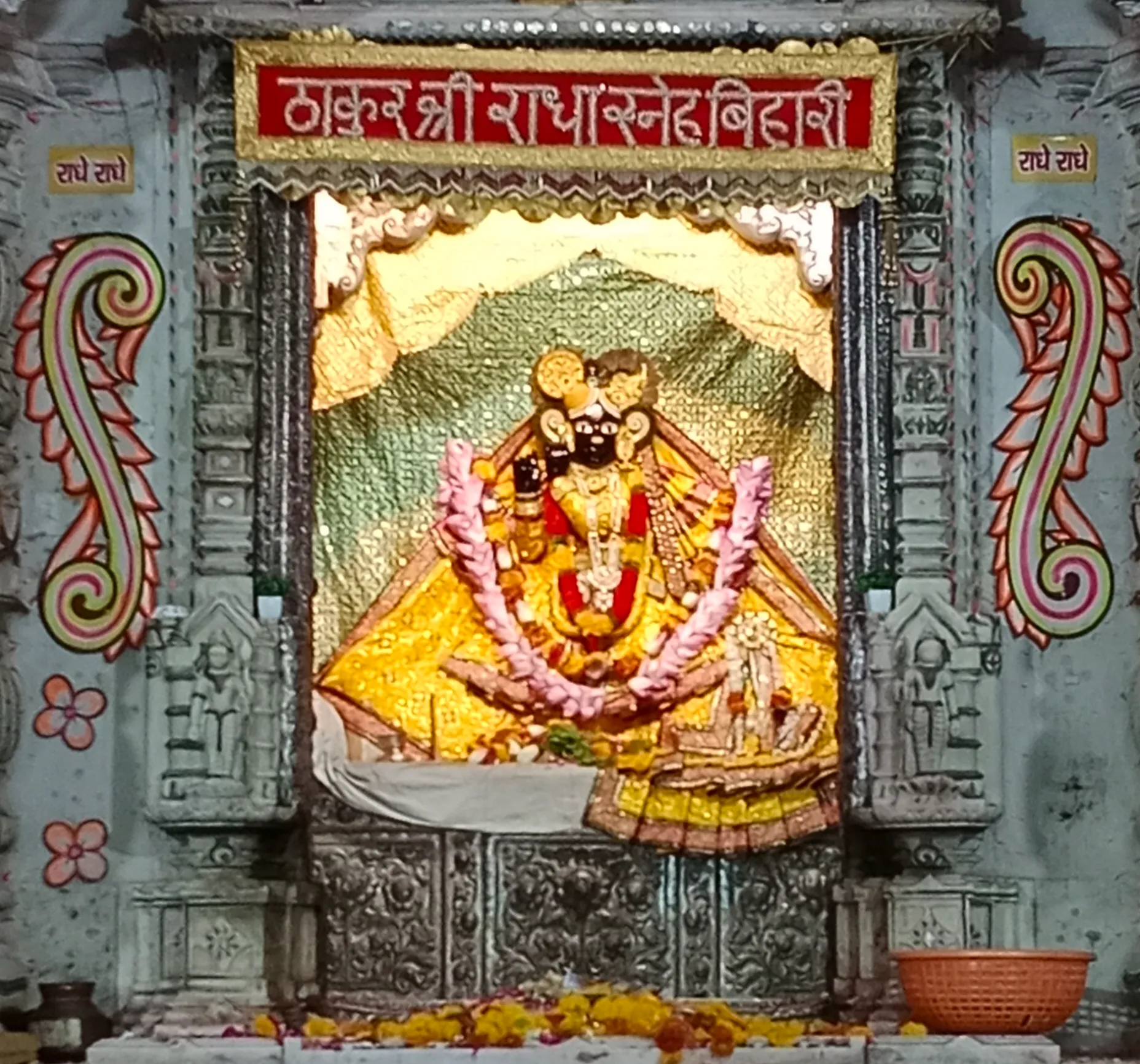
Banke Bihari (बाँके बिहारी) is Lord Krishna in his most enchanting form — a form so beautiful, so captivating, that tradition says even a moment of direct eye contact with his idol can pull the devotee out of the ordinary world entirely.
What does "Banke" mean? "Banke" (बाँके) means bent — curved — leaning. It refers to the Tribhanga posture: Krishna standing bent at three places simultaneously — the neck, the waist, and the knee. This triple curve creates the most graceful, almost playful stance. One hip tilted. One knee slightly bent. The whole body in a gentle S-shape. This is Krishna as he stands in Vrindavan — relaxed, confident, endlessly beautiful, not standing like a king or a warrior but like someone who knows exactly who he is and has nowhere in particular to be.
What does "Bihari" mean? "Bihari" (बिहारी) comes from "Vihari" — the one who enjoys, the one who roams freely, the one who plays. Specifically: the one who roams the groves and forests of Vrindavan, playing his flute, calling the gopis, teasing Radha, living the divine life of love in Braj.
Put together: Banke Bihari = The beautifully bent one who roams freely in Vrindavan. It is the name of pure divine joy.
This form is unique: This is not Krishna the cosmic deity. Not Krishna the charioteer of the Mahabharata. Not Krishna the king of Dwarka. This is Krishna of Vrindavan — the child who stole makhan (butter), the boy who played the flute by the Yamuna, the beloved who danced the Raas Leela in Nidhivan. This is Krishna at his most intimate, most personal, most approachable.
And the idol here — the one found in Nidhivan by Swami Haridas Ji — is said to be the combined form of Radha and Krishna. Not just Krishna alone. The divine couple merged into one.
FAQ: Is Banke Bihari Ji a form of Vishnu or specifically of Krishna? Krishna is the eighth avatar of Lord Vishnu — but in the Vaishnav tradition of Vrindavan, especially in the Nimbarka Sampradaya (the school of Swami Haridas Ji), Krishna is not seen as an avatar but as the original Supreme Being himself. Bihari Ji is Krishna in his most personal, human-scale form — not the cosmic formless, not the universal sovereign, but the beloved. That intimacy is the defining quality of this form.
FAQ: Why is the idol of Banke Bihari Ji dark-complexioned? Krishna's traditional iconographic color is dark blue or dark — the color of the deep ocean, the color of a monsoon cloud. This dark complexion is not incidental. It represents infinity, depth, and the mystery of consciousness itself. In Vaishnav poetry, the dark-complexioned Shyam (dark one) and the fair-complexioned Gauri (golden one, Radha) together represent the complete divine — dark sky and golden sun, night and day. The idol is described as the Shyam Sundar — the beautiful dark one.
🙏 Offer Chadhawa to Banke Bihari Ji →
📱 For any queries or Pay-After-Video: WhatsApp / Call +91 9667101992
DevPunya Promise: Video proof within 72 hours • Your name & gotra in the video • Authentic offering at Banke Bihari Temple, Vrindavan • Not satisfied? Full reschedule or complete refund — no questions asked.
<span id="origin"></span>
The Origin Story — This Ground Was Sacred Before the Temple Existed
To understand Banke Bihari Temple, you need to go back much further than Swami Haridas Ji. You need to go to the very beginning of this ground's sacred history.
Brahma Ji performed puja of Radha Krishna here.
Before the idol appeared. Before Swami Haridas Ji came to this forest. This land — what is now Nidhivan, the sacred grove connected to the Banke Bihari temple — was already a site of the most ancient devotion. Brahma Ji, the Creator of the universe, came to this place and performed the puja of Radha Krishna here.
Think about what that means. The Creator of all worlds, the one who wrote the script of creation, chose this ground in Vrindavan to offer worship to the divine couple. This was not an ordinary place. The earth here was already soaked with divine devotion before any human foot sought it out.
This is why, when Swami Haridas Ji came to Nidhivan centuries later to do his sadhana, the ground responded. The forest responded. The divine couple — who had been worshipped here from the beginning of time — was still present.
<span id="haridas"></span>
How the Idol Appeared — The Story of Swami Haridas Ji
Who was Swami Haridas Ji?
Swami Haridas Ji was born around 1478 CE in Rajpur, a village near Vrindavan. From childhood, he was immersed in devotion to Radha and Krishna. He grew up to be not just a saint but one of the greatest musicians in Indian history — the teacher of Tansen, the legendary court musician of Akbar's court.
Think about that lineage: the greatest classical musician of the Mughal era was trained by a saint who sang bhajans for Radha-Krishna in the forests of Vrindavan. Swami Haridas Ji belonged to the Nimbarka Sampradaya — the devotional tradition that places Radha and Krishna's love story at the center of all spiritual practice.
He came to Nidhivan — the sacred forest — and made it his home. He would sing here. Not perform. Not entertain. Sing with the complete abandonment of one who knows that the beloved is listening.
The Moment the Idol Appeared:
One day, at his disciples' request, Swami Haridas Ji sang a verse of devotion — a verse calling out to the divine couple. As he sang, something extraordinary happened. Shyama-Shyam — Radha and Krishna — appeared before him and his disciples, in their divine, luminous form.
At Haridas Ji's request, the divine couple merged into a single form. The two became one — and that one form became the idol of Banke Bihari that is worshipped to this day.
This was not a carved stone idol. This was a divine manifestation — a form that chose to appear. And it appeared because of the devotion of a saint, in a forest that had already been consecrated by Brahma Ji's puja, on ground that had been sacred since before recorded time.
The idol was originally called Kunj Bihari — the one who plays in the kunj (groves and bowers of Vrindavan). Haridas Ji's disciples, seeing that enchanting triple-bent posture, named him Banke Bihari — and that name carried.
From Nidhivan to the Temple:
For many years after Swami Haridas Ji, the idol was worshipped in Nidhivan itself — in the forest, intimate and personal. The present temple was built in 1864 CE when the idol was moved to a permanent temple structure in the main area of Vrindavan. The move happened after a disagreement within the community about the idol's location, and the new temple was built to give Bihari Ji a proper home accessible to all devotees.
FAQ: Is this the original idol? The same one that appeared to Swami Haridas Ji? Yes. The tradition holds that the idol in the temple today is the same that manifested before Swami Haridas Ji in Nidhivan. It has not been replaced or reconstructed. The same Bihari Ji who appeared to the saint is the one devotees see darshan of today.
FAQ: Was Tansen really a disciple of Swami Haridas Ji? This is a popular tradition and widely believed. Tansen himself, when asked in Akbar's court why his music was not as transcendent as his teacher's, reportedly said: "I sing for the emperor. My teacher sang for God." Whether this is historically verifiable or not, it captures something true about Swami Haridas Ji — his music was not art. It was devotion.
🙏 Offer Chadhawa to Banke Bihari Ji →
📱 For any queries or Pay-After-Video: WhatsApp / Call +91 9667101992
DevPunya Promise: Video proof within 72 hours • Your name & gotra in the video • Authentic offering at Banke Bihari Temple, Vrindavan • Not satisfied? Full reschedule or complete refund — no questions asked.
<span id="temple"></span>
The Temple — Architecture and Sacred Setting
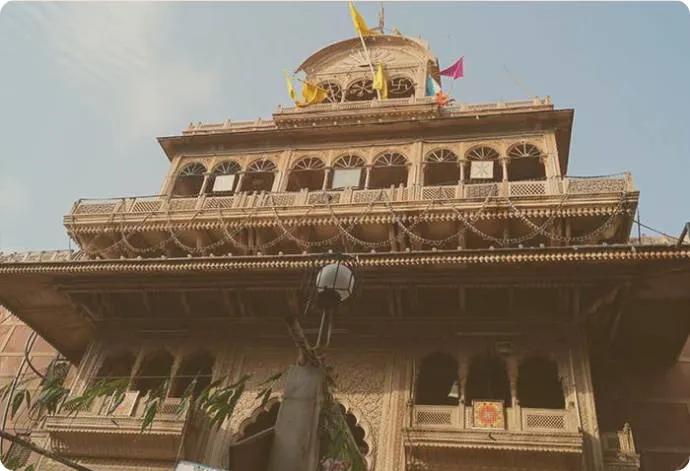
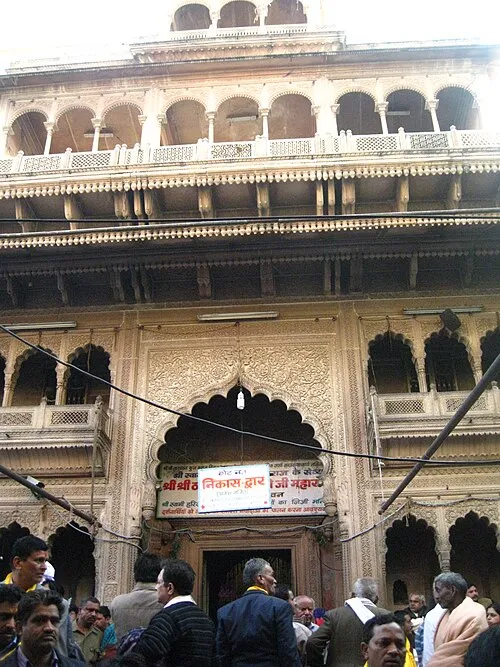
The Banke Bihari Temple stands in the heart of Vrindavan's old town, in the narrow lanes of Vrindavan Dham. It is impossible to miss — a multi-story structure built in red sandstone, with elaborate Rajasthani and Mughal-influenced architecture. Intricate carvings. Multiple arched galleries. Detailed stonework.
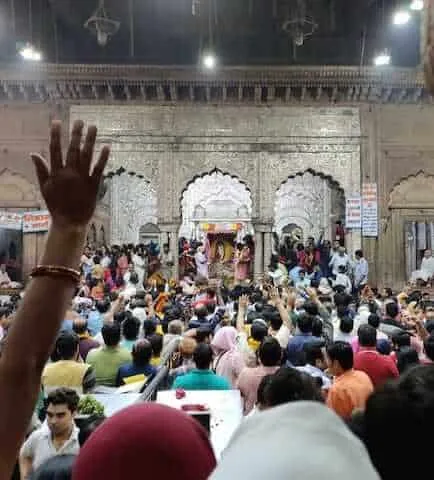
The temple draws an extraordinary number of visitors — tens of thousands on ordinary days, lakhs during festivals. The lanes leading to it are lined with flower sellers, prasad shops, and the constant sound of "Radhe Radhe" that defines Vrindavan.
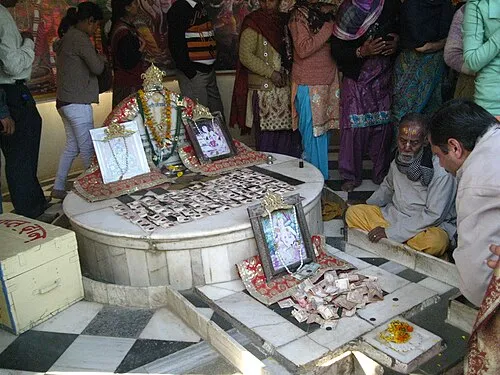
Inside, the sanctum is intimate relative to the scale of devotion it holds. Bihari Ji stands in the center — adorned every day in fresh clothes, fresh flowers, and jewelry. His eyes — slightly tilted, slightly downcast — are considered so powerful, so full of divine love, that the temple has built a unique system to protect the devotee from being overwhelmed.
FAQ: Is there an entry fee to visit Banke Bihari Temple? No. General darshan at Banke Bihari Temple is free. VIP darshan passes are available for those who want quicker access to the idol. For special occasions and festivals, crowd management systems are in place.
FAQ: What should I wear to the temple? Traditional, modest clothing is recommended — kurta-pajama, salwar kameez, saree, or dhoti. The temple is a place of active devotion, not sightseeing. Remove footwear before entering the premises. Many devotees also cover their head as a mark of respect.
<span id="traditions"></span>
Sacred Traditions That Make Banke Bihari Temple Unlike Any Other Temple in India
Most temples follow a standard pattern — bells ring, conch blows, aarti happens, devotees file past the idol. Banke Bihari Temple operates differently. The traditions here are so specific, so unusual, and so deeply rooted in love that they set this temple apart from every other Krishna temple in the country.
The Parda Tradition — Why the Curtain Opens and Closes Every Few Minutes
This is the most striking thing a first-time visitor notices. During darshan, the curtain in front of Bihari Ji opens and closes repeatedly — every few minutes. You get a few moments with him. Then the curtain falls. It opens again. Falls again.
Why?
The answer given in tradition is one of the most beautiful things about this temple: Bihari Ji's eyes are too powerful for continuous viewing. The divine love and intensity in those slightly downcast, slightly sideways eyes is believed to be so overwhelming that if a devotee looks continuously, they can lose themselves entirely — absorbed into divine bliss in a way that is too much for ordinary human consciousness to sustain.
The story of the Rajput princess: A princess from Rajasthan once came for darshan. She saw Bihari Ji. She was transfixed. She could not leave. She did not want to leave. The story says Bihari Ji himself was moved by her complete surrender — and was about to accompany her, to go with her wherever she went, such was his reciprocation of her bhakti.
The curtain was introduced to protect the devotee. To create intervals. To ensure that the experience of Bihari Ji's darshan remains within the frame of human endurance — and does not take the devotee so far that they cannot return.
To this day, the curtain falls every few minutes. Every time it opens again, there is an audible collective murmur from the crowd — "Jai Bihari Ji." The closing and opening becomes its own rhythm of longing. You wait for the curtain. It opens. You look. It falls. And the wanting begins again.
No Shankh (Conch), No Loud Bells
Walk into any typical Indian temple and you hear conches blown, bells rung, and the sharp metallic sounds that announce the deity's presence. At Banke Bihari Temple — silence instead.
Why no conch?
Bihari Ji is worshipped here as a small child — the mischievous, beloved child of Vrindavan. And this child does not like to be disturbed by loud sounds. He does not like being woken up abruptly. He does not want the sharp sound of a conch cutting through his rest.
There is also a specific tradition: the conch at Banke Bihari Temple is not blown because Bihari Ji, in his childlike divine love, once agreed to a certain way of being awakened — through the gentle call of love, not the formal blast of an instrument.
The result is that the Banke Bihari Temple has a different atmosphere from other major temples. Softer. More intimate. More like someone's home than a public ceremony.
Mangla Aarti — Only on Special Occasions
Most major temples perform Mangla Aarti before sunrise — the earliest worship that wakes the deity at dawn. Banke Bihari Temple does not follow this practice on regular days.
The reason? The same child-like tradition. Swami Haridas Ji did not favor disturbing Bihari Ji's sleep with an early morning aarti. Let the child rest. Let him wake when he is ready.
Exception: On Janmashtami (Krishna's birthday), Guru Purnima, Holi, and certain rare auspicious days, Mangla Aarti is performed. Devotees who want to experience this extraordinarily rare darshan plan their Vrindavan visit specifically for these days.
Sharad Purnima — The One Night Bihari Ji Holds His Flute
Banke Bihari Ji's idol does not hold a flute in its hands on regular days. This is distinct from most Krishna idols you see, where the flute is iconic.
There is one exception: Sharad Purnima — the full moon of the month of Ashwin (September-October). On this one night in the entire year, the idol of Bihari Ji is dressed with the murali (flute) near his lips. Devotees from across India travel specifically for this darshan — the only glimpse of Bihari Ji in his complete, flute-bearing form.
FAQ: Why does the curtain at Banke Bihari temple open and close so often? Is it to manage crowd? It is not primarily a crowd management tool — it is a devotional tradition that predates the modern crowds. The curtain's movement is rooted in the belief that Bihari Ji's darshan is so powerful that continuous viewing would overwhelm the devotee. Many visitors misunderstand it as crowd control and feel frustrated. Understanding the spiritual reason transforms the experience: each opening of the curtain becomes a gift, and each closing becomes the longing that makes the next opening more beautiful.
FAQ: Is the Banke Bihari Temple a Vaishnav temple? Yes — it belongs to the Nimbarka Sampradaya, one of the four major Vaishnav traditions. This sampradaya is specifically centered on the devotion of Radha-Krishna as the divine couple, and the worship here reflects that — Bihari Ji is the merged form of Radha and Krishna together.
🙏 Offer Chadhawa to Banke Bihari Ji →
📱 For any queries or Pay-After-Video: WhatsApp / Call +91 9667101992
DevPunya Promise: Video proof within 72 hours • Your name & gotra in the video • Authentic offering at Banke Bihari Temple, Vrindavan • Not satisfied? Full reschedule or complete refund — no questions asked.
<span id="nidhivan"></span>
Nidhivan — The Mystical Sacred Forest of Vrindavan
A short walk from the Banke Bihari Temple lies Nidhivan — the forest where it all began. Where Brahma Ji performed the original puja. Where Swami Haridas Ji sang and the divine couple appeared. And where, according to the belief of millions of devotees, Lord Krishna still comes every night.
Nidhi-van (निधिवन) means "Forest of Treasure." The name is ancient. The forest is small — a few enclosed acres in the middle of Vrindavan's urban sprawl. But inside, it is otherworldly.
The trees here grow in a form unlike any others you will see. The branches curve and twist downward instead of upward. The trunks are gnarled in spiraling patterns. The whole grove has the quality of a place that bends by different rules than the rest of the world.
What happens here at night:
According to the deepest tradition of Vrindavan — held by saints, priests, locals, and devotees for centuries — Krishna comes to Nidhivan every night to perform the Raas Leela. When he comes, the trees become gopis. The forest fills with divine presence. Radha and Krishna dance here in the darkness, in the way they danced when this was Vrindavan of 5,000 years ago.
At sunset, all the birds leave Nidhivan on their own. The animals leave. The priests lock the gates. No one is allowed inside after the evening aarti.
The Rang Mahal:
Inside Nidhivan stands the Rang Mahal — Radha's adornment room. Every evening, the priests lay out a bed, a pitcher of water, and paan (betel leaf). They close the Rang Mahal from outside and leave. In the morning, the bed shows signs of having been slept in. The water has been touched. The paan has been tasted.
The door was locked from outside. No one came in. And yet.
What happens to those who have tried to witness the night:
People who have attempted to hide in Nidhivan to witness the Raas Leela have reportedly returned in altered states — some unable to speak, some whose eyesight was affected, some who simply went silent for the rest of their lives. The tradition is not a warning to scare visitors away. It is a boundary born of experience — the experience of human beings encountering something too intense for ordinary consciousness to process.
The belief is not that Nidhivan is dangerous. It is that the divine love happening there is simply beyond what a human mind can witness and remain unchanged.
FAQ: Can I visit Nidhivan during the day? Yes. Nidhivan is open for visitors during the day — you can walk through the grove, see the Rang Mahal, and witness the unusual tree formations. The mystical dimension of Nidhivan is experienced at night, but the daytime visit is deeply moving on its own. Being in the same ground where Swami Haridas Ji sang and the idol appeared has its own quality.
FAQ: Is the Raas Leela belief at Nidhivan found in scripture? The belief that Krishna still performs Raas Leela at Nidhivan is part of the living tradition of Vrindavan — held by the temple priests, the sampradaya lineages, and the saints who have lived here for generations. It is not a story in a Purana with chapter and verse. It is the living faith of a city that has kept this belief alive for over 500 years, through generations of devotees who have witnessed the morning evidence and drawn their own conclusions.
🙏 Offer Chadhawa to Banke Bihari Ji →
📱 For any queries or Pay-After-Video: WhatsApp / Call +91 9667101992
DevPunya Promise: Video proof within 72 hours • Your name & gotra in the video • Authentic offering at Banke Bihari Temple, Vrindavan • Not satisfied? Full reschedule or complete refund — no questions asked.
<span id="yamuna"></span>
The Yamuna River — Sacred Artery of Vrindavan
Vrindavan sits on the western bank of the Yamuna River — the river that runs through every story Krishna ever lived.
Krishna herded his cows along the Yamuna's banks. He swam in these waters. He subdued the serpent Kaliya in this river. He played with the gopis at Keshi Ghat. He and Radha walked these banks in the evenings when the light turned golden and Vrindavan became the most beautiful place in any world.
Keshi Ghat, just a few kilometers from the Banke Bihari Temple, is the most famous ghat in Vrindavan — the spot where Krishna is said to have killed the demon Keshi and then bathed in the Yamuna. The ghat steps lead down to the river, and early mornings here — when the mist is on the water and the aartis are being performed — are considered among the most spiritually charged moments in all of Vrindavan.
For the devotee who comes to Banke Bihari Temple, the Yamuna is not just a nearby river. It is the river that shaped the god they are worshipping. The water here has known him.
FAQ: Can I take a dip in the Yamuna at Vrindavan? Yes. Bathing in the Yamuna at Vrindavan's ghats is considered highly auspicious. Keshi Ghat is the most significant. Many pilgrims take a ritual dip before visiting the temples. The Yamuna's waters in Vrindavan are considered sacred due to Krishna's direct association with the river.
<span id="why-devotees"></span>
Why Devotees Come — What Bihari Ji Fulfills
Banke Bihari Ji is not worshipped primarily as a deity of power or protection. He is worshipped as the beloved — and in that role, he fulfills things that formal rituals often cannot.
The devotee of Bihari Ji comes not to demand but to be in his presence. The love-tradition (prema-bhakti) of Vrindavan does not work through transactions. It works through surrender. You come, you offer your love, and Bihari Ji — who is the embodiment of divine love — responds.
What the tradition says he fulfills:
- Love, relationships, and marriage — he is the deity of divine love, and those seeking love in their lives have come to him for centuries
- Business and prosperity — the businessman who wants divine protection on his work, the trader who wants obstacles removed
- Family harmony — peace in the home, resolution of conflicts between family members
- Children and family growth — couples seeking children, families seeking unity
- Students and learning — those appearing for exams who seek blessing
- Karmic cleansing — those who feel weighed down by past actions and seek lightness
- General wellbeing and grace — and the devotee who simply loves him and comes for no reason except the joy of being in his presence
Every sincere offering at Bihari Ji's feet carries weight here. The tradition is that Bihari Ji listens — attentively, personally, to every single devotee who comes. The stories of miracles at this temple are not about grand interventions. They are about a judge's case being mysteriously resolved, a blind man having his sight restored, a couple finally receiving the child they had prayed for.
The deity here is not distant. He is present. Personal. Responsive. That is the nature of the god of love.
Can't travel to Vrindavan? DevPunya performs chadhawa at Banke Bihari Temple on your behalf and sends you video proof within 72 hours — so your offering reaches Bihari Ji's feet at the actual temple in Vrindavan.
🙏 Offer Chadhawa to Banke Bihari Ji →
📱 For any queries or Pay-After-Video: WhatsApp / Call +91 9667101992
DevPunya Promise: Video proof within 72 hours • Your name & gotra in the video • Authentic offering at Banke Bihari Temple, Vrindavan • Not satisfied? Full reschedule or complete refund — no questions asked.
<span id="aarti-timings"></span>
Aarti Timings & Darshan Hours
Banke Bihari Temple follows a unique daily schedule rooted in Swami Haridas Ji's tradition — Bihari Ji is given full rest and the aarti structure honors his child-like nature.
Summer Schedule (April – September):
| Ceremony | Time |
|---|---|
| Temple Opens / Shringar Aarti | 7:45 – 8:00 AM |
| Raj Bhog Aarti | 12:00 PM |
| Temple Closes (Afternoon) | ~12:30 PM |
| Evening Opening | 5:30 PM |
| Gwal Aarti (Evening) | 5:30 PM |
| Shayan Aarti (Sleep) | 9:30 PM |
| Temple Closes | 9:30 PM |
Winter Schedule (October – March):
| Ceremony | Time |
|---|---|
| Temple Opens / Shringar Aarti | 8:45 – 9:00 AM |
| Raj Bhog Aarti | 1:00 PM |
| Temple Closes (Afternoon) | ~1:30 PM |
| Evening Opening | 4:30 PM |
| Gwal Aarti (Evening) | 4:30 PM |
| Shayan Aarti (Sleep) | 8:30 PM |
| Temple Closes | 8:30 PM |
Special: Mangla Aarti (before sunrise) Only on: Janmashtami, Guru Purnima, Holi, and select auspicious occasions. Summer timing: 4:30 AM | Winter timing: 5:30 AM
Timings may vary during festivals. Confirm locally before planning.
FAQ: Which aarti at Banke Bihari is considered most auspicious to attend? The Shringar Aarti (morning) is considered most auspicious by devotees — it is the first darshan of the day when Bihari Ji has just been bathed and dressed in fresh clothes and flowers. The Gwal Aarti (evening) is the most vibrant — the crowd, the bhajans, the energy in the temple at dusk is something visitors describe as unlike anywhere else. The Mangla Aarti on Janmashtami is the rarest and most intense — many devotees plan their entire year around attending it.
<span id="holi"></span>
Holi at Banke Bihari — India's Most Vibrant and Soul-Stirring Holi Celebration
If there is one thing that draws the world to Vrindavan, it is Holi. And at the center of Vrindavan's Holi is Banke Bihari Temple.
Holi was not invented as a spring festival. It was born here — in Braj, in the leelas of Krishna and Radha. Krishna would play with colors with the gopis. He would splash Radha with gulaal. The celebrations at Vrindavan are not a modern recreation of the festival — they are the continuation of what began here thousands of years ago.
How long does Holi last at Vrindavan?
Holi in Vrindavan lasts approximately 10 days — not one day like the rest of India. It begins a week before the main Holi date with different celebrations at different temples, and the energy builds gradually until the climax at the main Holi bonfire (Holika Dahan).
Phoolon Wali Holi — The Flower Holi at Banke Bihari:
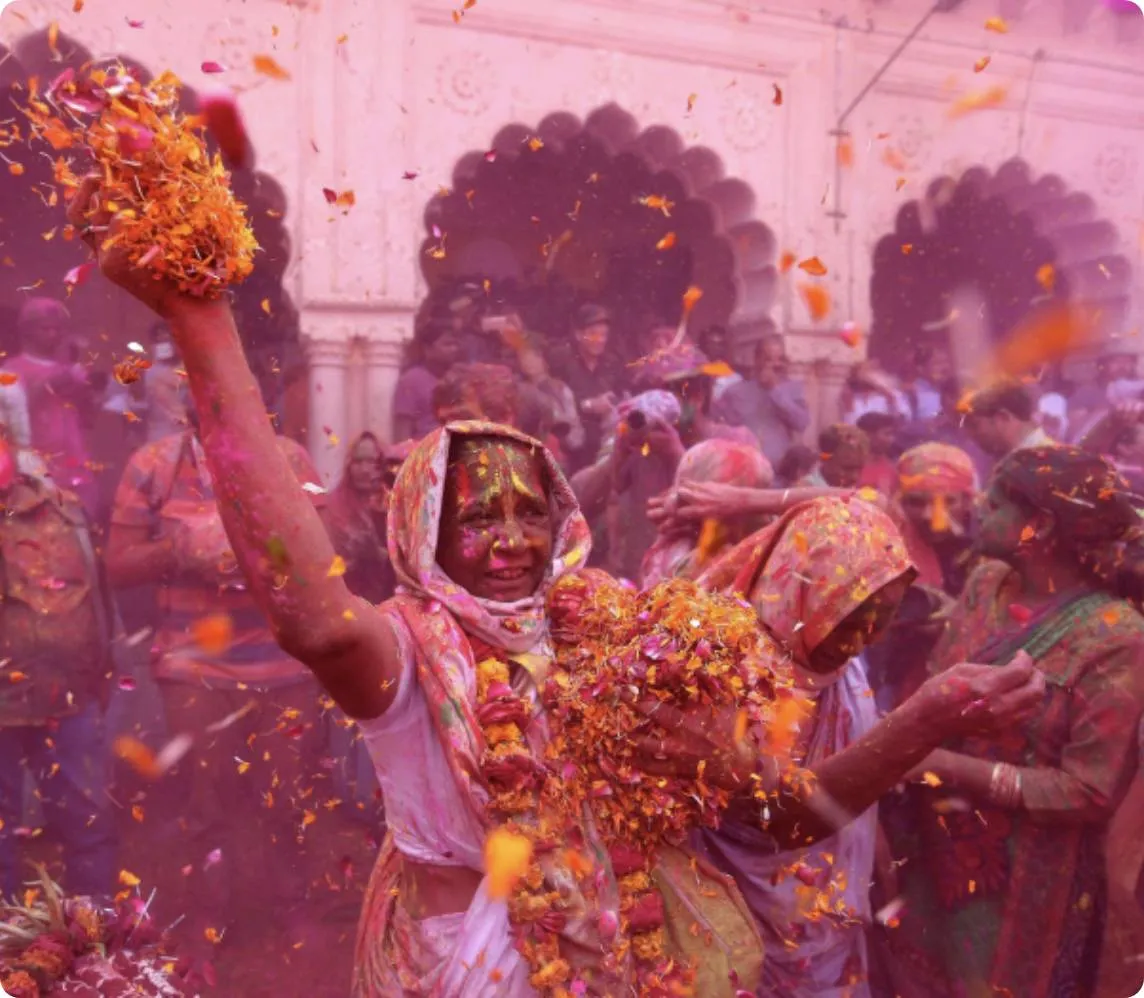
The most unique and visually extraordinary event happens at Banke Bihari Temple: Phoolon Wali Holi — Holi celebrated with flowers, not chemical colors.
The stage is the temple itself. Priests and attendants shower the entire crowd with thousands of flower petals — rose, lotus, marigold. The air turns gold and red and orange with flowers. Devotees, covered in petals, raise their hands, chant "Radhe Radhe," and experience something that is simultaneously a festival and a darshan.
This is how it is believed Holi was originally played in Krishna's time — not with synthetic gulaal but with the flowers of Vrindavan's forests.
2026 Phoolon Wali Holi at Banke Bihari: March 2, 2026 at approximately 4 PM (15-20 minutes).
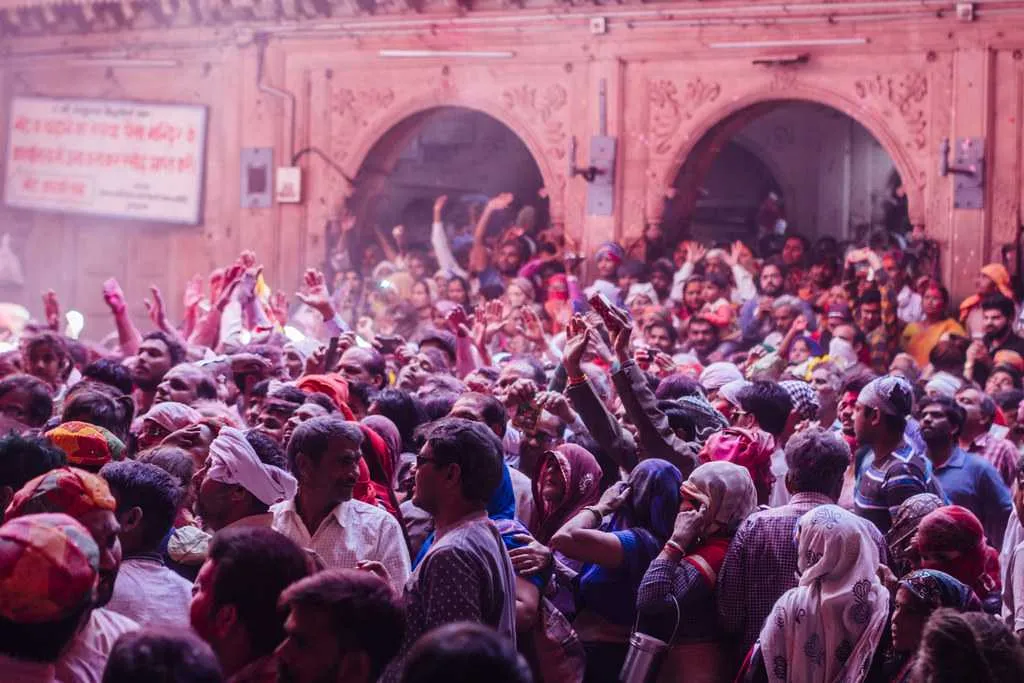
Gulaal Holi: Alongside the flowers, the traditional gulaal (herbal colored powder) is played with devotion. The gulaal filling the air around the temple, the crowd of thousands, the sound of bhajans and the sight of everyone covered in pink and saffron — this is the Holi that people travel from across the world to witness.
The Parda During Holi: Even in the midst of the most vibrant Holi celebration, the curtain tradition continues. The parda opens and closes for Bihari Ji's darshan even as flowers and gulaal fill the air. This continuity — the sacred tradition unbroken even in the middle of a festival — speaks to how deeply these customs are held.
FAQ: Can non-Hindus attend Holi at Banke Bihari Temple? Yes. Holi at Vrindavan — and specifically at Banke Bihari Temple — draws international visitors from every country and every faith. Bihari Ji's love is not restricted by religion. Come with a joyful heart, wear clothes you don't mind getting colored, and participate in the celebration fully.
FAQ: Is it safe to attend Holi at Banke Bihari? The Phoolon Wali Holi at the temple is very safe — it is a 15-20 minute event in an organized temple setting. The gulaal Holi in the lanes of Vrindavan is more intense and requires common sense about your surroundings. Going with a group is recommended. The overall atmosphere is devotional, not disorderly.
FAQ: When exactly is Phoolon Wali Holi at Banke Bihari Temple? It changes each year based on the Hindu calendar. It is celebrated close to Holi week — typically the afternoon of the day before or during Holi. Confirm dates locally or through the temple's official calendar. For 2026, it falls on March 2 at approximately 4 PM.
Celebrate with Bihari Ji even from far — offer Gulaal or Pichkari chadhawa at the temple this festive season. Your offering, your name and gotra, presented at Bihari Ji's feet in Vrindavan with full video proof.
🙏 Offer Gulaal / Pichkari Chadhawa for Holi →
📱 WhatsApp / Call +91 9667101992
DevPunya Promise: Video proof within 72 hours • Your name & gotra in the video • Authentic offering at Banke Bihari Temple, Vrindavan • Not satisfied? Full reschedule or complete refund — no questions asked.
<span id="festivals"></span>
Other Major Festivals at Banke Bihari Temple
Janmashtami — Krishna's Birthday
Janmashtami is the biggest festival in Vrindavan's calendar, and Banke Bihari Temple becomes the center of the universe for devotees on this night.
The celebration builds for weeks. On the night itself, the temple is decorated with extraordinary attention — new clothes for Bihari Ji, fresh flowers, special lighting. At midnight — the hour of Krishna's birth — the atmosphere reaches its peak. Thousands of devotees are in the temple and its surrounding lanes.
The rare Mangla Aarti: On Janmashtami, Mangla Aarti is performed at 4:30 AM (summer) / 5:30 AM (winter) — breaking the usual no-early-aarti tradition. Devotees who attend the midnight celebration often stay through the night for this Mangla Aarti.
Jhulanotsav — The Swing Festival
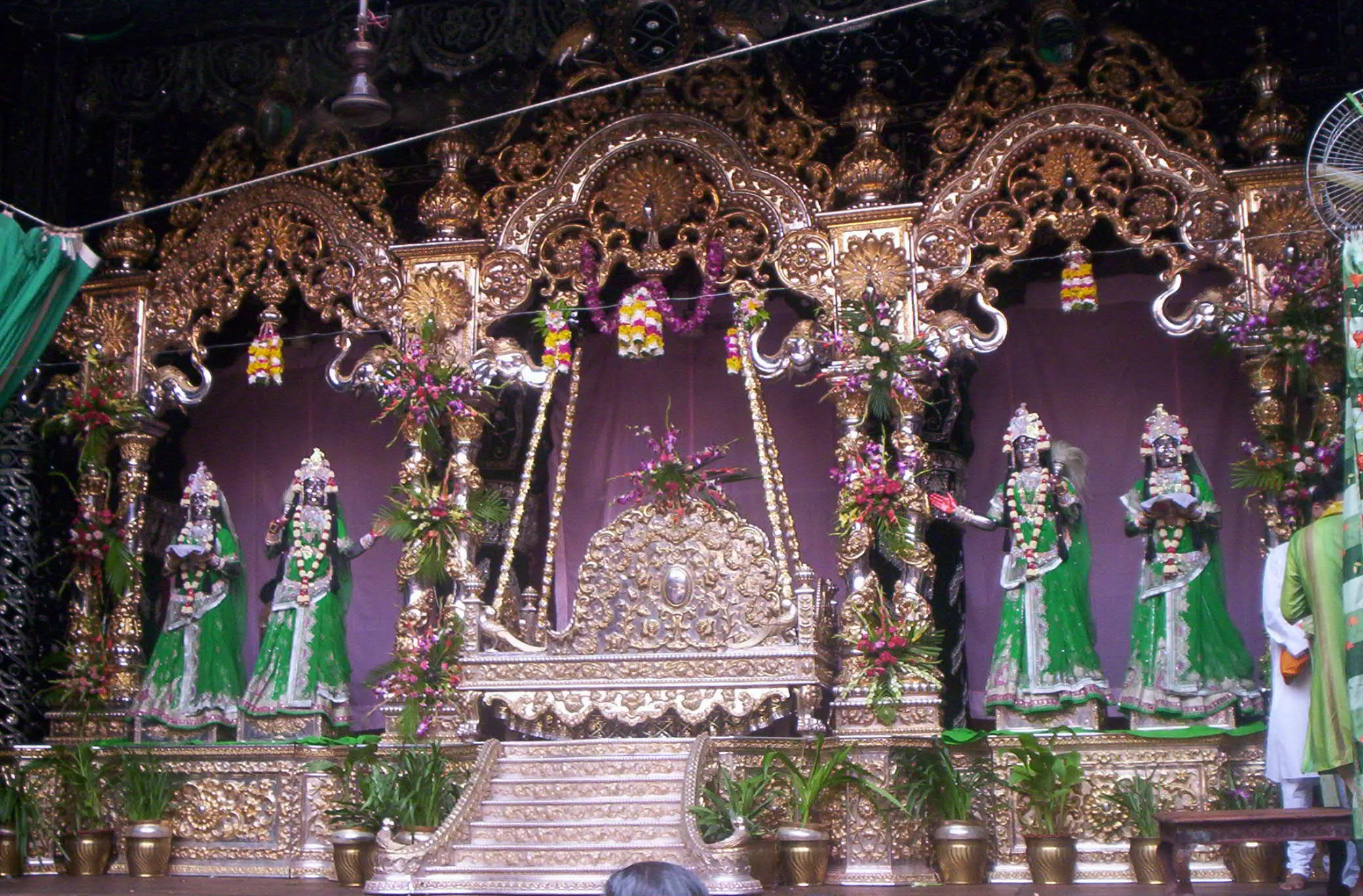
Celebrated during the monsoon month of Shravan (July-August), Jhulanotsav is a festival of pure beauty. The idol of Bihari Ji is placed on an ornately decorated swing — a golden, flower-laden jhoola — and gently rocked by the priests while devotees sing jhulana bhajans.
The rain outside, the flowers inside, the gentle swinging of the idol, and the sound of monsoon bhajans together create one of the most tender experiences in Vrindavan's festival calendar.
Sharad Purnima — The Night of the Flute
As described earlier: the one night in the year when Bihari Ji holds his murali. The full moon of Ashwin (September-October). Tens of thousands travel specifically for this darshan.
Ekadashi
Ekadashi (the 11th day of each lunar fortnight) is observed with special darshan and devotional programs. Putrada Ekadashi and Nirjala Ekadashi are among the most important, drawing large gatherings and extended darshan timings.
<span id="how-to-reach"></span>
How to Reach Banke Bihari Temple, Vrindavan
Vrindavan is well connected and easy to reach from major cities.
From Delhi:
| Route | Distance | Time |
|---|---|---|
| Via Yamuna Expressway | ~150 km | ~2.5–3 hours |
| By Bus (UPSRTC/private) | ~150 km | ~3–4 hours |
The Yamuna Expressway is the fastest and most comfortable option for those driving from Delhi. Take the Mathura exit and then follow signs to Vrindavan (12 km from Mathura town).
From Other Cities:
| From | Distance | Route |
|---|---|---|
| Mathura | 12 km | Taxi/auto — 30 minutes |
| Agra | ~60 km | ~1.5–2 hours by road |
| Lucknow | ~300 km | ~5 hours by road |
| Jaipur | ~240 km | ~4 hours by road |
By Train: Nearest railway station: Mathura Junction (MTJ) — 12 km from Vrindavan, well-connected to Delhi, Lucknow, Agra, Mumbai, and most major cities. Top trains: Gatimaan Express (from Delhi — fastest), Taj Express, Intercity Express. From Mathura, take an auto-rickshaw or taxi to Vrindavan (~₹100–150).
By Air: Nearest airport: Indira Gandhi International Airport, Delhi (~150 km). Agra Airport is closer (flights limited). Most visitors fly to Delhi and drive or take a train from there.
Getting to the Temple from Vrindavan Bus Stand / Station: The Banke Bihari Temple is in the old town lanes — auto-rickshaw from any point in Vrindavan will take you close. The final stretch to the temple entrance is on foot through the narrow lanes (no vehicles). Give yourself 15-20 minutes to walk from the parking area, especially during peak season when the lanes are crowded.
FAQ: Is Vrindavan easy to navigate? It can feel overwhelming to first-time visitors. Vrindavan is compact but dense — narrow lanes, constant activity, thousands of temples. First-time visitors often feel slightly disoriented. A few practical things: hire a local auto or cycle-rickshaw driver who knows the area; keep the name "Banke Bihari Mandir" ready to show in Hindi if needed; reach early in the morning to avoid peak crowd hours. And most importantly — allow yourself to get slightly lost. That is often how Vrindavan reveals itself.
If visiting in person isn't possible right now — because of distance, health, work, or anything else — your offering can still reach Bihari Ji's feet in Vrindavan. DevPunya performs the chadhawa at the actual temple and delivers your video proof within 72 hours.
🙏 Offer Chadhawa at Banke Bihari Temple, Vrindavan →
📱 Want to see the video first, pay after? WhatsApp / Call +91 9667101992
DevPunya Promise: Video proof within 72 hours • Your name & gotra in the video • Authentic offering at Banke Bihari Temple, Vrindavan • Not satisfied? Full reschedule or complete refund — no questions asked.
<span id="chadhawa-meaning"></span>
What is Chadhawa? The Tradition of Offering to the Beloved
Chadhawa (चढ़ावा) is the act of offering something to the deity — placing it at the god's feet as an expression of love, gratitude, or devotion. The word simply means "to offer up."
At a Vaishnav temple like Banke Bihari, chadhawa carries a specific emotional quality. You are not transacting with a vending machine — you are not exchanging an offering for a result. You are doing something much more intimate: you are giving a gift to someone you love.
Think about how Krishna is described in Vaishnav tradition. He is the beloved — the one who received makhan stolen from the neighbors' pots with the same delight as the most elaborate ritual offering. He is the one who accepted a handful of flattened rice from his poor friend Sudama with more joy than he ever received from a king's banquet. What mattered was never the scale of the offering. It was the love behind it.
When you offer chadhawa to Banke Bihari Ji, you are participating in this ancient tradition of seva (service and love). Your name and gotra are taken at the time of the offering — so it is not anonymous. It is personal. Bihari Ji receives it from you, from your family, by name.
FAQ: Why is gotra taken for chadhawa? Gotra is your ancestral family lineage — it identifies your specific lineage within the larger family of humanity. When the priest performs the chadhawa with your name and gotra, it creates a precise spiritual address — this offering is from this specific person, of this specific lineage. The offering is not generalized. It reaches you.
<span id="chadhawa-items"></span>
The Chadhawa Offerings for Banke Bihari Ji — What You Can Offer
Each offering has its own tradition, its own story, its own connection to Krishna's leelas. None of these are invented for modern consumption. Each has roots in what Krishna loved, what Krishna played with, what Krishna received with joy.
Offer Murali (Flute)
The flute is Krishna's most iconic attribute. The murali is how he called the gopis, how he expressed the inexpressible, how his divine love traveled across the Yamuna's banks into every corner of Vrindavan. When Krishna plays the flute, the entire creation listens — the rivers pause, the cows turn, the gopis leave whatever they are doing and follow the sound.
Offering the flute to Bihari Ji is an offering of his own identity — his music, his call, his language of love. It is an extraordinarily intimate gesture.
Traditionally, offering a murali is associated with removing obstacles in love and marriage — because the flute was how Krishna called his beloved. When you offer the murali, you are invoking that energy of divine calling, divine meeting.
Makhan Bhog (Butter Offering)
Makhan — pure white fresh butter — is what Krishna stole from neighbors' pots as a child. Makhan is his food, his joy, his most beloved taste. The entire mythology of Makhan Chor (the butter thief) is centered on how much Bihari Ji loves makhan.
This is not a complex offering. It is the simplest, most direct thing you can give him — what he has always loved.
Makhan Bhog is associated with abundance, nourishment, and removing the roughness and hardship from life. Just as makhan is soft and full, this offering is believed to bring softness and fullness to the devotee's circumstances.
Mishri Bhog (Rock Sugar Offering)
Mishri — crystallized rock sugar — is perhaps the most traditional offering at any Krishna temple. Krishna loved mishri. It is sweet, pure, and associated with joy.
The tradition says offering mishri to Bihari Ji removes bitterness — from relationships, from situations, from the mind itself. Mishri dissolves. Bitterness, if offered up, is replaced by sweetness.
For those dealing with conflict, estrangement, or situations that have turned sour — mishri bhog is the traditional offering.
Kanha Vastra (Sacred Dress)
Dressing the beloved is one of the highest acts of seva in Vaishnav tradition. Krishna is dressed every day at Banke Bihari Temple — his clothes changed with the seasons, the festivals, the days. The priest who dresses Bihari Ji is performing one of the most intimate acts of devotion.
When you offer Kanha Vastra, you are participating in that seva. You are clothing the beloved with your love and care.
This offering is associated with prosperity and protection — the tradition that when you clothe the Lord, the Lord clothes you with grace and abundance.
MorPankh (Peacock Feather)
The peacock feather in Krishna's crown is one of the most recognizable images in Hindu art. But why does Krishna wear it?
In Vrindavan tradition, when Krishna played the flute, even the peacocks danced. The peacock, moved by the divine music, shed a feather and offered it to Krishna. Krishna accepted it — and wore it in his hair, in his crown, ever since. The MorPankh is a gift from creation to the creator, received with love.
Offering MorPankh to Bihari Ji is considered especially auspicious for students, for those appearing in examinations, for those seeking clarity of mind and divine grace in learning.
Gulaal Offering
Gulaal — the sacred colored powder — is the offering of Holi. Krishna played Holi with gulaal. Offering gulaal at Bihari Ji's feet is an act of participatory joy — joining in his divine play, even from far away.
This offering is available year-round, not just during Holi. Because for Bihari Ji, every day in Vrindavan is a celebration.
Pichkari Offering
The pichkari — the traditional syringe used to spray colored water during Holi — is among the most playful offerings you can make. It connects directly to Krishna's Holi leelas, to his joyful, mischievous nature.
This offering is for those who want to connect to the joy of Bihari Ji — his playful, festive side. It is the offering of someone who comes not with a problem but with a desire to celebrate.
Gau Seva (Cow Service)
The cow is inseparable from Krishna's identity. He was Gopal — the cowherd. He tended cows from childhood. He loved them with the same easy affection he gave to the gopis and to Radha.
Gau Seva — contributing to the care and feeding of cows in the service of the temple — is considered one of the most meritorious acts of devotion in Vaishnav tradition. When you support Gau Seva, you are caring for what Krishna cared for.
This offering is associated with merit, karmic cleansing, and the accumulation of divine grace over time.
🙏 Offer Chadhawa to Banke Bihari Ji →
📱 For any queries or to use our Pay-After-Video option: WhatsApp / Call +91 9667101992
DevPunya Promise: Video proof delivered within 72 hours • Your name & gotra clearly included in the video • Authentic offering at the Banke Bihari Temple • Not satisfied? Full reschedule or complete refund — no questions asked.
<span id="which-chadhawa"></span>
Which Chadhawa is Best For... — Honest Answers Based on Tradition
These are the questions devotees actually ask. Here are honest answers — rooted in what the tradition says, not in what sells.
Which chadhawa is Banke Bihari Ji most pleased by?
The tradition's honest answer is: Makhan and Mishri.
These are the offerings most deeply tied to Krishna's own story — the makhan he stole as a child, the mishri that represents pure sweetness. If you want to offer what Bihari Ji loves from the heart of his own leelas, these two are what tradition points to.
That said, Bihari Ji is not a deity who grades offerings. The flute he plays, the peacock feather in his hair, the vastra he wears — all of these are equally beloved parts of his being. An offering made with genuine love, whatever it is, reaches him.
Offer Makhan Bhog or Mishri Bhog → 🙏 devpunya.com/chadhaava/v2/[id]
📱 WhatsApp / Call +91 9667101992
Which chadhawa is best for love marriage?
The Murali (flute) is the traditional answer. The murali is how Krishna called his beloved. When Radha heard the flute, she left everything and came. The flute is the sound of divine calling, of one soul calling another across all obstacles.
Offering the murali at Bihari Ji's feet when you seek a specific person, when there are obstacles in your love, when you want the right person to come into your life — this is what devotees have done for generations.
Offer Murali → 🙏 devpunya.com/chadhaava/v2/[id]
📱 WhatsApp / Call +91 9667101992
Which chadhawa is best for peace and harmony at home?
Mishri Bhog. The tradition is direct about this: mishri removes bitterness. For a household where there is conflict, misunderstanding, distance between family members, or where the sweetness has gone out of relationships — offering mishri to Bihari Ji is the traditional remedy.
Makhan Bhog also works for this — makhan represents nourishment and fullness, the quality that a harmonious home should have.
Offer Mishri Bhog → 🙏 devpunya.com/chadhaava/v2/[id]
📱 WhatsApp / Call +91 9667101992
Which chadhawa is best for business success and financial growth?
Kanha Vastra is associated with prosperity and protection — in the tradition that clothing the Lord brings divine abundance in return. It is a tangible, meaningful seva.
Gau Seva is also traditionally associated with long-term prosperity — the accumulation of merit (punya) that creates favorable conditions over time.
Offer Kanha Vastra or Gau Seva → 🙏 devpunya.com/chadhaava/v2/[id]
📱 WhatsApp / Call +91 9667101992
Which chadhawa is best for students and exams?
MorPankh. On the DevPunya page itself, MorPankh is specifically described as blessings for examinations. The peacock feather represents the dance of creation responding to divine grace — a beautiful, apt symbol for a student seeking clarity and success.
Offer MorPankh → 🙏 devpunya.com/chadhaava/v2/[id]
📱 WhatsApp / Call +91 9667101992
Which chadhawa is best to offer during Holi or a festival?
Gulaal and Pichkari — both naturally. Offering what Krishna played with during his own divine Holi, at his own temple, during the celebration — this is the most aligned offering for the festive season. It is joining in his joy rather than approaching him with a request.
Offer Gulaal or Pichkari → 🙏 devpunya.com/chadhaava/v2/[id]
📱 WhatsApp / Call +91 9667101992
Can I offer multiple chadhawa items together?
Yes. Many devotees offer a combination — Makhan and Mishri together (the classic pairing), or MorPankh with Murali, or Vastra with Gau Seva. There is no prescribed formula. Choose what feels right from the heart and what resonates with your intention.
<span id="four-benefits"></span>
4 Benefits of Offering Chadhawa to Banke Bihari Ji
<span id="business"></span>
1. Business Success & Financial Prosperity
The devotional understanding: In Hindu tradition, wealth and prosperity are not purely the result of human effort — they are also a flow of divine grace. When that grace is flowing, your efforts multiply. When there are blocks — karmic, spiritual, energetic — the same effort yields less.
Banke Bihari Ji, as the supreme enjoyer (Bihari), is traditionally invoked for the removal of these blocks. His energy is associated with abundance — the abundance of the Vrindavan groves, the abundance of a life lived in divine love, the natural fullness that comes when one is aligned with the divine.
What the offering does: When you offer chadhawa with the intention of your business's growth — Kanha Vastra for divine protection, Gau Seva for accumulated merit, Makhan Bhog for nourishment and abundance — you are inviting Bihari Ji's grace into your work. The offering creates a link between your effort and divine support.
Keep working. Keep building. The chadhawa is not a substitute for your effort — it is a way of inviting grace to meet your effort.
🙏 Offer Chadhawa for Business Prosperity →
📱 WhatsApp / Call +91 9667101992 DevPunya Promise: Video in 72 hours • Your name & gotra in the video • Full refund if not satisfied, no questions asked
<span id="peace-harmony"></span>
2. Peaceful Home & Relationship Harmony
The devotional understanding: A home is not just a physical structure — it has an energy, an atmosphere, a quality of feeling. Some homes feel peaceful even when things are difficult. Others feel heavy even when externally everything is fine.
When relationships within a family are strained, when there is unspoken conflict, when the sweetness has gone out of a marriage or a parent-child relationship — the Vaishnav tradition recognizes this as something that can be addressed through devotion.
Bihari Ji is the deity of love and divine relationship — the most intimate, loving relationship in all of mythology (Radha-Krishna) is what he embodies. Invoking his energy specifically for relationship harmony carries genuine weight.
What the offering does: Mishri Bhog for removing bitterness. Makhan Bhog for bringing nourishment and care back into the relationship. These are not arbitrary choices — they are rooted in what Krishna himself represents: the god who loved without conditions, who gave without accounting.
🙏 Offer Chadhawa for Home Harmony →
📱 WhatsApp / Call +91 9667101992 DevPunya Promise: Video in 72 hours • Your name & gotra in the video • Full refund if not satisfied, no questions asked
<span id="karmic-cleansing"></span>
3. Karmic Cleansing & Wish Fulfillment
The devotional understanding: Everyone carries karmic weight — accumulated from actions, from unresolved situations, from things left undone or done wrongly. This weight does not disappear on its own. It shapes circumstances, colors experiences, creates patterns.
In the Vaishnav tradition, sincere devotion to Krishna — seva, love, offering — is one of the most powerful ways to begin clearing this weight. Not because karma is being bypassed, but because sincere love and devotion generate merit (punya) that balances and gradually dissolves accumulated negative karma.
What the offering does: Gau Seva is specifically associated with karmic merit — the act of caring for what Krishna cared for, which generates deep punya over time. Regular chadhawa, offered with sincere intention and love, builds this connection gradually.
🙏 Offer Chadhawa for Karmic Cleansing →
📱 WhatsApp / Call +91 9667101992 DevPunya Promise: Video in 72 hours • Your name & gotra in the video • Full refund if not satisfied, no questions asked
<span id="love-marriage"></span>
4. Love, Marriage & Family Growth
The devotional understanding: Banke Bihari Ji is above all the deity of love. Not love in a greeting-card sense — love as the highest force in the universe, the force that moves Krishna to play his flute, that moves Radha to leave everything and come, that moves all of creation toward beauty and joy.
For those seeking a life partner, facing obstacles in a love relationship, dealing with family resistance to a marriage, or seeking the growth of their family through children — Bihari Ji's energy is the most directly aligned.
What the offering does: The Murali for the calling of the beloved. The Mishri for sweetness in relationships. The MorPankh for divine grace. These offerings, made with sincere intention and love, create a devotional link between the devotee and the energy of divine love that Bihari Ji embodies.
The result — whether and how it manifests — is between you and Bihari Ji. What the tradition consistently says is that sincere love directed at the deity of love is never wasted.
🙏 Offer Chadhawa for Love & Marriage →
📱 WhatsApp / Call +91 9667101992 DevPunya Promise: Video in 72 hours • Your name & gotra in the video • Full refund if not satisfied, no questions asked
<span id="devpunya"></span>
DevPunya Chadhawa Service at Banke Bihari Temple
DevPunya performs chadhawa at the Banke Bihari Temple, Vrindavan on your behalf.
How it works: You choose your chadhawa items and complete your booking with your name and gotra details. A DevPunya representative performs the chadhawa at the actual Banke Bihari Temple — the items are offered at the feet of Bihari Ji at the sacred temple in Vrindavan. Your name and gotra are clearly included in the offering.
What you receive: A video proof of your chadhawa being performed at the Banke Bihari Temple — delivered to you within 72 hours. You can see the temple, see the offering, and see your name and gotra included. The video is your confirmation that your devotion reached Bihari Ji's feet in Vrindavan.
The Pay-After-Video option: If you want to see the video of the chadhawa first and pay only after you are satisfied with what you see — DevPunya offers this option. Contact us on WhatsApp or call before booking: 📱 +91 9667101992
This option reflects a simple belief: we are confident in what we do. If you want proof before payment, we will provide it.
The DevPunya difference: Many online platforms offer puja and chadhawa services. The differences worth knowing: DevPunya provides video proof for every single booking — not as an upsell, not as a premium feature, but as the standard. Your name and gotra are in that video. You can verify what was done.
If you are not satisfied with the service for any reason, you can ask for a full reschedule or a complete refund. No conditions. No questions from our side. We stand behind what we do.
🙏 Offer Chadhawa to Banke Bihari Ji →
📱 For Pay-After-Video or any queries: WhatsApp / Call +91 9667101992
DevPunya Promise: Video proof within 72 hours • Your name & gotra in the video • Authentic offering at Banke Bihari Temple, Vrindavan • Not satisfied? Full reschedule or complete refund — no questions asked.
<span id="how-to-book"></span>
How to Book
Step 1: Click the link below. Select your chadhawa items — you can choose one or more.
Step 2: Enter the number of members and your name and gotra details.
Step 3: Complete your booking. Your chadhawa is performed at Banke Bihari Temple on an auspicious date.
Step 4: Receive your video proof within 72 hours.
Want to pay after watching the video? WhatsApp or call us at +91 9667101992 before booking. We will arrange it.
🙏 Offer Chadhawa to Banke Bihari Ji →
📱 WhatsApp / Call: +91 9667101992
<span id="guarantee"></span>
DevPunya Guarantee
- Video proof delivered within 72 hours
- Your name & gotra clearly included in the video
- Authentic chadhawa performed at Banke Bihari Temple, Vrindavan
- Updates given throughout the process
- If not satisfied: Full reschedule or complete refund, no questions asked
<span id="faq"></span>
Frequently Asked Questions
About Banke Bihari Ji & the Temple
Why is the curtain opened and closed repeatedly during darshan? Many visitors find it frustrating. The curtain tradition is not crowd management — it predates the modern crowds by centuries. The tradition holds that Bihari Ji's eyes carry such intense divine love that continuous gazing can overwhelm the devotee entirely. The curtain creates breathing space — intervals that make the darshan sustainable. Understanding this changes the experience: instead of waiting for the curtain to open, you begin to feel the longing in the waiting. Each opening becomes a gift. That longing is itself a form of devotion.
Why is no conch blown at Banke Bihari Temple? Bihari Ji is worshipped as a child — a child who rests fully and does not like to be startled by loud sounds. The conch, which signals the deity's presence dramatically in most temples, has no place in the child-like worship that Swami Haridas Ji established. The temple's atmosphere is softer than most major temples as a result.
What is Nidhivan and can I visit it? Nidhivan (the Forest of Treasure) is the sacred grove a short walk from the temple where Swami Haridas Ji first sang and the idol of Banke Bihari appeared. It is open during the day for visitors. After sunset it is strictly closed — the tradition holds that Krishna performs the Raas Leela here every night. The Rang Mahal inside Nidhivan shows morning evidence of nightly activity (used bed, tasted paan, touched water) that devotees interpret as proof of Krishna's nightly presence.
Is Banke Bihari Temple one of the most important temples in Vrindavan? Yes — it is considered one of the seven most important temples in Vrindavan (the Sapta Devalayas). Among these seven, Banke Bihari is arguably the most widely visited. Vrindavan has over 5,000 temples but only a handful carry this level of sanctity and devotional significance.
On which day is MorPankh held in the idol's hands? The tradition about the flute is for Sharad Purnima — when the murali appears in the idol's hands. The MorPankh (peacock feather) is part of the idol's permanent ornamentation in the crown. The murali is the rare, once-a-year addition on Sharad Purnima.
Which river flows near Vrindavan and Banke Bihari Temple? The Yamuna River. Vrindavan sits on its western bank. The Yamuna is inseparable from Krishna's story — he grew up on its banks, played in its waters, and his entire Vrindavan leelas happened in and around this river. Keshi Ghat, about 1.5 km from the temple, is the most sacred ghat on the Yamuna in Vrindavan.
About Chadhawa & Offerings
What does chadhawa mean? Is it the same as puja? Chadhawa means "offering" — placing something at the deity's feet as an act of love or devotion. It is not the same as puja (which is a formal ceremony with fire, mantras, and a full ritual structure). Chadhawa is more personal — choosing something meaningful and offering it to the beloved. Both are valid forms of devotion, but chadhawa is an act of giving, not a ceremony.
What chadhawa does Bihari Ji love the most? Makhan and Mishri — the butter and rock sugar of his childhood leelas. These are what tradition consistently identifies as Bihari Ji's most beloved offerings, rooted in the stories of Krishna as a child in Vrindavan. That said, any offering made with genuine love is received. Bihari Ji is not a deity who measures the monetary value of what you give him.
Can I offer chadhawa for a specific wish? Yes. When you book your chadhawa through DevPunya, your name and gotra are included — this creates a personal connection between the offering and you. Many devotees offer with a specific intention in mind. The tradition is simply to come with honesty — an honest wish, an honest offering, and trust in Bihari Ji's response.
Can I offer multiple chadhawa items in one booking? Yes. You can combine any items — Makhan Bhog and Mishri together, Murali and MorPankh, or the full set. There is no restriction.
If I offer chadhawa today, when will it be performed? DevPunya performs chadhawa on auspicious dates — Ekadashi, Purnima, and other auspicious days in the Hindu calendar. After the chadhawa is performed, you receive a video proof within 72 hours.
About the DevPunya Service
How do I know the chadhawa was actually performed at Banke Bihari Temple? You receive a video proof within 72 hours of the chadhawa being performed. The video shows the offering being made at the Banke Bihari Temple in Vrindavan, with your name and gotra included. You can see the temple, the offering, and your details. This is DevPunya's standard practice — not an optional upgrade.
Many platforms provide only a receipt or a generic confirmation. DevPunya provides video proof for every booking as the base standard. If you want to see the video first and pay only after — contact us on WhatsApp at +91 9667101992.
What is the Pay-After-Video option? For those who want complete confidence before making a payment: contact DevPunya on WhatsApp (+91 9667101992) or call us on the same number before booking. We will arrange for you to see the video of your chadhawa first, and you pay only after you are satisfied with what you see.
What if I am not satisfied with the service? Contact us. DevPunya offers a full reschedule or complete refund if you are not satisfied — no conditions, no questions from our side. This is not fine print. This is what we stand by.
Some platforms have complicated refund processes. We do not. If you are not satisfied, say so and we will make it right.
How many members can I include in the chadhawa? You can select the number of members in your booking. Each member's name and gotra is included in the offering.
I live outside India. Can I still book? Yes. DevPunya accepts bookings from devotees worldwide. The chadhawa is performed at Banke Bihari Temple, Vrindavan. The video reaches you wherever you are.
Is it better to visit in person or book online? Both are valid. Physical presence in Vrindavan has its own quality — the lanes, the atmosphere, the continuous sound of "Radhe Radhe," the darshan of Bihari Ji in the temple. If you can go, go.
If you cannot — whether because of distance, health, work, or other circumstances — DevPunya's service ensures your offering reaches Bihari Ji's feet at the actual temple. The intention and love you carry into the booking are what matter.
Can I offer chadhawa regularly — every month or every Ekadashi? Yes, and this is traditionally recommended for those who want to maintain a sustained devotional connection. Regular offerings — especially on Ekadashi, Amavasya, or Purnima — deepen the relationship with the deity over time. Contact DevPunya on WhatsApp(+91 9667101992) for monthly chadhaawa series.
About Results and Expectations
Will Bihari Ji fulfill my wish if I offer chadhawa? Bihari Ji listens to every devotee — this is the consistent tradition of this temple. What he does with what you bring him is in his wisdom, not ours. The tradition says sincere love directed at the deity of love is never wasted. But the result — the form it takes, the timing — is his to decide.
Come with honest intention. Come without trying to control the outcome. And keep doing your own work alongside the devotion.
I have offered chadhawa at other temples before and nothing changed. Will this be different? Different temples carry different energies. Banke Bihari Ji is one of the most awakened, most personally responsive deities in the Vaishnav tradition — the stories of miracles here are specifically about ordinary people receiving personal, direct responses to sincere prayer. What the tradition says: come with a pure heart, with love rather than demand, and let Bihari Ji respond in his own way.
How long does it take to see results after offering chadhawa? There is no fixed timeline. Some devotees report circumstances shifting within days. Others describe a gradual change over months. A few say the change was internal first — their own clarity, peace, or direction — and external circumstances followed. In the end the result is between you and bihari baba, you should not expect instant results, DevPunya's promise is that we will conduct authentic chadhawa at bihari-baba's mandir on your behalf.
What regular devotion to Bihari Ji does, consistently, is change the quality of your inner life. The outer circumstances often follow.
<span id="mantra"></span>
Aarti of Banke Bihari Ji — The Beloved's Song
The most famous aarti of Banke Bihari Ji:
श्री बाँकेबिहारी तेरी आरती गाऊँ मैं तेरी शरण में आया, मुझे अपना बना लो
(Shri Banke Bihari teri aarti gaoon Main teri sharan mein aaya, mujhe apna bana lo)
Meaning: I sing your aarti, O Banke Bihari. I have come to your refuge — make me your own.
This one line captures the entire tradition of Vrindavan bhakti: not a transaction, not a demand, not a negotiation — simply the surrender of a soul to the beloved. Make me your own. That is the prayer. And Bihari Ji's tradition says he accepts every such prayer with his characteristic half-smile and those slightly downcast eyes that hold more love than any poetry has been able to describe.
Mantra for daily connection with Bihari Ji:
ॐ नमो भगवते वासुदेवाय Om Namo Bhagavate Vasudevaya
This is the universal mantra of Lord Vishnu-Krishna. Chanting it 108 times with a Rudraksha mala builds a sustained, daily connection with the divine.
Radhe Radhe.
There is a saying in Vrindavan: whoever comes to Bihari Ji once, comes back. The lanes of Vrindavan are full of people who meant to visit once and never left — in body or in heart. That is the nature of this place. That is the nature of this god.
May your offering reach him. May he receive it with the same joy with which he received the stolen makhan. And may his grace meet your sincerity.
🙏 Offer Chadhawa to Banke Bihari Ji →
📱 For Pay-After-Video or any queries: WhatsApp / Call +91 9667101992
DevPunya Promise: Video proof within 72 hours • Your name & gotra in the video • Authentic offering at Banke Bihari Temple, Vrindavan • Not satisfied? Full reschedule or complete refund — no questions asked.
Watch Banke Bihari Temple and Vrindavan Darshan: